Shipments crashed 42% to 49%: This is a supply chain correction, not a field demand collapse. Distributors overstocked R-410A in 2024, and factories are now frozen while the field keeps working.
The “repair economy” is here: Sticker shock from $12K to $15K replacement quotes is pushing homeowners toward repairs. Techs who troubleshoot beat techs who just swap boxes.
A2L transition costs money: New tools, training, and inventory run $2K to $5K per truck. Companies that already invested are positioned; those who did not are scrambling.
Installers are hurting, service techs are not: If you are a skilled diagnostician, you are insulated. If you only know how to hang equipment, the next 12 months will be rough.
If you have been paying attention to the trade press lately, the headlines are hard to miss. Heat pump and AC shipments down 42% in September. Down 49% in October. The sharpest single-month decline since 2010.¹
Numbers like that sound catastrophic. But before you start updating your resume, understand this: the story is more complicated than “the industry is dying.” What is actually happening is a market correction that has been building since 2024, and the difference between what the numbers say and what they mean for your daily work is critical.
The Numbers Do Not Lie, But They Do Not Tell the Whole Story
Factory Freeze vs. Field Reality
This is the bullwhip effect in action. In late 2024, distributors went on a buying spree, stockpiling R-410A equipment before the January 1, 2025 regulatory deadline. October and November 2024 saw shipments surge 53% and 55% above the prior year.³ Warehouses were packed to the rafters with “legacy” inventory.
Figure 1: Monthly Year-over-Year shipment changes (Combined AC & Heat Pump). The artificial demand spike in late 2024 (green) directly precipitated the inventory correction and shipment collapse in late 2025 (red).
Now those same distributors are selling from bloated warehouses instead of placing new factory orders. Factory shipments have cratered while field consumption continues at a reduced, but not catastrophic, pace.
HARDI reported only a 1% revenue decline in October 2025, with Days Sales Outstanding stable at 38 days.⁴ If field demand had actually dropped 50%, every HVAC company in North America would be bankrupt. They are not.
The Affordability Bomb
When Your Quote Makes Homeowners Walk
The real story of 2026 is not factory shipments. It is what happens when a homeowner opens your quote.
System prices have nearly doubled since 2019. What used to be a $6,000 to $8,000 replacement now runs $12,000 to $15,000 or higher.⁵ And manufacturers are not slowing down. Carrier announced 6% to 8% increases for 2025. Trane pushed 2% to 5%. Lennox went up to 10%.⁶
Then there are tariffs. The 10% baseline tariff on all imports, combined with 145% on Chinese goods and 25% on Mexican products, is adding 15% to 30% to equipment costs before it even hits the supply house.⁷ Some contractors are already reporting 22% price increases from their distributors.⁸
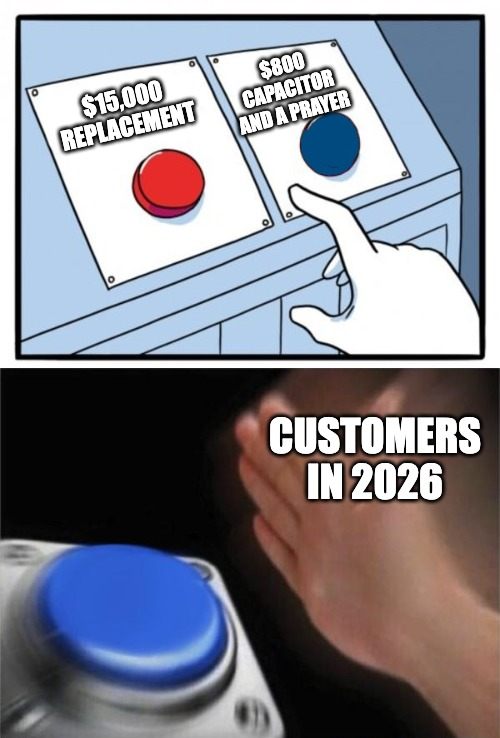
When homeowners cannot afford $15,000, they will pay $800 for a capacitor and a promise. This is not a temporary blip. As Gary wrote in his piece on pursuing a career in the skilled trades, people will always need comfort, but how they pay for it changes with the economy.
🎙️ Related Podcast: Building long-term client relationships over transactional volume
The A2L Factor
We are covering A2L equipment and tool upgrades in depth in a separate article, but here is what you need to know for this conversation: the transition is adding real costs that are compounding the market pressure.
Over 90% of new residential systems now use A2L refrigerants like R-454B.⁹ Equipment costs 10% to 15% more due to safety sensors, sealed relays, and detection boards. R-454B pricing has spiked up to 42% compared to R-410A.¹⁰
The tooling burden is real: spark-proof recovery machines, left-handed thread adapters, and A2L leak detectors run $2,000 to $5,000 per truck. Multiply that by five vans and you are looking at a $25,000 capital hit during a revenue downturn.
For a deeper dive on the refrigerant landscape, check out our article on alternative refrigerants for the HVAC industry.
The bottom line: techs without A2L certification are becoming unemployable. Get certified now. EPA 608 Universal now includes A2L modules.
📺 Related YouTube Content
Installers vs. Service Techs: The Great Divergence
Box Swappers vs. Troubleshooters
Here is where the market correction hits different depending on what you do every day.
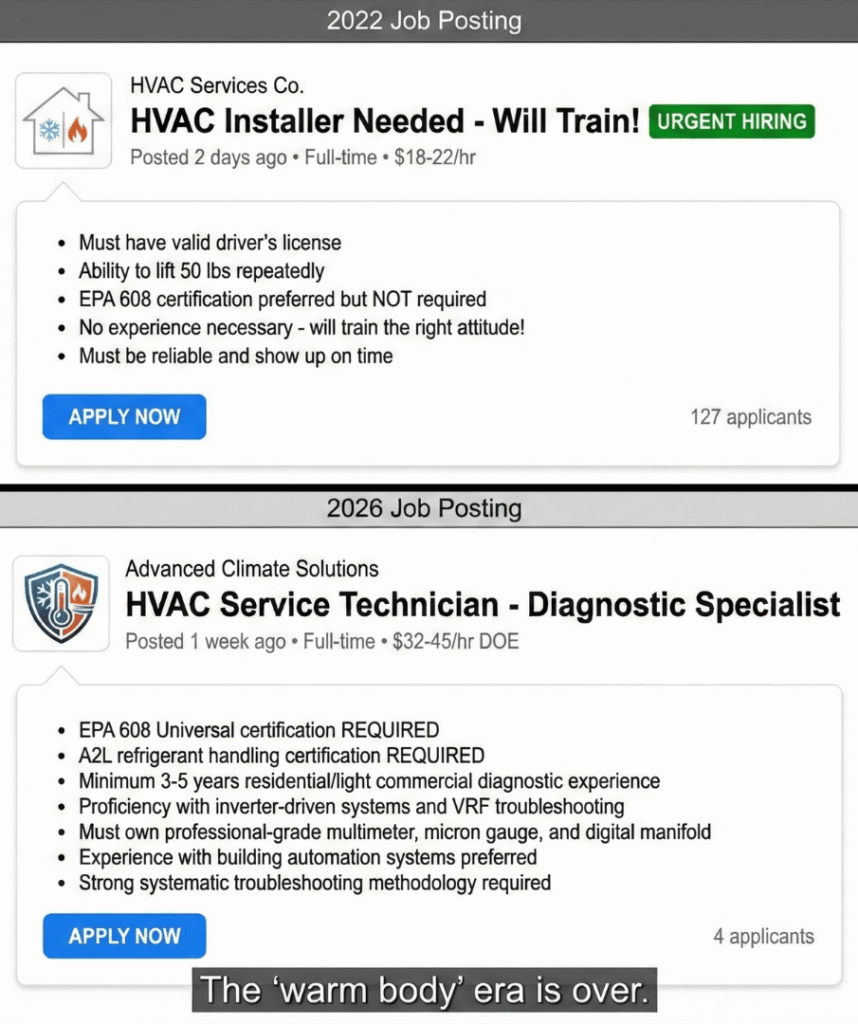
Installation demand has dropped in lockstep with that 40%+ shipment decline. Installers are reporting reduced hours, mid-week layoffs, and crews sitting at home.¹¹ The “warm body” hiring era is over. Employers are not looking for anyone who can hold a drill; they want EPA-certified troubleshooters who can actually diagnose problems.
But service demand for aging equipment? That is robust. Homeowners patching 15-year-old units need complex repairs, compressor change-outs, and inverter board diagnostics. The techs who can troubleshoot are eating. The techs who can only hang equipment are competing for shrinking work.
📸 Related from Instagram: Deferred Maintenance Reality Check – Why neglected systems eventually force costly repairs (the repair economy in action)
What Smart Contractors Are Doing
Survival Lessons from the 2008 Recession Playbook
We have seen this before. In 2008, Wade Hamstra of Hamstra Heating & Cooling made a decision that saved his company. He shifted from 70% new construction to 95% service and retrofit work before the recession hit. His revenue grew from $5.9 million in 2009 to $11.1 million by 2015, right through the worst of the downturn.¹²
Gary profiled Wade in his article HVACING Like a Boss, and the lessons are even more relevant today.
The contractors surviving 2026 are doing three things:
1. Treating maintenance agreements as a financial lifeboat. Recurring revenue covers overhead during shoulder seasons and slow months. Data suggests customers on maintenance plans are 70% to 80% more likely to purchase their replacement system from the same company.¹³
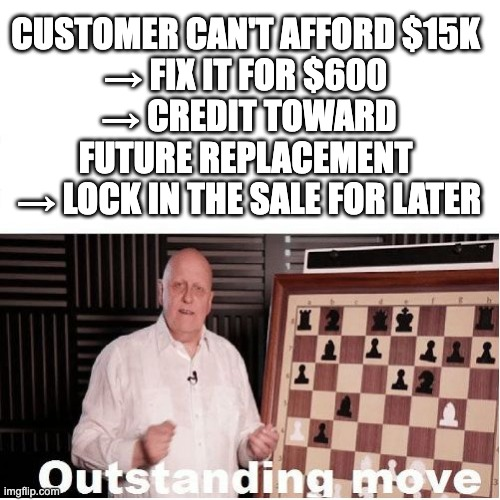
2. Running a “repair-then-replace” strategy. Instead of pushing hard closes on $15,000 replacements, they are fixing the immediate problem and offering to credit 50% to 100% of the repair cost toward a replacement within 12 months. This secures immediate revenue and locks in the future sale.
3. Cutting overhead ruthlessly but intelligently. As Steve Marino, CEO of Home-Tech, put it: “Reducing staffing by 10% isn’t difficult in declines. Those are employees you could have cut even when times were good.”¹⁴
Growing Your Service Business Smarter For contractors looking to win more profitable jobs during lean times, Property.com’s “Know Before You Go“ tool provides permit history and equipment records before you arrive. No more surprise system swaps or forgotten warranty work. When every service call counts, showing up prepared separates the professionals from the parts-changers.
What Techs Should Do Right Now
Your 2026 Action Plan
Get A2L certified. EPA 608 now includes A2L modules. Do it before you need it, not after you lose a job opportunity.
Sharpen diagnostic skills. The repair economy rewards troubleshooters, not part-changers. If you are not confident diagnosing inverter boards or performing complex compressor replacements, now is the time to learn.
Push maintenance agreements. Help your company build recurring revenue. It protects your job and gives the business breathing room.
Consider refrigeration or commercial. These sectors still have overtime available. The skills transfer more than you think.
Do not panic-jump. The techs leaving now will regret it when recovery starts late 2027. The BLS reports 100K+ unfilled technician positions nationwide, with 3 techs retiring for every 1 entering the workforce.¹⁵ Long-term demand is real.
The Path Forward
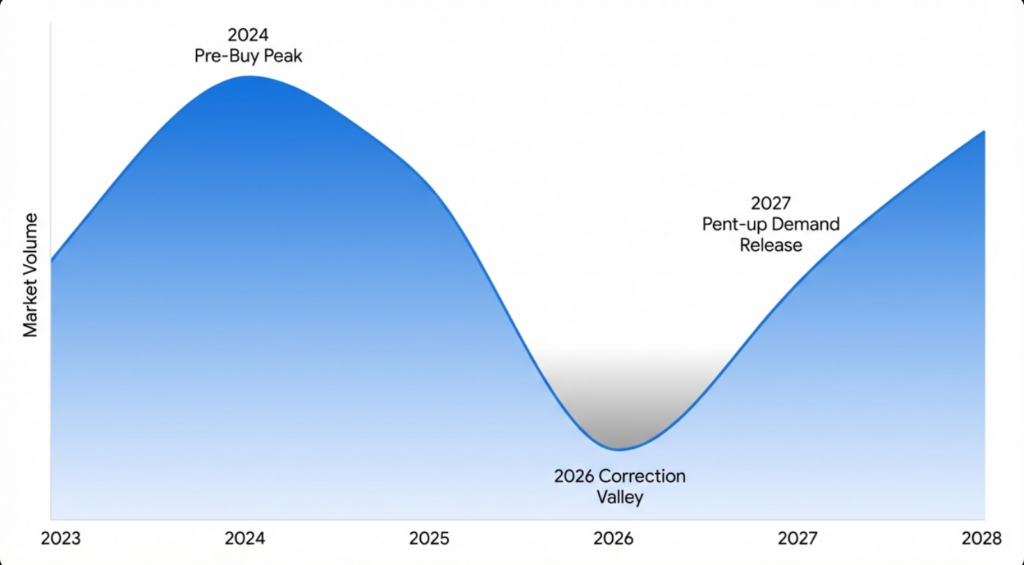
The systems being patched today will fail tomorrow. Every homeowner who chose a $600 repair over a $15,000 replacement is building pent-up demand that will release when conditions stabilize. Forecasters project a recovery trajectory beginning in late 2027 as the R-410A inventory overhang clears and interest rates normalize.¹⁶
Figure 4: Long-term market volume forecast. 2026 represents the cyclical trough (“The Great Correction”). A rebound is projected for 2027 as deferred replacements force market re-entry and interest rates stabilize.
The macro trends that made this industry essential have not changed. Electrification mandates are expanding. Heat pump adoption is growing. Efficiency requirements are tightening. The long-term fundamentals remain strong.
Additional Sources
“Hardly getting hours rn,” Reddit r/HVAC; “HVAC IS SO SLOW THIS YEAR,” Reddit r/HVAC; “Our busy season never really took off,” Reddit r/Construction, 2025.
“HVAC shipments plunge 42% in September,” HomePros News, 2025; “Heat Pump, A/C Shipments Fall for 5th Straight Month,” ACHR News, 2025.
“Beware of the Bullwhip Effect in Residential HVAC” ACHR News, 2022.
“HARDI Distributors Report 1.0% Revenue Decline in October,” HARDI, 2025.
“Local HVAC company says system prices are increasing 10-15% every 6 months,” Reddit r/hvacadvice, 2025.
“How Tariffs Will Affect HVAC Prices in 2025,” UniColorado, 2025.
“22% across the board price increase January 2025,” Reddit r/hvacadvice, 2025.
“How HVAC Techs Can Use A2L Refrigerants Without Replacing Recovery Tools,” AC Service Tech LLC YouTube, 2025.
“Refrigerant Phasedown: What You Need to Know,” TDIndustries, 2025.
“Hardly getting hours rn,” Reddit r/HVAC, 2025; “HVAC IS SO SLOW THIS YEAR,” Reddit r/HVAC, 2025.
“Arizona HVAC Company Spans Multiple Generations,” ACHR News, 2015.
“HVAC Maintenance Contracts,” FieldPulse, 2025.
“Steve Marino, CEO Of Home-Tech Reaches For The Stars,” Home-Tech Corporate, 2024.
“Heating, Air Conditioning, and Refrigeration Mechanics and Installers,” U.S. Bureau of Labor Statistics, 2025.
“HVAC Industry Cycle: The Path to 2028 Recovery,” Industry analyst projections based on AHRI, HARDI, and OEM data, 2025.
Whether you require installation, repair, or maintenance, our technicians will assist you with top-quality service at any time of the day or night. Take comfort in knowing your indoor air quality is the best it can be with MOE heating & cooling services Ontario's solution for heating, air conditioning, and ventilation that’s cooler than the rest.
Contact us to schedule a visit. Our qualified team of technicians, are always ready to help you and guide you for heating and cooling issues. Weather you want to replace an old furnace or install a brand new air conditioner, we are here to help you. Our main office is at Kitchener but we can service most of Ontario's cities