
Your Guide to a Warm and Comfortable Indianapolis Home
Reliable gas furnaces in Indianapolis, IN keep your home warm when winter hits hard. If your gas furnace stops working or shows signs of trouble, you need fast, reliable repair service to restore heat and safety to your home. Here’s what to do when your furnace needs attention:
- Call a licensed HVAC professional experienced in gas furnace repair
- Check for warning signs like strange noises, odd smells, or no heat
- Don’t wait – furnace problems can escalate quickly in cold weather
- Ensure safety first – gas leaks or carbon monoxide risks require prompt action
Indianapolis winters are no joke. When temperatures drop below freezing, your gas furnace becomes one of the most critical systems in your home. A broken furnace doesn’t just mean discomfort – it can lead to frozen pipes, dangerous carbon monoxide leaks, and expensive damage to your property.
Many homeowners don’t realize their furnace is struggling until it stops working completely. Catching problems early can save you from significant discomfort and a costly repair bill. Understanding the warning signs and knowing when to call for professional help makes all the difference.
If you’re dealing with heating issues, you’re not alone. Our team at Star Heating, Cooling & Plumbing has helped countless Indianapolis families restore warmth and comfort to their homes. Whether you need a quick fix or a complete system evaluation, schedule your furnace service today to get your heating back on track.
I’m Jeff Rich II, and I’ve spent years diagnosing and repairing gas furnaces in Indianapolis, IN for families just like yours. Growing up in the trade and now leading technical teams at Star Heating, Cooling & Plumbing, I’ve seen how a well-maintained gas furnace can make all the difference during our coldest months.
Signs Your Furnace Needs Professional Attention
During chilly Indianapolis winters, your gas furnace works hard to keep your home cozy. Like any appliance, it can show signs of distress. Ignoring these signals can lead to bigger problems, so it’s key to know what to look for to maintain comfort and safety.
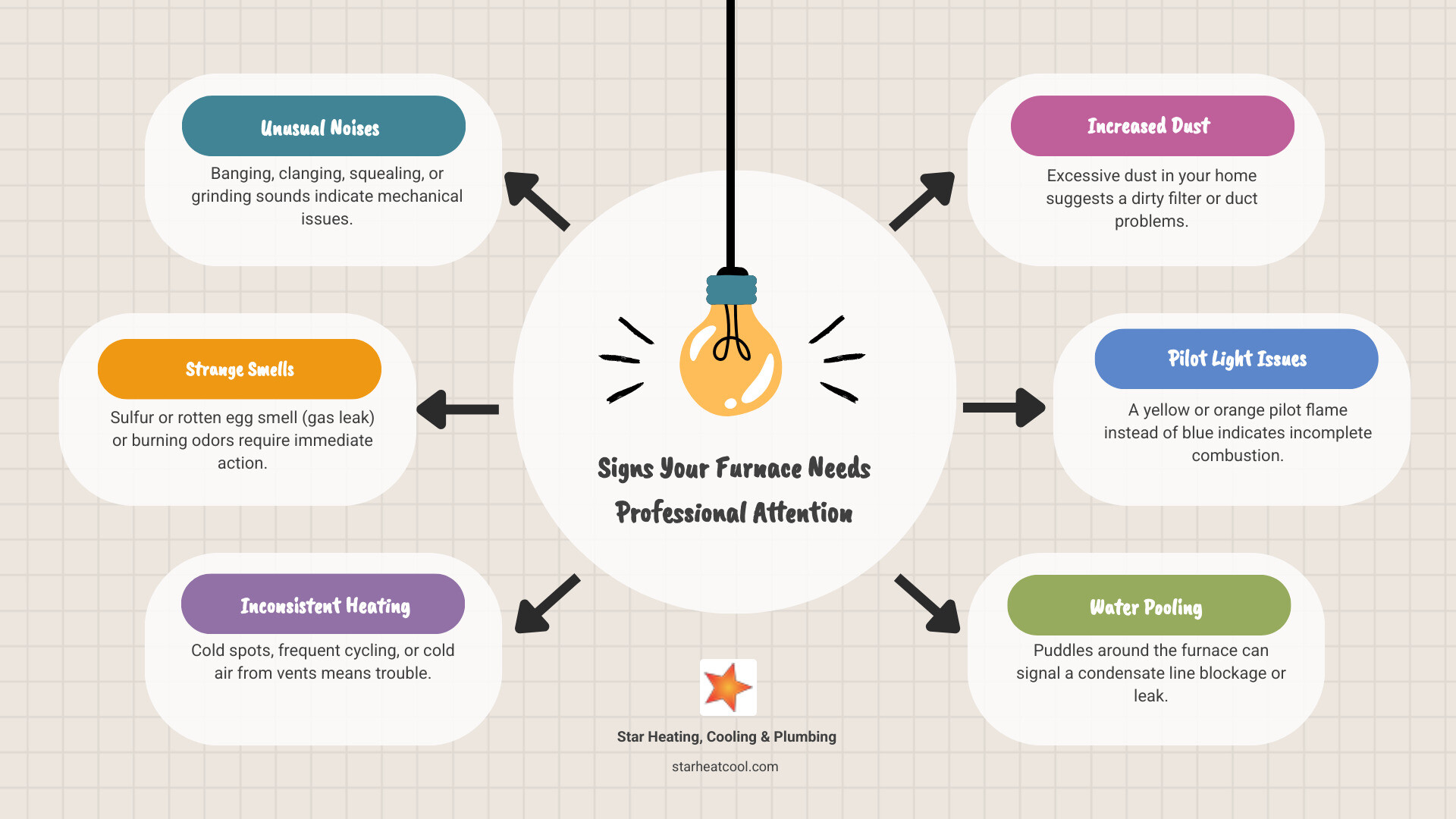
One of the most obvious signs your furnace needs a check-up is unusual noises. If your furnace starts sounding like a percussion section gone wild, with banging, clanging, squealing, or grinding, it’s telling you something’s amiss. These sounds can indicate loose components, worn-out bearings, or other mechanical issues that require professional attention.
Strange smells are another red flag. While a slight burning odor when you first turn on your furnace for the season is often just dust burning off, persistent or unusual smells should never be ignored. A sulfur-like or “rotten egg” smell strongly suggests a gas leak, which is a serious safety hazard. Natural gas companies add a chemical called mercaptan to natural gas specifically to give it this distinct odor, making leaks detectable. If you detect this smell, prioritize your family’s safety by evacuating and contacting your gas provider immediately, then call us for a thorough inspection. Other burning smells could indicate electrical issues or overheating.
Inconsistent heating, cold spots in your home, or frequent cycling (where your furnace turns on and off too often) all point to your system struggling to maintain temperature. This could be due to a clogged air filter, a malfunctioning thermostat, or an issue with the furnace’s heat exchanger. When your furnace cycles frequently, it’s working harder than it should, which can lead to increased wear and tear and higher utility bills.
An increase in household dust can also be a subtle indicator of furnace problems. A dirty or clogged furnace filter can hinder airflow and filtration, causing more dust to circulate throughout your home. Beyond discomfort, this can impact indoor air quality and strain your furnace.
Finally, pay attention to the pilot light if your furnace has one. While many modern furnaces have electronic ignitions, older models still rely on a pilot light. A healthy pilot light should burn with a strong, steady blue flame. If you notice a yellow or orange flame, it suggests incomplete combustion, which can produce dangerous carbon monoxide. According to the Indiana Office of Utility Consumer Counselor, a pilot light with a yellow or orange flame means the gas isn’t burning hot enough and could indicate a carbon monoxide leak. This is a hazard and should always be left to the professionals. Puddles of water or steam around your furnace are also concerning, as they might signal a leak in the condensate line, a problem with the humidifier, or even a cracked heat exchanger. For any of these issues, skilled furnace repair in Indianapolis, IN is essential.
Warning Signs of a Potential Carbon Monoxide Leak
Carbon monoxide (CO) is often called the “silent killer” because it’s a colorless, odorless gas. It’s a byproduct of incomplete combustion in fuel-burning appliances like gas furnaces. While modern furnaces are designed with safety in mind, malfunctions can occur, leading to dangerous CO leaks. Recognizing the warning signs can be life-saving.
Beyond a yellow or orange pilot flame, other visual indicators include soot streaks around your furnace or other fuel-burning appliances. These streaks suggest that combustion gases are escaping rather than venting properly. Another sign is a lack of upward draft in your chimney or flue, which can cause exhaust gases to build up in your home.
More importantly, be aware of physical symptoms in household members that resemble flu-like illness, such as headaches, dizziness, nausea, weakness, and confusion. These symptoms can worsen with increased exposure. If multiple people or even pets in your home experience these symptoms simultaneously, especially when indoors, it’s crucial to consider CO poisoning.
The best defense against carbon monoxide is a working CO detector. We strongly recommend that you install carbon monoxide detectors in your Indianapolis home and check their batteries regularly. If your carbon monoxide detector sounds its alarm, get everyone out of the house immediately and call for help from a safe location. This is not a situation to take lightly.
When to Schedule a Service Call for Your Gas Furnace in Indianapolis, IN
Knowing when to pick up the phone for professional help can save you from a lot of stress and potential hazards. If you notice persistent banging or clanging sounds, it’s usually a sign of mechanical failure within the furnace. Components like the blower motor or inducer fan might be failing or have loose parts.
The smell of rotten eggs, as mentioned earlier, is a definite call-to-action. If you detect this, turn off your gas supply if safe to do so, leave your home, and contact your gas company immediately. Then, call us to schedule a service call.
A furnace that cycles frequently, turning on and off more often than usual, is an inefficient and potentially problematic furnace. This short-cycling can indicate a dirty flame sensor, a clogged filter, or an improperly sized furnace. It wears out components faster and wastes energy.
If you feel cold air blowing from your vents when the furnace is supposed to be heating, it could be a simple issue like a clogged filter or a more complex problem with the igniter or gas supply. If your furnace is running but not producing warm air, it’s essentially just circulating cold air, which is not what we want in Indianapolis during winter!
Finally, thermostat issues like inaccurate readings or a furnace that doesn’t respond to settings warrant a service call. It might be a simple battery replacement, but it could also indicate a wiring problem or an issue with the furnace’s control board. A timely service call can prevent minor problems from becoming major repairs.
How to Prepare Your Furnace for Indianapolis Winters
To ensure your gas furnace handles the biting cold of an Indianapolis winter without a hitch, a little preparation goes a long way. This pre-season prep helps prevent unexpected breakdowns and keeps your home warm and efficient.
One of the simplest yet most effective steps you can take is to regularly change your air filters. A clogged filter restricts airflow, forcing your furnace to work harder, which wastes energy and can lead to overheating. We recommend checking your filter monthly and replacing it every 1-3 months, or more frequently if you have pets or allergies. It’s a small task that makes a big difference in both your furnace’s performance and your home’s indoor air quality.
Next, take a moment to clear the area around your furnace. Ensure there’s no clutter, debris, or flammable materials within several feet. Proper airflow around the unit is important for its safe and efficient operation. Also, check that all your home’s vents and registers are open and unobstructed by furniture or drapes. Blocked vents can create uneven heating and put unnecessary strain on your system.
Testing your thermostat before the heating season begins is another smart move. Set it to “heat” and lower the temperature significantly to ensure your furnace kicks on. If it doesn’t respond, check the batteries (if applicable) and ensure the settings are correct. A malfunctioning thermostat can lead to inefficient heating or no heat at all.
While these DIY steps are helpful, nothing beats a professional tune-up. An annual maintenance visit from our team at Star Heating, Cooling & Plumbing is the best way to prepare your furnace for winter. During a professional tune-up, our technicians will:
- Inspect and clean key components like the burners, heat exchanger, and blower.
- Check electrical connections and gas pressure for safe and efficient operation.
- Lubricate moving parts to reduce wear and tear.
- Test safety controls and thermostat accuracy.
- Identify potential issues before they become costly breakdowns.
Regular maintenance helps your furnace run at peak performance, which can extend its lifespan and keep your manufacturer’s warranty active. It’s a proactive approach that ensures your system is ready to deliver reliable warmth throughout the cold months. For more tips on furnace repair and maintenance or to schedule your annual service, explore our comprehensive Indianapolis heating services.
Understanding Furnace Efficiency and Technology
Not all gas furnaces are created equal when it comes to keeping your Indianapolis home warm. Modern technology offers options that impact your comfort and utility bills. Understanding the types and their efficiency ratings helps you make an informed decision when choosing a new system.
The efficiency of a gas furnace is measured by its Annual Fuel Utilization Efficiency (AFUE) rating. This percentage tells you how much of the fuel your furnace consumes is converted into usable heat for your home, versus how much is lost through the chimney or other means. For example, a furnace with a 90% AFUE rating converts 90% of the gas it burns into heat, with only 10% being lost. Many older furnaces from the 1990s and earlier had AFUE ratings of 65% or less. Today’s high-efficiency models can reach upwards of 98% AFUE, offering significant savings on operating costs compared to older units.
Gas furnaces typically come in three main stages of heating: single-stage, two-stage, and modulating. Each offers a different level of comfort and efficiency:
| Feature | Single-Stage Furnaces | Two-Stage Furnaces | Modulating Furnaces |
|---|---|---|---|
| Heat Output | One setting (full capacity) | Two settings (low and high capacity) | Varies output incrementally (35-100% capacity) |
| Comfort | Can lead to temperature swings; “cold air blow” | More consistent temperatures; less “cold air blow” | Most consistent temperatures; precise comfort control |
| Efficiency | Less efficient; runs at full power even when not needed | More efficient than single-stage; runs at lower capacity more often | Highly efficient; matches heat output to demand exactly |
| Noise Level | Can be louder due to constant full operation | Quieter, especially when running on low capacity | Quietest; operates at lower, consistent levels |
| Humidity Control | Limited | Better when paired with compatible cooling systems | Excellent when paired with compatible cooling systems |
Single-stage furnaces are the most basic. They operate at full capacity whenever they’re on, which can lead to temperature fluctuations and less consistent heating. While they are generally the most affordable upfront, their lower efficiency might mean higher utility bills over time.
Two-stage furnaces offer a step up in comfort and efficiency. They have two heat output settings: a low setting for milder days and a high setting for colder periods. This allows the furnace to run at a lower capacity more often, providing more consistent heating, reducing temperature swings, and operating more quietly than single-stage models.
Modulating furnaces are the most advanced and efficient. They can precisely adjust their heat output in small increments, often between 35% and 100% of their capacity, to perfectly match your home’s heating needs. This continuous, low-level operation provides the most consistent temperatures, eliminates “cold air blow,” and results in the quietest operation and highest energy efficiency. They are especially effective at managing humidity when paired with compatible cooling systems. You can learn more about various gas furnace options and their features from manufacturers like Day & Night®.
What to Know About Gas Furnaces in Indianapolis, IN
For homeowners in Indianapolis and surrounding areas like Carmel, Fishers, and Noblesville, understanding your gas furnace is crucial. The average lifespan of a gas furnace is typically between 15 and 20 years, especially with proper maintenance. However, this isn’t a hard and fast rule. Some furnaces might last longer, while others might require replacement sooner due to various factors.
When your furnace starts acting up, you’ll inevitably face the question: repair or replace? Several factors play into this decision. The age of your system is a major consideration. If your furnace is approaching or has exceeded the 15-year mark, and repairs are becoming frequent or costly, replacement might be the more economical choice in the long run. The “50 percent rule” is a good guideline: if the cost of a repair is 50% or more than the cost of a new furnace, it’s often better to invest in a replacement.
Another key factor is the frequency of repairs. A furnace that constantly needs attention is not only a headache but also a sign of a system that’s nearing the end of its functional life. Each repair might fix one problem, only for another to pop up soon after. This cycle can be frustrating and expensive.
Finally, consider your energy bills. Older furnaces, even if still working, are often much less efficient than newer models. If you’ve noticed a sudden spike in your heating expenses without a significant change in usage or gas prices, your furnace might be struggling to convert fuel into heat efficiently. Upgrading to a high-efficiency gas furnace can significantly reduce your operating costs, potentially saving you a substantial amount on your monthly bills. For example, new high-efficiency furnaces can save up to 50% in operating costs over a ten-year-old furnace. Given the cold Indianapolis winters, these savings can really add up. We can help you assess your current system and provide expert recommendations custom to your home’s needs and your budget.
Maximizing Performance with Smart Tech and Warranties
Smart technology has transformed home heating. Integrating it with your gas furnace offers new levels of comfort, convenience, and energy savings for your Indianapolis home. Understanding your furnace’s warranty also provides peace of mind.
Smart thermostats and communicating systems are at the forefront of this revolution. Unlike traditional thermostats, smart models can learn your daily schedule and preferences, automatically adjusting temperatures to maximize comfort when you’re home and conserve energy when you’re away. Imagine arriving home to a perfectly warm house without ever touching the thermostat! Many can be controlled remotely via your smartphone, allowing you to make adjustments from anywhere. This level of control not only improves comfort but also significantly reduces energy waste, as your furnace isn’t running unnecessarily. Some systems even provide detailed energy usage reports, empowering you to make informed decisions about your heating habits.
Communicating systems take this a step further. These advanced HVAC setups allow your furnace, air conditioner, and thermostat to “talk” to each other, optimizing performance across your entire heating and cooling system. This seamless communication ensures that each component operates in perfect sync, leading to more precise temperature control, quieter operation, and even better humidity management, especially when paired with a compatible cooling system. Features like Greenspeed™ Intelligence in some high-end furnaces allow for load matching, delivering optimal heat precisely when and where it’s needed.
Beyond technological advancements, understanding the warranty terms for your gas furnace is vital. Most new gas furnaces come with a manufacturer’s limited warranty, typically covering parts for a period, often 10 years upon registration. The heat exchanger, a critical component, often has a separate, longer warranty, sometimes 20 years or even a lifetime, depending on the model and manufacturer. It’s crucial to register your new furnace promptly after installation to ensure these warranties are active. These warranties protect your investment and can save you significant repair costs should a covered component fail. We always ensure our customers understand their warranty coverage and help them with the registration process.
Frequently Asked Questions about Gas Furnaces
Homeowners in Indianapolis often ask about their gas furnaces. Here are some common questions and our expert insights to guide your heating decisions.
How do I choose the right gas furnace for my home?
Choosing the right gas furnace involves a blend of science and understanding your specific needs. It’s not a one-size-fits-all decision, especially with the variety of homes and climates in our service areas like Fishers, Greenwood, and Westfield.
First, consider your home’s size and insulation. A furnace that’s too small won’t adequately heat your home, while one that’s too large will cycle on and off too frequently (short-cycling), leading to inefficiency and premature wear. We perform a professional load calculation to determine the exact heating capacity (measured in BTUs) your home requires, taking into account square footage, window efficiency, and insulation levels.
Next, think about your budget – both for the initial purchase and long-term operating costs. While high-efficiency modulating furnaces might have a higher upfront cost, their lower operating expenses can lead to significant savings over their lifespan.
Your efficiency needs are also crucial. If you’re looking to minimize your carbon footprint and maximize savings on your utility bills, a high-AFUE, ENERGY STAR® certified model is an excellent choice. If consistent comfort and quiet operation are top priorities, a two-stage or modulating furnace would be ideal.
The best way to choose is through a professional consultation. Our experienced team can assess your home, discuss your comfort preferences, and recommend options that perfectly balance performance, efficiency, and budget.
Are there rebates for installing a high-efficiency gas furnace in Indiana?
Yes, there are often opportunities for homeowners in Indiana to save money when installing high-efficiency gas furnaces! These incentives are designed to encourage energy conservation and reduce utility demand.
Federal tax credits are frequently available for specific ENERGY STAR® certified HVAC equipment. These credits can reduce the amount of income tax you owe, essentially putting money back in your pocket. The eligibility criteria and amounts can change, so it’s always a good idea to check the latest information from the IRS or consult with a tax professional.
Local utility rebates are also common. Many gas and electric utility providers in Indiana offer rebates to customers who upgrade to high-efficiency furnaces or other energy-saving appliances. These rebates can come in the form of direct payments or credits on your utility bill. We often have information on current local programs specific to our service areas, including Carmel, Lawrence, and McCordsville.
The ENERGY STAR® program is a national standard for energy-efficient products. Furnaces that meet ENERGY STAR® qualifications are verified to be more efficient than minimum federal standards, making them excellent candidates for various rebates and tax credits.
We always recommend checking for current incentives before making a purchase. Our team can help you identify eligible systems and point you towards resources for available rebates and tax credits, ensuring you take advantage of every opportunity to save.
How does a smart thermostat improve my furnace’s performance?
A smart thermostat is more than just a fancy gadget; it’s an intelligent control center that can significantly improve your gas furnace’s performance and efficiency.
One of the primary benefits is its ability to learn your schedule and preferences. Over time, a smart thermostat can observe when you’re home, when you’re away, and what temperatures you prefer at different times of the day. It then creates an optimized heating schedule automatically, reducing the need for manual adjustments and ensuring your home is always comfortable when you need it to be.
The remote control feature is incredibly convenient. Imagine leaving work early or deciding to stay out late – you can adjust your home’s temperature from your smartphone, ensuring you don’t waste energy heating an empty house or arrive home to a cold one. This flexibility contributes directly to energy savings.
By precisely managing your furnace’s operation based on actual occupancy and learned habits, a smart thermostat helps to reduce energy waste. It prevents your furnace from running unnecessarily, cutting down on fuel consumption and lowering your utility bills.
Many smart thermostats also provide usage reports and insights. These reports can show you how much energy your furnace is consuming, identify patterns, and offer suggestions for further savings. This data empowers you to make smarter decisions about your heating. A smart thermostat allows your gas furnace to operate more intelligently, efficiently, and responsively to your lifestyle, delivering optimal comfort with minimized energy use.
Trust the Professionals for Your Heating Needs
The performance of your gas furnace is paramount for your Indianapolis home’s comfort and safety, especially during colder months. Attempting complex DIY repairs or installations on gas appliances is risky. Trusting licensed, experienced professionals is essential.
The importance of professional service cannot be overstated. Gas furnaces involve intricate systems of gas lines, electrical components, and ventilation. Our skilled technicians are trained to diagnose issues accurately, perform repairs safely, and ensure that your system operates according to manufacturer specifications and local codes. This expertise is crucial for your family’s safety, preventing hazards like gas leaks or carbon monoxide exposure.
Proper installation, maintenance, and repair directly contribute to your system’s longevity. A well-maintained furnace, installed correctly, will run more efficiently, experience fewer breakdowns, and last closer to its expected lifespan of 15-20 years. This not only saves you money on premature replacements but also ensures consistent, reliable heat when you need it most.
At Star Heating, Cooling & Plumbing, we are dedicated to providing top-notch Indianapolis heating services to our neighbors in areas like Fishers, Noblesville, and Zionsville. As a family-owned business, we pride ourselves on transparency, customer education, and ensuring your complete satisfaction. We understand the unique heating challenges of our local climate and are committed to keeping your home warm and comfortable. When you choose us, you’re choosing peace of mind, knowing that your gas furnace is in capable and caring hands.
Whether you require installation, repair, or maintenance, our technicians will assist you with top-quality service at any time of the day or night. Take comfort in knowing your indoor air quality is the best it can be with MOE heating & cooling services Ontario's solution for heating, air conditioning, and ventilation that’s cooler than the rest.
Contact us to schedule a visit. Our qualified team of technicians, are always ready to help you and guide you for heating and cooling issues. Weather you want to replace an old furnace or install a brand new air conditioner, we are here to help you. Our main office is at Kitchener but we can service most of Ontario's cities
Source link