
Barton James, president and CEO of ACCA, didn’t mince words when summing up last year.
“2025 was a freaking train wreck,” he said. “It was tough.”
What is coming down the pipeline for 2026? We asked around the industry and looked at some of our coverage from 2025. Here is what I think will be the top headlines of 2026.
1/Tariffs aren’t going anywhere.
Bart James, CEO of ACCA, has seen this happen in D.C. before.
“They’ve had a taste of the money,” he said.
Sure, it’s not a significant amount. And political winds may shift. But according to James, none of that makes any difference.
Looking for quick answers on air conditioning, heating and refrigeration topics?
Try Ask ACHR NEWS, our new smart AI search tool.
Ask ACHR NEWS
“Politically, once it’s been tasted, you can’t get rid of it,” he said. “It doesn’t matter who’s in the White House. It’s going to be a tool that will be utilized, at least from my prediction, for the foreseeable future.”
Manufacturers are already responding by bringing production to the U.S., he said, and it’s going to continue.
2/ Heat pumps are still in demand, but the reason for buying them will change.
With federal tax incentives gone December 31 at the stroke of midnight, heat pumps are now at the mercy of state/local incentives, contractors’ advocacy, and their own merits.
“I think it’s going to continue to grow,” James said. But equipment pricing is going to play a bigger role, as well as rising energy costs — specifically, which is higher, gas or electricity, in that particular customer’s region.
Marco Radocaj, owner of Balance HVAC in Vero Beach, Florida, said heat pumps are here to stay — what’s going to change is whether people are buying top-tier or mid-range equipment.
“It’ll put it back into that playing field where you’re kind of paying the tax incentive price for a less efficient system,” he said.
3/ AI is part of life now — and that goes for HVAC, too.
AI still can’t troubleshoot a rooftop unit, but as with any other tool, the businesses that use it effectively will certainly win more jobs and opportunities than those who don’t.
That’s according to Jimmy Thompson, senior manager, HVAC and plumbing sales, Podium
“Think of AI as a superpower tool — a Thor’s hammer, if you will — and not so much of a replacing the characters altogether,” he said.
In contrast with a few years back, today’s AI-based trades software comes pre-packaged and readily available for small and mid-sized businesses to roll out on day one. There’s another change, too: Customers are getting used to it.
“All your consumers are consumers in a number of other industries, and they’re using AI in all those places as well,” Thompson said. “So if that’s a hesitation for some contractors, that’s something that should be quickly relieved, just because the consumers are expecting that type of interaction with the business.”
4/ Shipments and installations: think stabilization, not recovery.
Don’t expect a snapback in HVAC shipments in 2026. OEMs are largely aligned on one prediction: The residential market will stabilize, but a full recovery will take longer.
After a brutal 2025 — when residential cooling shipments routinely fell more than 25% year over year and, at times, nearly 50% — manufacturers are tempering expectations. Carrier CEO Dave Gitlin said the U.S. market exited 2025 well below its typical replacement pace and that a return to “normal” won’t happen in a single year. Carrier is currently assuming flat residential volumes in 2026, while Trane expects the first half of the year to remain difficult, even as one-time disruptions tied to the refrigerant transition fade.
“None of us predicted that with the refrigerant change, there would have been a canister shortage,” said Donald Simmons, group president of Americas at Trane. “Contractors couldn’t get refrigerant to do the installations, which was a problem. The third factor is that the cooling season was shorter than what we had expected. Of those three drivers, two won’t repeat in 2026.”
There are modest tailwinds. Rheem’s Kevin Ruppelt, senior vice president and general manager, U.S. Air, sees improving housing activity, easing interest rates, and stronger consumer confidence supporting a rebound — though not a dramatic one.
The real growth story, however, continues to sit squarely in commercial HVAC. Data centers remain the headline driver, but OEMs also point to strong demand across healthcare, higher education, government buildings, and Class A office renovations. In 2026, residential may find its footing, but commercial will keep carrying the load.
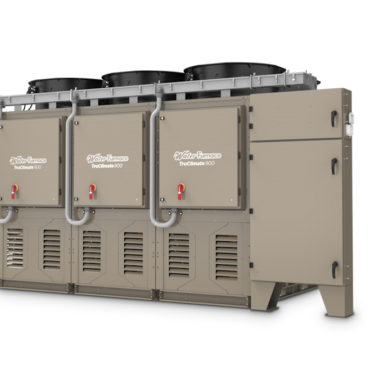
5/ Speaking of data centers, Silicon Valley wants a chiller — and private equity can already smell the money.
Private equity in HVAC used to mean one thing: service contractors. Now, the focus has shifted upstream. Driven by an explosion in data-center demand, PE has locked onto equipment manufacturers capable of delivering high-capacity, high-efficiency cooling at scale.
The result? A surge in demand for advanced chillers, controls, monitoring, and replacement parts. Expect a wave of acquisitions in 2026, as both outside investors and HVAC’s largest players race to secure technology, engineering talent, and intellectual property tied to next-generation cooling.
6/ Financing will become the norm — but it comes with a caveat.
$13,000 upfront or $300 a month? As HVAC equipment prices climb, more homeowners are choosing option two. But for contractors, that shift comes with higher expectations — and higher risk.
“As this equipment’s increased in price — sometimes over four times — consumers are going to expect a lot more, and they’re going to expect better air quality,” said James. “They’re going to expect that equipment’s not oversized and causing them health issues in their home, and mold, and all the other things that you maybe got away with, but it was a very different price.”
If expectations aren’t met, James sees trouble ahead.
“I think we’ve got a lot of liability coming our way,” he said. “There’s going to be some lawsuits.”
Radocaj sees that risk clearly in humid markets like Florida.
“There’s no really efficient way to remove water from a house, and humidity is a 365-day issue down here,” he said. When systems don’t run long enough to dehumidify, homeowners may start asking, “Hey, why do I have a humidity problem all of a sudden, with my new equipment that was $13,000?”
“If you’re not taking the time to explain everything, prepare for dehumidification, have a plan for that,” Radocaj said, “you’re building problems that are going to get really expensive for you down the road. … Quality installs are going to be huge. I think it’s going to be a good opportunity to separate the men from the boys.”
7/ Refrigerant bounties are coming.
There’s been no shortage of debate about how to motivate contractors and technicians to recover more refrigerant. As Carl Grolle of Golden Refrigerant told me a few years back, the real motivator is simple: cash.
Now, California is testing that theory. The California Air Resources Board just announced a new pilot program with Hudson Technologies that will pay HVAC contractors for recovered HFCs and HCFCs sent for reclamation. Called REFRESH — Refrigerant F-gas Reclamation Support for Home HVAC — the program includes up to $5 million to fund refrigerant buybacks and cover reclamation costs.
D.C. has a brand-new recovery program as well. If the pilots prove the model, expect refrigerant recovery to turn from an afterthought into a metric — with contractors creating their own internal bounties for techs who bring the most refrigerant back.
Whether you require installation, repair, or maintenance, our technicians will assist you with top-quality service at any time of the day or night. Take comfort in knowing your indoor air quality is the best it can be with MOE heating & cooling services Ontario's solution for heating, air conditioning, and ventilation that’s cooler than the rest.
Contact us to schedule a visit. Our qualified team of technicians, are always ready to help you and guide you for heating and cooling issues. Weather you want to replace an old furnace or install a brand new air conditioner, we are here to help you. Our main office is at Kitchener but we can service most of Ontario's cities
Source link