For small non-union federal contractors, the stakes are high. On November 5, Alaska’s Bill Slayden of Slayden Plumbing & Heating, Inc. filed a lawsuit targeting a Biden-era executive order, upheld by the Trump administration, that requires project labor agreements (PLAs) for federal construction contracts over $35 million.
Slayden’s challenge is one of several nationwide, but this one seeks to vacate the rule entirely. Slayden has already withdrawn bids for two projects at Joint Base Elmendorf–Richardson because of the PLA mandate.
This case comes amid a wave of PLA-related lawsuits nationwide. At least three major suits now challenge the mandate in different courts, including one from the Associated Builders and Contractors (ABC) pending in the Eleventh Circuit; the Associated General Contractors and other industry groups have also weighed in or filed parallel challenges in other courts.
These legal battles are fueled by a growing split among the Federal Courts of Appeal about how to interpret the Federal Property and Administrative Services Act. Some courts, notably in the D.C. and Third Circuits, have long granted presidents broad authority to regulate contract terms in the name of “economy and efficiency.” Others, such as the Fifth and Eleventh Circuits, argue that the Act was never meant to let the executive branch effectively rewrite national labor policy without Congress.
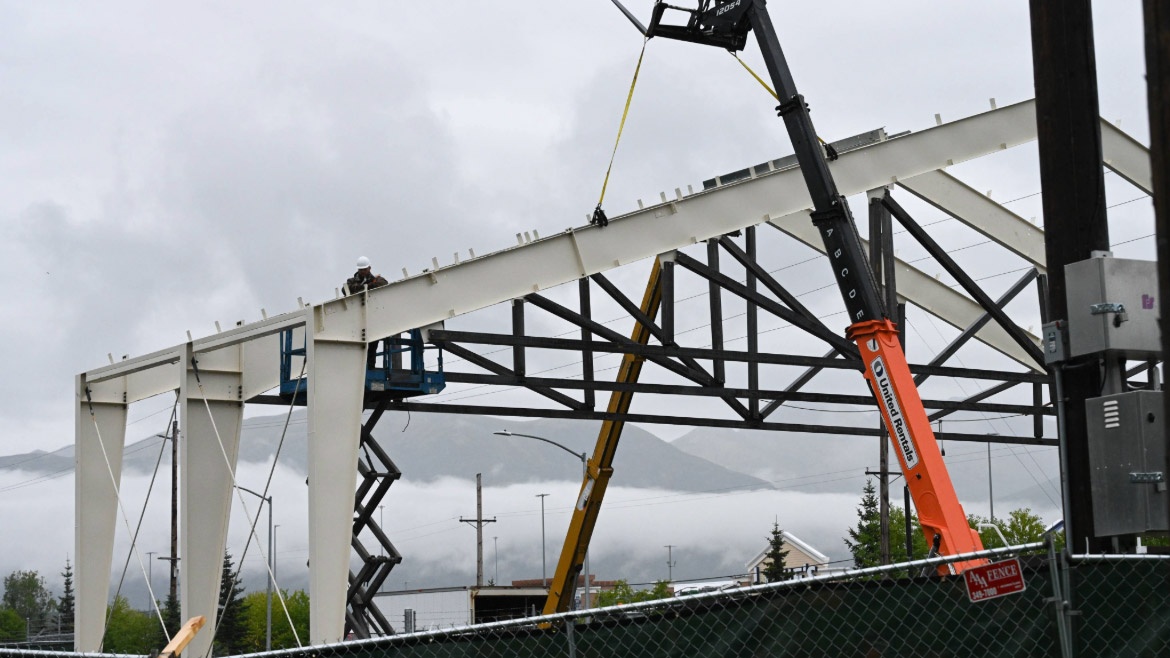
JOINT BASE: Construction on Muldoon Gate at Joint Base Elmendorf – Richardson adds weather protection and safety features for personnel. (Courtesy of the U.S. Air Force | Airman Eli Rose)
With this division unresolved, legal observers and litigants – including those backing Slayden – see the Supreme Court as the likely venue for resolution.
Luke Wake, an attorney at the firm representing Slaydon, Pacific Legal Foundation, explained that across the federal appellate courts, “there is sort of a divide, a split in authority, if you will, about the proper interpretation of the Procurement Act and how much power it does or does not give to the President.” This split, Wake explained, is why these lawsuits may ultimately need to be resolved by the Supreme Court.
“This is their livelihood, right?” Wake asked. “If they’re being told that as a condition of continuing to bring in revenue from those kind of projects, they have to agree to these terms, which requires ultimately signing on to this agreement with unions … it creates a tremendous problem for them.”
Wake explained that the mandate doesn’t distinguish between union and non-union contractors. “They’re required to sign agreements that, as a subcontractor, they’re not even negotiating. It’s the prime contractor and the unions at the bargaining table.”
Contractors’ attorneys say these mandates go well beyond wage compliance, effectively requiring even small non-union shops to operate under union-style rules. “Those agreements demand, effectively, what a union would demand from a company where its employees are all union,” said Jacob Scott, partner in Smith Currie Oles’ DC Metro Area office.
Chief among the hidden costs are mandatory pension contributions –
money that non-union workers may never see but that dramatically increase a project’s price for their employer. “When you start tacking on the union fringes and benefits, and the pension costs that their employees don’t get, that becomes very expensive, and that money has to come out of somewhere,” Scott noted.
Smith Currie Oles Attornery Allison Geewax regularly counsels contractors on government PLA disputes, and said the PLA mandates especially “cause a bit of panic” in places with little union presence. “Prime contractors need to reach out to non-local subs to perform work, which has the opposite effect on the local market for that trade,” she said, undermining one of the goals of PLAs –
local workforce development.

WITHDRAW: Bill Slayden, facing the PLA mandate, has already withdrawn from two federal project bids at Joint Base Elmendorf – Richardson. (Courtesy of the U.S. Air Force)
Wake noted the required agreements force Slayden’s workers – who have chosen not to unionize – into relationships with labor unions. “Our view is that the statute shouldn’t be read as this sort of elastic authority for the President to do whatever he wants in labor policy,” Wake said of the statutory dispute underlying the case, “but if we’re going to read it that way … then you run into this question of, okay, well, then, has Congress given away its power to make law?”
As he put it: “Under the National Labor Relations Act, Congress says no one’s forced into a collective bargaining agreement, even if the employees in a company unionize … it’s never mandated under the NLRA that a company has to enter into collective bargaining. So it’s really an extraordinary thing for the President and these agencies to assert that sort of nebulous language in the Federal Procurement Act gives them that extraordinary power.”
Wake said about 80% of Slayden’s business comes from federal projects, and they’re “not well suited to just pivot and start doing private work.” He added that Slayden offers “very generous benefits, and they’re very competitive,” and their workers “have plenty of opportunity over the years” to unionize, but “they’re not interested.”
Wake summarized the broader context, saying the case is “an extension out of sort of a long-running dispute between the successive administrations increasingly asserting broader control under the Procurement Act to do this sort of thing.”

FROM LEFT: Chief Master Sgt. Katie McCool, Gen. Kevin Schneider and Elizabeth Madison discuss base upgrades at Joint Base Elmendorf – Richardson. (Courtesy of the U.S. Air Force | Airman 1st Class Tala Hunt)
On Dec. 18, 2025, the U.S. Court of Federal Claims sided with an ABC-member contractor, ordering removal of the PLA mandate from a U.S. Army Corps of Engineers project. While the Biden executive order remains in effect nationwide, the ruling is expected to affect 15 other pending protests, removing PLA requirements from their solicitations as well. Kristen Swearingen, ABC’s vice president of government affairs, called it another “recognition of the real-world harm inflicted on contractors and taxpayers by unlawful and costly PLA mandates.” ABC argues there’s been no evidence these mandates benefit taxpayers, while they consistently find the rules restrict competition and drive up costs.
“For those solicitations that have a PLA requirement with submission, if you would like to protest, it needs to be done before proposal submissions are due,” Geewax advised. She emphasized the importance of moving quickly and seeking legal help as soon as the market research phase begins. Despite fears that protests hurt relationships with agencies, the attorneys said there is little evidence of lasting retaliation:
“Everybody recognizes that it’s part of the process to get the best work for the best price,” Scott added.

METAL: Fred Wing Jr., 773d Civil Engineer Squadron, removes metal during repairs at Joint Base Elmendorf – Richardson. (Courtesy of the U.S Air Force | Airman 1st Class Caitlin Russell)
Broader Legal Landscape and Growing National Tensions
As legal challenges mount –
with new victories, like ABC’s win at the U.S. Court of Federal Claims, now shifting the landscape –
contractors across the country are closely watching whether the courts, or ultimately the Supreme Court, will decide the fate of federal PLA mandates.
The legal fights over PLAs aren’t confined to Alaska. In January 2025, the U.S. Court of Federal Claims ruled in favor of a group of contractors who challenged the PLA mandate on seven federal projects, declaring the requirements “arbitrary and capricious” and a violation of open competition principles. While the decision applied only to those specific contracts, it arguably ignited PLA challenges across the country.
Elsewhere, the battle is spreading to states and major trade associations. In Oregon, for instance, a coalition of construction groups led by the National Federation of Independent Business (NFIB) recently filed suit to overturn a statewide executive order imposing PLAs on public projects – a signal that legal challenges are rapidly expanding beyond the federal level.
These lawsuits add up to a nationwide debate over whether government-mandated PLAs protect workers or box out non-union contractors. With multiple cases now working their way through the courts and mounting pressure from industry groups, the disagreement over PLAs is poised to shape the rules of public construction for years to come.
Whether you require installation, repair, or maintenance, our technicians will assist you with top-quality service at any time of the day or night. Take comfort in knowing your indoor air quality is the best it can be with MOE heating & cooling services Ontario's solution for heating, air conditioning, and ventilation that’s cooler than the rest.
Contact us to schedule a visit. Our qualified team of technicians, are always ready to help you and guide you for heating and cooling issues. Weather you want to replace an old furnace or install a brand new air conditioner, we are here to help you. Our main office is at Kitchener but we can service most of Ontario's cities
Source link