Key Takeaways
- Departmentalization means running separate P&Ls for service and install: Without it, a profitable install quarter can mask a service department that is losing money on every call, and you would never know.
- Do not departmentalize until you have dedicated crews: Technicians who only do service and crews who only do installs. That typically means five or more trucks, somewhere between $1.5 million and $2 million in revenue.
- Service carries higher overhead per hour than install because it is more labor-intensive: Ruth King benchmarks overhead at under $40/hr for service and under $30/hr for install. Blending them on one P&L hides the difference.
- Get your books right first: Clean, accrual-basis accounting with a qualified bookkeeper is the prerequisite. Departmentalization built on messy books just doubles the mess.
There comes a point in every growing HVAC business where running a single set of books stops telling you the truth. The service side might be carrying the install side, or the other way around, and you would never know because everything is lumped together on one P&L.
That is the case for departmentalization: running separate profit and loss statements for your service department and your install department. But the timing matters. Do it too early and you create complexity that distracts from the basics. Do it too late and you find out one side of your business has been losing money for years.
What Departmentalization Actually Means
In a single-department setup, your P&L shows total revenue, total cost of goods sold, total gross profit, total overhead, and total net operating profit. Everything goes into one bucket. You can see whether the company as a whole made money, but you cannot see where the money came from or where it leaked out.
Departmentalized books split all of that into separate columns. Service gets its own revenue line, its own COGS, its own gross profit, and its own share of overhead. Install gets the same treatment. Each department stands on its own, and you can see immediately which one is performing and which one needs attention.
The vast majority of contractors do not departmentalize. George Hedley, writing in Facility Cost Professional, estimates that roughly 80% of construction business owners do not know the true cost of doing business, and without departmentalized books, they have no way to find out.¹ For most small shops, that is fine. But for companies that have grown past the one-person-does-everything stage, operating without departmental visibility is like diagnosing a system without gauges.
Why Service and Install Are Different Animals
The core reason departmentalization matters is that service and install have fundamentally different cost structures.
Service is labor-intensive. A service technician drives to the job, diagnoses the problem, performs the repair, and bills for the time. The material cost is usually low relative to the labor. Ruth King publishes specific overhead benchmarks: under $40 per hour for service and under $30 per hour for installation.² Industry benchmarks put service department overhead at 45% to 60% of sales.³
Install work flips that ratio. Material and equipment costs are a much larger share of the total job price. The labor component is significant but represents a smaller percentage of revenue. Install department overhead typically runs 30% to 40% of sales.³
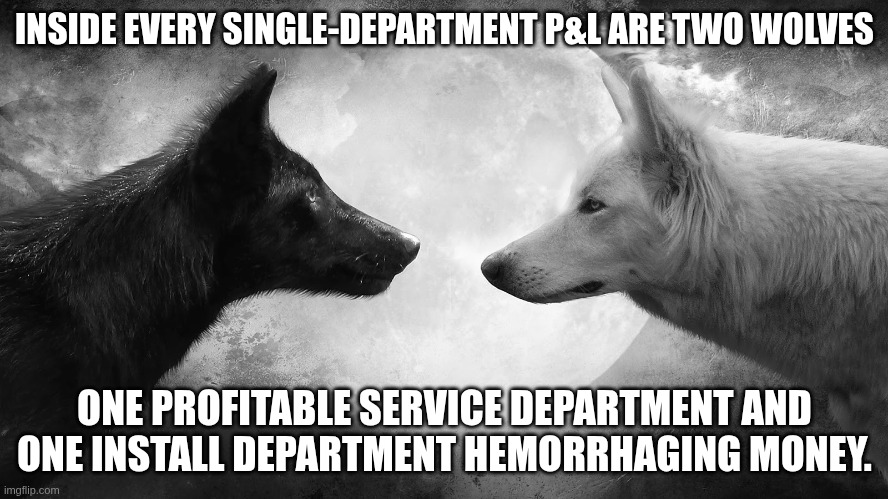
When you run a single P&L, these two very different cost structures get blended together. Your gross margin might look acceptable overall while one department is underwater. A profitable install quarter can mask a service department that is losing money on every call.
When to Pull the Trigger
Not every contractor needs departmentalized books. The deciding factor is whether you have people who only do one type of work.
If you are a one, two, or three-truck operation and your techs float between service calls and installations depending on the day, departmentalization adds complexity without much benefit. Your bookkeeper has to allocate every transaction to the correct department, and if your techs are splitting time, those allocations turn into guesswork.
The threshold is usually around five trucks, when you have at least one or two techs who exclusively run service and a separate crew that handles installations. At that point, probably somewhere between $1.5 million and $2 million in revenue, the split becomes meaningful because the costs genuinely belong to one department or the other.

This is also the revenue range that Doug Tatum calls “No Man’s Land” in his book of the same name: too big to be small, too small to be big.⁴ You have added a dispatcher, a warehouse, insurance, and admin overhead across a revenue base that can barely absorb it. Profitability Partners’ analysis of 200-plus contractor P&Ls puts overhead at roughly 30% of revenue for a $2 million company, dropping to 22-25% at $5 million and 20-24% at $10 million and above.⁵ Departmentalized books are what let you see which side of the business is carrying that burden and which side is dragging.
Before you get there, focus on the fundamentals: clean books on an accrual basis, a competent bookkeeper, and a monthly habit of reviewing your P&L and balance sheet. Departmentalization built on top of messy books just gives you two sets of unreliable numbers instead of one.
How to Set It Up
QuickBooks and most accounting platforms support departmentalization through a feature called “classes” or “tracking categories.” Your bookkeeper assigns every income and expense transaction to the appropriate department: service, install, or general overhead (which gets allocated proportionally).
The standard allocation method for overhead uses direct labor.⁶ If your service techs account for 60% of total direct labor hours and your install crew accounts for 40%, then 60% of shared overhead (rent, office staff, insurance) goes to the service column and 40% goes to install. That is a reasonable starting point. Some contractors refine it further with activity-based costing, but the labor-split method gets you 90% of the way there.
Once the departments are separated, review each one independently every month. Is service gross margin above 50%? Is install gross margin above 30%? Is each department’s net profit positive? If one side is consistently underperforming, you now know exactly where to focus: pricing, efficiency, staffing, or overhead allocation.
The Foundation Comes First
Departmentalization is a scaling tool, not a startup tool. It belongs in the playbook for contractors who have outgrown the single-P&L stage, have dedicated crews, and already have their financial foundation in order.
If you are not there yet, that is fine. Get the basics right. Review your financials monthly. Know your pricing math. Build the culture before you build the systems. When the time comes to split the books, you will be ready, and the numbers will actually mean something.
Additional Sources
- “Roughly 80% of Construction Owners Don’t Know the True Cost of Doing Business”, George Hedley, Facility Cost Professional White Paper, 2023.
- “Are You Calculating Overhead Correctly?”, Ruth King, HVACR Business, 2023.
- “Service and Install Overhead Benchmarks”, Contracting Business / CFM Distributors / EGIA Contractor University, Industry Analysis, 2024.
- “No Man’s Land: Where Growing Companies Fail”, Doug Tatum, Portfolio/Penguin, 2008.
- “HVAC Profit Margins: Benchmarks From 200+ P&Ls”, Profitability Partners, Industry Analysis, 2025.
- “Direct Labor as Standard Overhead Allocation Method for HVAC Contractors”, Aptora HVAC Software Documentation / Ruth King (HVACR Business) / Whyte CPA, Industry Reference, 2024.
Whether you require installation, repair, or maintenance, our technicians will assist you with top-quality service at any time of the day or night. Take comfort in knowing your indoor air quality is the best it can be with MOE heating & cooling services Ontario's solution for heating, air conditioning, and ventilation that’s cooler than the rest.
Contact us to schedule a visit. Our qualified team of technicians, are always ready to help you and guide you for heating and cooling issues. Weather you want to replace an old furnace or install a brand new air conditioner, we are here to help you. Our main office is at Kitchener but we can service most of Ontario's cities
Source link