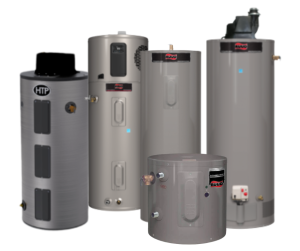
 Deciding on the size water heater your home and family needs is not as simple as it sounds. A water heater is an expensive appliance and there are many things to consider before buying one.
The size of the water heater really does not mean it’s physical size, there is little difference in physical size of a 40 gallon and a 50 gallon unit. The size means the capacity of heated water you need in your home.
Identify Your Household’s Peak Hour Demand
For tank‑style heaters, the most important calculation is Peak Hour Demand which is the amount of hot water your home uses during the busiest hour of the day.
Think about your household’s typical “rush hour.” For many families, it could be morning showers plus dishwashing or laundry.
Typical hot water usage per activity:

Then add up what happens in the busiest hour.
For Example:
- 2 showers (15 gallons each)
- 1 dishwasher cycle (8 gallons)
- 1 handwashing session (2 gallons)
Peak Hour Demand = 40 gallons
You’d look for a tank water heater with a First Hour Rating (FHR) of around 40–50 gallons.
Match Your Peak Demand to the Water Heater Type
Tank Water Heaters
Find the Energy Guide label for the unit you are considering or comparing. Identify the First Hour Rating (FHR) on the yellow EnergyGuide label. Generally speaking the following sizes are common for many households:

This is only a starting point, your actual usage matters more so it is best to consider all the ways you use hot water in your home, every day as well as Holidays, if you have frequent visitors, etc.
Consider Fuel Type
- Gas heaters recover hot water faster, so you may get away with a slightly smaller tank.
- Electric heaters recover slower, so sizing up is often smart.
Lifestyle Factor
 A few examples:
- Teenagers = more showers
- Large soaking tub = high demand
- Frequent guests = higher peak usage
- Working from home = more daytime hot water use
There are many other factors to consider when replacing a water heater in your home other than the capacity. It is important to consider the upfront cost and the efficiency that can help reduce the monthly costs over the lifetime of the water heater.
Energy Efficiency
Higher‑efficiency units cost more upfront but reduce monthly bills. Check the Energy Factor (EF) or Uniform Energy Factor (UEF) ratings. Uniform Energy Factor (UEF) is the current standard, UEF is now the official Department of Energy rating for water heater efficiency. It replaced EF in 2017 to give consumers a more accurate, consistent measure. US Department of Energy Link (Cost of Water Heaters)
According to ENERGY STAR, a water heater must meet specific UEF criteria to qualify for certification. UEF is important to consider when selecting a new water heater. It helps compare models on true efficiency, considers annual operating cost (shown on the yellow EnergyGuide label). The UEF determines ENERGY STAR eligibility, the higher UEF often means higher upfront cost but lower long‑term bills.
What UEF measures:
- How much hot water the unit produces per unit of energy consumed
- Performance under different usage patterns (low, medium, high draw)
- Standby heat loss
- Cycling losses
How to interpret UEF:
- Higher UEF = more efficient water heater
- UEF varies by type and size (tank, tankless, heat pump, etc.)

Heat Pump Water Heater link
Warranty and Lifespan
A longer warranty often indicates higher quality materials in manufacture which is then backed up by the manufacturer’s warranty. Manufacturer warranties can vary from five years to twelve years with some offering extended warranties. Some Warranties are for tanks only, some include components and labor (extended warranties)- it pays to research warranties for water heaters you are considering.
Typical lifespans:
- Tank: 8–12 years
- Tankless: 15–20+ years
- Hybrid: 10–15 years
Water Quality
Know your home’s water type. Hard water will shorten a water heater’s lifespan and increases maintenance needs.
 What you should consider:
- Installing a water softener
- Choosing a model with better corrosion protection
Safety Features
Some water heaters have built in safety features, it is wise to check for
- Temperature & pressure relief valve (T&P valve)
- Overheat protection
- Leak detection systems
- Automatic shutoff valves
Your Future Plans
 Consider your plans for the next five to ten years, will you be making changes that may require more hot water usage in your home such as:
- Adding bathrooms
- Finishing a basement
- Growing family
- Switching energy sources
Choosing the right unit now can save money later.
Always check your household’s needs when considering replacing a Hot Water Heater, it can lead to better performance and reduced costs overall. Contact Air Doctor Heating and Air for a Free Estimate, Contact Us, Call or Text Us at 301-799-7200
Whether you require installation, repair, or maintenance, our technicians will assist you with top-quality service at any time of the day or night. Take comfort in knowing your indoor air quality is the best it can be with MOE heating & cooling services Ontario's solution for heating, air conditioning, and ventilation that’s cooler than the rest.
Contact us to schedule a visit. Our qualified team of technicians, are always ready to help you and guide you for heating and cooling issues. Weather you want to replace an old furnace or install a brand new air conditioner, we are here to help you. Our main office is at Kitchener but we can service most of Ontario's cities
Source link