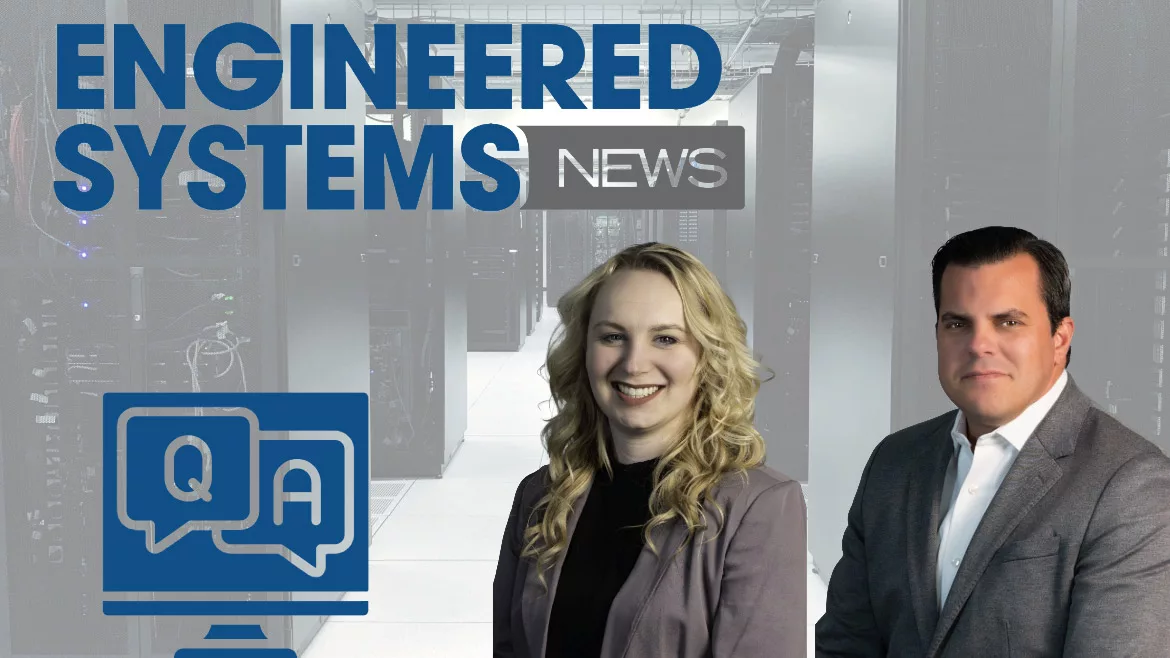
Data centers sit at the digital heart of modern society, but their exponential growth brings enormous energy and sustainability challenges. At the forefront of tackling this paradox are Amanda Bryant, global product application engineering manager at Danfoss Power Solutions, and Zach Dominique, global director of data center sales at Danfoss Climate Solutions. Combining technical expertise with a relentless drive to innovate, they share how Danfoss is helping customers transform everything from cooling to power distribution, supporting both legacy sites and next-gen hyperscale projects to achieve ambitious sustainability goals.
1. Your liquid cooling offerings, like the Hansen FD83 Quick Disconnect Couplings and CoolTrain smart valve trains, are highlighted for energy efficiency and reliability. Can you share data or case studies on measurable improvements these products deliver in live data centers?
In high-density data centers, the secondary loop is responsible for moving coolant through cold plates to extract heat from processors and then back to the cooling distribution unit (CDU). Maintaining high flow in this loop is critical because insufficient flow reduces heat transfer at the chip level and forces CDU pumps to operate at higher speeds to compensate, increasing energy consumption and wear. Pressure drop across components – especially quick-disconnect couplings – is one of the biggest contributors to flow restriction.
The Danfoss Hansen FD83 coupling was engineered to address this challenge. Its optimized internal geometry provides near-full bore flow, reducing turbulence and hydraulic resistance. In fact, FD83 achieves up to 98% lower pressure drop compared to conventional couplings. This dramatic reduction means pumps can maintain required flow rates with less head pressure, improving pump efficiency and extending pump life. The result is better thermal performance for chips, lower energy usage, and improved Power Usage Effectiveness (PUE). By minimizing pressure drop in the secondary loop, FD83 enables scalable, reliable, and energy-efficient cooling for today’s high-density compute environments.
2. The Turbocor TGS380 Compressor is described as having zero performance degradation over its lifetime. How does Danfoss achieve and validate this, and what does it mean for long-term total cost of ownership compared to conventional compressors?
Turbocor’s success is chiefly attributed to its design, incorporating oil-free magnetic bearing technology. Conventional compressor designs require oil lubrication – which brings with it the cycle of mechanical wear and oil migration on the heat exchanger surfaces, and this process starts the minute the compressor is operational, leading to the progressive loss of efficiency. Turbocor’s magnetic bearing is frictionless, eliminating the need for any oil lubrication, removing the variables that cause degradation.
Over 160,000 Turbocor compressors installed globally have demonstrated stable performance over extended periods. We also have TurbocorCloud, which provides real-time performance analytics, ensuring peace of mind in Turbocor’s reliable performance.
Oil-free design and variable-speed operation deliver up to 40% higher efficiency than equivalent oiled compressors, reducing energy and maintenance costs, the largest component of TCO. Magnetic bearings and fewer moving parts reduce failure risk, minimizing downtime costs. And Turbocor is optimized for low-GWP refrigerants, which helps to avoid future retrofit costs with the inevitable changes in regulatory compliance with refrigerants.
3. With rising focus on harmonics management in mission-critical facilities, how do Danfoss’ ultra-low harmonic solutions and Advanced Active Filter AAF 007 differentiate themselves in deployment and life-cycle impact?
Danfoss offers ultra-low harmonic drives and the Advanced Active Filter AAF 007. The drives are built right into the motor control, so they clean up power at the source – perfect for new installations. The AAF 007 is a separate, modular filter that can be added to existing systems, making it ideal for retrofits or when you need extra protection.
Both keep power clean and stable, but the filter also adds power factor correction and imbalance compensation, saving energy and reducing cooling needs over time. Together, they help cut costs, improve reliability, and meet strict standards.
4. How are your white space and gray space solutions tailored to address both legacy data centers and new hyperscale builds – especially when it comes to rapid deployment and uptime requirements?
Think of Danfoss as a partner across the entire facility – existing or new. We design solutions that fit existing footprints – so operators don’t need major structural changes. That means compact components, standardized interfaces, and pre-engineered kits that drop into place with minimal wiring changes.
For new hyperscale builds, speed and scale drive everything in this market. In the white space, we focus on liquid cooling conveyance and smart hydronics that accelerate deployment – quick-connect solutions and pre-tested, turnkey valve trains reduce install time and risk. In the gray space, modular power conversion and harmonics management simplify electrical room design and support rapid commissioning. Across both environments, we integrate heat-reuse options and sustainability features without compromising reliability.
In the gray space, we emphasize heat transfer and reliability with components like gasketed plate heat exchangers. These can often be deployed almost directly without heavy integrator involvement, making them ideal for rapid deployment and heat reuse strategies. Combined with harmonics management and sustainability features, these solutions give operators a clear path to efficiency and resilience, whether retrofitting a 10-year-old site or standing up a hyperscale campus.
5. Danfoss is a founding member of the Net Zero Innovation Hub For Data Centers. Can you talk about concrete outcomes or pilots from this initiative, and how collaboration with organizations like Google and Microsoft is shaping your R&D agenda?
For reference, the Net Zero Innovation Hub was created to accelerate decarbonization in data centers through cross-industry collaboration. It’s not just activity – it’s progress. For example, the Hub launched a Request for Innovation to identify low-carbon alternatives to diesel backup generators, a critical step toward eliminating Scope 1 emissions. This initiative is now in a validating pilot phase. They’re also working on heat reuse projects, developing reference designs and calculators to help hyperscalers capture waste heat and feed it into practical applications – turning unused energy into a renewable advantage.
Collaboration with hyperscalers like Google and Microsoft is shaping our R&D in big ways. These partnerships influence our roadmap for liquid cooling, heat pumps, and grid-interactive power modules, ensuring they meet hyperscale requirements for efficiency and carbon neutrality. It’s all about scaling solutions that can be deployed quickly and replicated globally.
6. For operators seeking to maximize heat reuse or recovery, which Danfoss products are most critical, and what’s the typical ROI or operational impact for large hyperscale or colocation sites?
Heat reuse isn’t just about hardware, it’s about engineering precision. At Danfoss, we bring decades of expertise in thermal management and hydronics to design custom systems that capture waste heat and turn it into that renewable advantage.
The most critical components are our gasketed plate heat exchangers, which transfer heat efficiently between circuits, and Turbocor oil-free compressors, which enable high-temperature lift for heat pumps without the efficiency penalties of oil systems we discussed earlier.
For hyperscale and colocation sites, the ROI can be compelling. Depending on local energy pricing and the mating application, typical payback periods range from 2 to 5 years. But, beyond financial returns, the operational impact is significant: free cooling, improved PUE/WUE, reduced carbon footprint, and compliance with tightening ESG mandates, all without compromising uptime.
7. Can you expand on how iC7 Liquid-cooled System Modules fit into data center modernization – particularly in hybrid or grid-interactive facilities looking to marry battery storage, renewables, and traditional power distribution?
Modern AI and cloud campuses need power systems that are dense, modular and grid‑friendly. That’s exactly where our iC7 liquid‑cooled system modules come in. They package high‑efficiency power conversion with pre‑wired input/output filters under the module, so integrators don’t have to build bulky filter cabinets. The result is a much smaller electrical‑room footprint, faster cabinet buildouts, and simpler thermal management because losses are carried away by liquid rather than heating the room.
Where these modules really earn their place are in those hybrid or grid‑interactive facilities. That means the same platform can:
- Act as a string PCS for BESS
- Provide grid support
- Interconnect renewables behind the meter – while meeting modern interconnection requirements
Operationally, this flexibility lets data centers blend UPS, batteries, renewables, and conventional generation into a coordinated plant that can ride through grid events rather than trip off.
It’s a little complex, but bottom line: iC7 liquid‑cooled system modules let operators compress space and schedule, meet grid‑support expectations (GFM/GFL), and future‑proof for BESS and renewables, without redesigning the whole plant.
8. In the face of tightening regulatory and ESG requirements, what does Danfoss offer to help operators accelerate their sustainability roadmaps without compromising uptime or performance?
Operators are under pressure to cut emissions and improve efficiency without risking reliability. Danfoss helps by combining proven technologies with deep engineering expertise.
For cooling, our Turbocor oil-free compressors eliminate efficiency loss from oil fouling and enable low-GWP refrigerants. In hydronic systems, our new CoolTrain smart valve train with ABQM PiCV (Pressure independent control valve) with Novocon controller ensures precise flow balancing at the rack and manifold level, improving liquid cooling efficiency and reducing energy losses.
In power systems, ultra-low harmonic drives and active filters improve power quality while lowering energy waste.
We also enable heat reuse through gasketed plate heat exchangers and high-lift heat pumps, turning unused energy into a renewable benefit.
Beyond hardware, we provide application guidance, design assistance, system optimization, digital tools, and lifecycle support so operators can meet ESG targets confidently.
The result: measurable reductions in PUE/WUE and carbon footprint – without compromising uptime or performance.
9. With a footprint spanning over 100 factories worldwide, how does Danfoss ensure continuity of supply, quality, and local support for data center customers in different regions?
Continuity of supply starts with redundancy. For our core product lines like Turbocor compressors, heat exchangers, data center hoses, quick disconnect couplings like FD83, and power electronics, we maintain redundant manufacturing capabilities across multiple regions.
We also regionalize production and inventory to shorten lead times and meet local compliance requirements. Every factory operates under the same global quality standards, supported by rigorous testing and digital traceability systems.
And beyond manufacturing, we have local engineering and service teams in key markets to provide commissioning support, troubleshooting, and lifecycle guidance.
10. What are the most frequent misconceptions you encounter about data center cooling and power distribution, and how does Danfoss help educate the market?
One big misconception is that efficiency loss over time is unavoidable. Many operators assume performance will degrade as systems age, but with oil-free compressors like Turbocor, we eliminate oil fouling – the main culprit – so efficiency stays consistent for decades. Another misconception is that harmonics are just a nuisance. In reality, unmanaged harmonics can trip protection systems, reduce generator capacity, and jeopardize uptime. That’s why we emphasize active harmonic mitigation with solutions like our AAF 007 filter and ultra-low harmonic drives.
We also see confusion around heat reuse – some think it’s too complex or only viable in new builds, or certain global regions. In fact, with the right engineering support (that Danfoss offers) and components like our gasketed plate heat exchangers and high-lift heat pumps, it’s easily achievable even in legacy sites.
We see tremendous untapped potential in the U.S. for heat reuse solutions. Imagine a data center partnering with local businesses that can use excess heat in their production processes or even supporting a nearby greenhouse to grow fresh food and flowers year-round using recovered energy. These ideas aren’t just about sustainability; they’re about creating shared value for communities, driving local jobs, and moving toward carbon-neutral operations. With a little creativity, we can turn waste heat into an engine for economic and environmental progress.
Whether you require installation, repair, or maintenance, our technicians will assist you with top-quality service at any time of the day or night. Take comfort in knowing your indoor air quality is the best it can be with MOE heating & cooling services Ontario's solution for heating, air conditioning, and ventilation that’s cooler than the rest.
Contact us to schedule a visit. Our qualified team of technicians, are always ready to help you and guide you for heating and cooling issues. Weather you want to replace an old furnace or install a brand new air conditioner, we are here to help you. Our main office is at Kitchener but we can service most of Ontario's cities
Source link