That sinking feeling when the house starts getting stuffy or chilly is one we all know. You realize your heater and ac not working, and your mind immediately jumps to an expensive repair bill. But hold on—before you pick up the phone, a lot of common HVAC meltdowns have surprisingly simple fixes you can handle yourself.
What to Do First When Your Heater and AC Stop Working
It’s a truly frustrating moment for any Phoenix Valley homeowner: the air stops blowing, the temperature creeps in the wrong direction, and your comfort is suddenly gone. When both your heating and cooling decide to quit at the same time, it’s almost never a coincidence. It usually points straight to a single, shared part that’s failed.
And here’s the good news: you don’t have to be an HVAC pro to solve some of the most common issues.
This guide is your step-by-step troubleshooting checklist, starting with the easiest and most likely culprits. We’ll walk through the simple checks that could save you time, stress, and the cost of a service call. Our team at Comfort Experts has been diagnosing these exact problems across the Phoenix Valley for over a decade, and we want to share that hands-on experience with you.
Check the Thermostat First
Before you even think about a major mechanical failure, your first stop should always be the thermostat. It’s the brain of your entire system, and a tiny glitch here can bring everything to a grinding halt.
- Verify the Settings: It sounds almost too simple, but it happens more than you’d think. Make sure the thermostat is actually set to “Cool” or “Heat” and not accidentally switched to “Off.” Double-check that the temperature you want is lower (for AC) or higher (for heating) than the current room temperature.
- Inspect the Batteries: Many digital thermostats run on batteries. A totally blank screen is the obvious clue, but dying batteries can also make the system act erratically. If you can’t remember the last time they were swapped out, now’s the time.
- Look for Error Codes: Some of the newer smart thermostats will flash an error code or a light to tell you what’s wrong. A quick Google search for that code can often point you right to the problem.
Move to the Circuit Breaker
If the thermostat looks good, the next logical place to check is the power source: your circuit breaker panel. An HVAC system is a power-hungry piece of equipment, so it has its own dedicated circuit.
A tripped circuit breaker is one of the top reasons we get called out. It’s just a safety feature doing its job, protecting your equipment from a power surge. From our experience in the field, a quick reset often gets everything running again instantly.
Find your home’s main electrical panel and look for the breaker labeled “HVAC,” “Furnace,” or “Air Conditioner.” If the switch is sitting in the middle or flipped to “Off,” push it firmly all the way to “Off” first, then back to “On.”
If it trips again right away, do not reset it again. That’s a clear sign of a more serious electrical issue that needs a professional technician. By the way, a severely clogged air filter can restrict airflow so much that your system overheats and trips the breaker. For more on this crucial bit of maintenance, check out our guide on how often to change air filters.
Diagnosing Power and Thermostat Problems
Alright, if the easy stuff didn’t get your system running, it’s time to dig a little deeper into the common power and thermostat issues that can knock an HVAC system offline. When both your heater and AC are not working, the problem is almost always electrical. The good news? The culprit is often a power interruption hiding in plain sight.
You know what? A surprising number of our service calls boil down to simple power-related hiccups that homeowners can safely find themselves. We’re going to move beyond the main breaker panel and check a few other key spots.
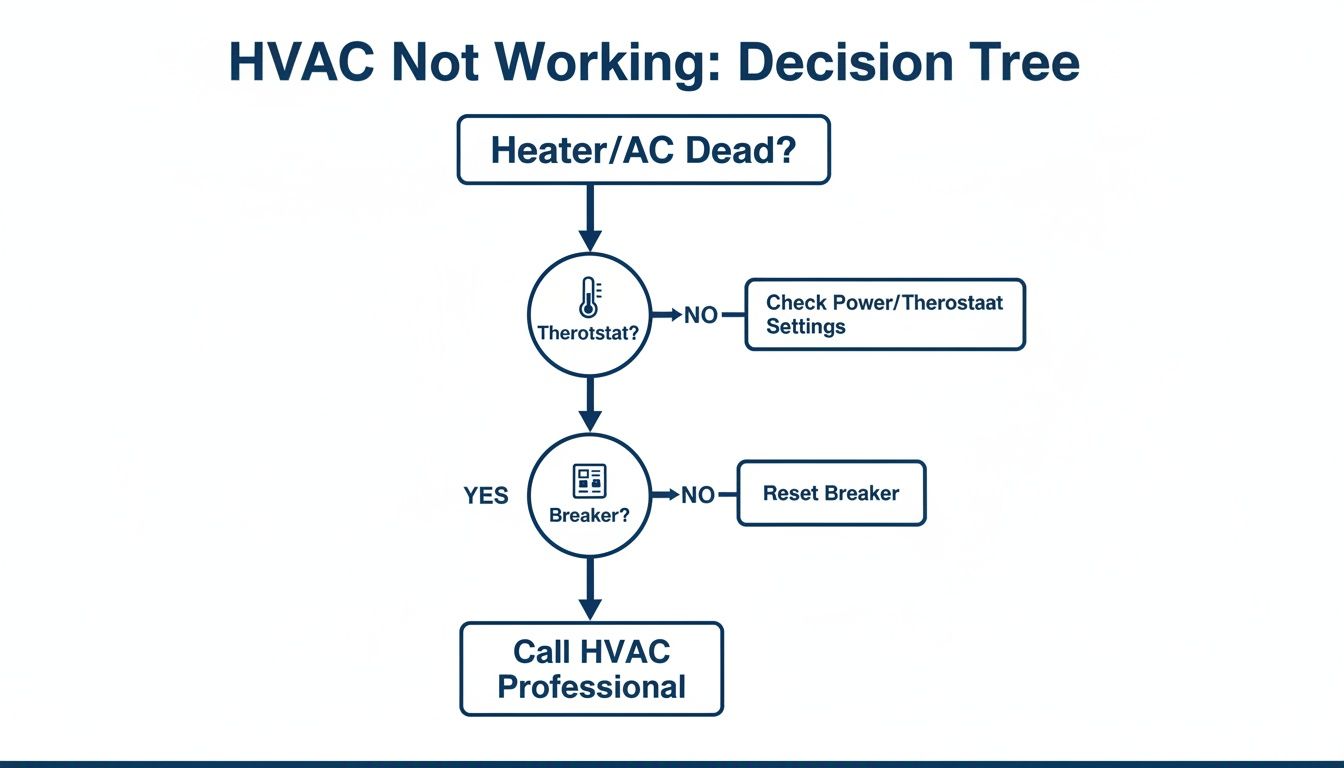
This little decision tree can help you visualize the path we’re about to take, starting with the simplest checks.
As you can see, the logic flows from the easiest things—thermostat and breaker—before we start looking at the equipment itself.
Beyond the Main Breaker Panel
So, the breaker in your main electrical panel is fine. Great. Now let’s check the other power switches that control your system. Both your outdoor unit (the condenser) and your indoor unit (the furnace or air handler) have their own dedicated disconnects.
- The Outdoor Disconnect Switch: Look for a small metal box mounted on the wall near your outdoor AC unit. Inside is a disconnect switch, which can be a lever or a pull-out block. We’ve seen these get turned off by landscapers, kids, or even homeowners who mistake them for a light switch. Make sure it’s firmly in the “On” position.
- The Indoor Unit Switch: Your furnace or air handler has its own power switch, too. It often looks exactly like a standard light switch and is usually located on or very near the unit. If it’s in a closet, attic, or basement, it’s incredibly easy for it to get flipped off by mistake.
- Internal Fuses: Both the indoor and outdoor units have small fuses on their control boards, kind of like the ones in your car. A power surge can pop one of these, killing the system. Finding this requires opening a panel (always shut the power off at the breaker first!), but it’s a very common point of failure that a technician can spot in minutes.
Advanced Thermostat Checks
If you’re absolutely sure the power is on everywhere it should be, let’s circle back to the thermostat for a second look. A faulty thermostat can send scrambled signals—or no signals at all—to your HVAC system, making it seem like the whole thing is dead.
Over time, especially in older homes, the low-voltage wires connecting the thermostat can jiggle loose from their terminals. A quick visual inspection (after popping the faceplate off) can sometimes reveal a wire that’s come undone.
A thermostat is way more than a temperature dial; it’s the brain of your entire comfort system. When it malfunctions, it can perfectly mimic a massive mechanical failure, tricking you into thinking you need a major repair when all you need is a simple replacement.
If your thermostat is old, unreliable, or you just want better control, it might be time to look into what a modern thermostat installation in Mesa, AZ can do for your home’s efficiency and comfort.
To help you connect the dots, we put together a quick reference table for common HVAC symptoms and where to look first.
HVAC Symptom and Cause Quick Reference
Use this table to match what you’re seeing and hearing (or not hearing) with the most likely cause and the first action you can take.
| Symptom | Potential Cause | Your First Step |
|---|---|---|
| System is completely dead | No power; tripped breaker or switch; dead thermostat batteries | Check the main breaker, all disconnect switches, and replace thermostat batteries. |
| Outdoor unit not running | Tripped outdoor disconnect; faulty capacitor; control board issue | Reset the disconnect switch. If it doesn’t start, a professional check is needed. |
| Air blows but isn’t hot/cold | Low refrigerant (for AC); ignition failure (for heat); frozen coils | Check air filters for blockages; allow frozen coils to thaw completely before restarting. |
| System cycles on and off rapidly | Clogged air filter; incorrect thermostat calibration; oversized system | Replace the air filter and check thermostat settings for accuracy. |
This table covers the most frequent issues we encounter. If your first step doesn’t solve the problem, it’s usually a sign that a component has failed and it’s time to call for a professional diagnosis.
Why Both Heating and Cooling Fail at the Same Time
It’s one of the most confusing things that can happen with your HVAC system. A broken AC is one thing, a dead heater is another. But when both your heater and AC are not working, it feels like a total system catastrophe. So, why would both stop working at the same time?
Here’s the thing: it’s almost never a coincidence. This situation almost always points to a single failure in a component shared by both your heating and cooling systems.
Think of your HVAC system less as two separate machines and more as one integrated unit with a central nervous system. A handful of key parts are mission-critical whether you’re trying to survive a Mesa summer or just take the chill off a January morning. When one of these shared components fails, it takes the whole ship down with it.
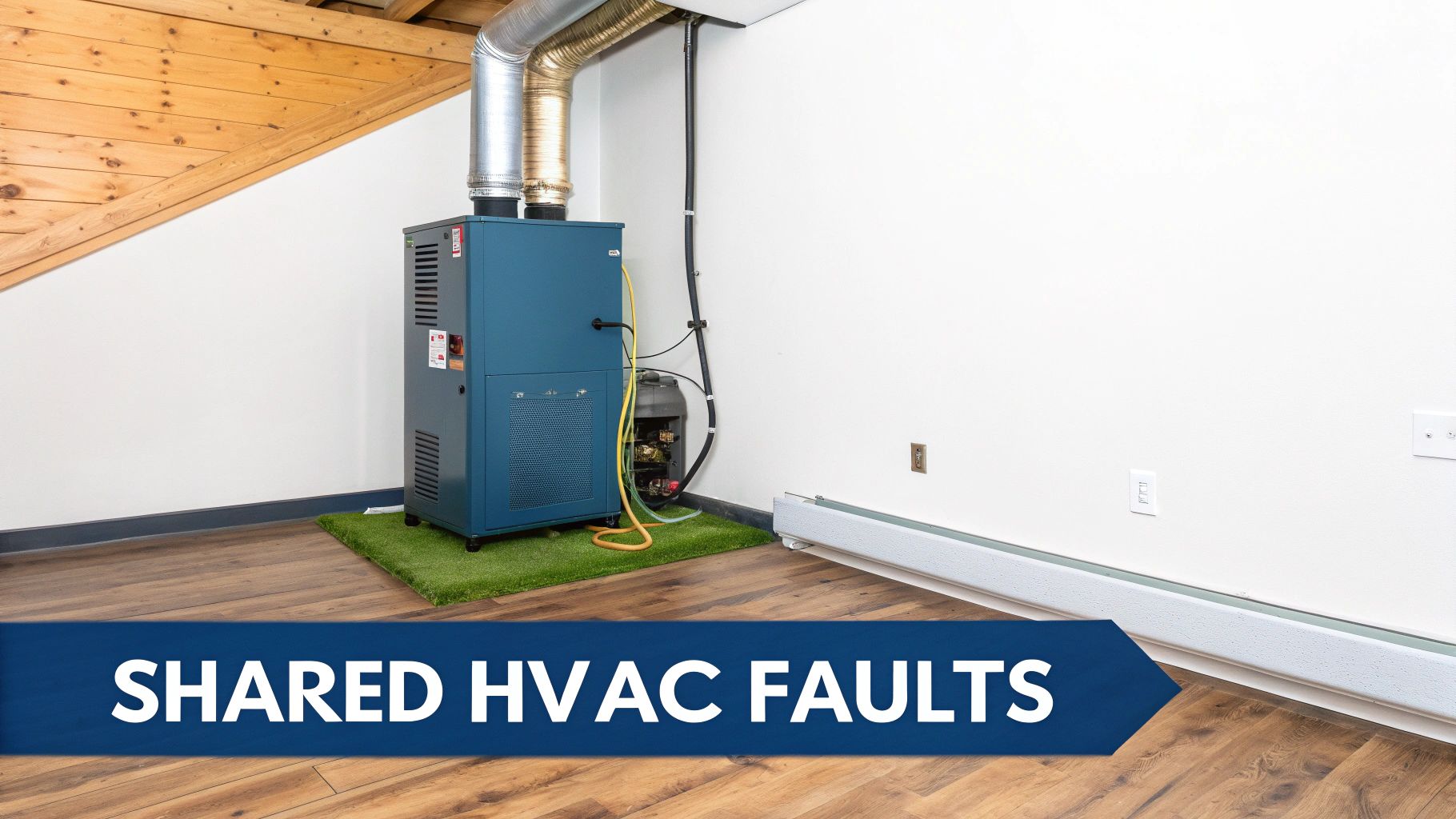
Let me explain the most common single points of failure that can knock out both heating and air conditioning. Understanding how these parts connect makes the problem feel a lot less mysterious and points you toward a manageable diagnosis.
The primary shared components usually boil down to one of these:
- The Thermostat: As we covered, this is the brain of the operation. If it loses power, has a bad wire, or just plain fails, it can’t tell either the furnace or the air conditioner to get to work.
- The Blower Motor: This is the powerful fan tucked inside your furnace or air handler. Its only job is to push all that conditioned air—both hot and cold—through your home’s ductwork. If the motor burns out or its capacitor fails, no air moves, period.
- The Main Power Supply: A simple tripped circuit breaker or a blown fuse cuts all electricity to your indoor unit. No power, no HVAC.
- The Condensate Drain Line: Your AC wrings moisture out of the air, and that water has to go somewhere. If the drain line clogs, a safety switch trips to shut the whole system down and prevent a flood. That same safety switch is often wired to kill the furnace, too.
It’s a domino effect. A simple clog in a drain line, which is purely an AC function, can completely shut down your furnace because they share the same safety circuit. It’s a smart protective feature that understandably confuses a lot of homeowners.
How One Bad Part Causes a Total Shutdown
A single faulty component can have a massive ripple effect. For example, a failing run capacitor for the blower motor is an issue we see all the time. This small, cylinder-shaped part gives the fan the electrical kick it needs to start spinning. When it goes bad, you might hear a faint humming sound from your indoor unit, but zero air will come out of your vents.
That one tiny part failing means neither your powerful furnace nor your high-efficiency AC can do its job.
The same goes for heat pumps, which are designed to handle both heating and cooling from the start. A problem with its reversing valve (the part that switches between AC and heat mode) or its main control board can easily knock out both functions. If you have one of these all-in-one systems, our guide to heat pump repair in Mesa, AZ offers a much deeper look.
These kinds of faults are more common than you might think. One study of commercial buildings found that on any given day, around 40% of air handling units had some sort of fault. That shows just how often these complex systems can run into trouble, from tiny sensor errors to major component failures.
Knowing When to Call an HVAC Professional
DIY troubleshooting is a great way to save a little money and understand your home better, but it’s just as important to know your limits. Some HVAC problems are far more serious than a clogged filter or a tripped breaker, and trying to tackle them without the right training can be a recipe for disaster.
Honestly, knowing when to put the tools down and pick up the phone is one of the smartest things a homeowner can do. Pushing your luck with complex electrical or mechanical issues can turn a manageable repair into a complete system replacement—or worse, create a serious safety risk. Your comfort matters, but your well-being comes first, always.
Clear Signs to Stop and Call for Help
If you run into any of these red flags during your troubleshooting, it’s time to stop immediately. These symptoms almost always point to a deeper problem that requires a certified technician with the right diagnostic gear.
- Burning Smells: Any odor that smells like burning plastic, hot metal, or scorched wiring is a major warning. It often signals an overheating motor or a dangerous electrical short that could be a fire hazard. Kill the power to your HVAC system at the breaker panel and call a pro right away.
- Loud, Unusual Noises: Your system should make a steady, gentle humming sound. If you hear loud grinding, metallic screeching, or violent banging, something is seriously wrong inside. It could be a failing motor bearing or a damaged compressor. Don’t let it run—you’ll only cause more damage.
- Signs of a Refrigerant Leak: Noticing a hissing sound, finding an oily film on the refrigerant lines, or realizing the air from your vents is just lukewarm are all classic signs of a leak. Refrigerant is a controlled substance that requires special certification to handle; this is absolutely not a DIY job.
Safety First: Your HVAC system is a mix of high-voltage electricity and chemical refrigerants. If you ever feel unsure or unsafe, just stop. No potential savings is worth risking personal injury or major damage to your home.
It’s a tough pill to swallow, but a U.S. Department of Energy field study found that over 65% of residential HVAC systems suffer from installation flaws right from the start. These mistakes contribute to a staggering $10 billion that homeowners spend on HVAC repairs every single year. When your own efforts hit a wall, you need help from experienced HVAC companies who can spot the real root cause, not just the symptom.
Knowing how to find a trustworthy technician is just as critical as knowing when to call one. To make sure you’re getting reliable, certified service from a team that knows our area, check out our guide on how to choose the right HVAC company.
How to Prepare for Your HVAC Service Visit
Okay, so you’ve walked through the checklist and it’s clear the problem is deeper than a simple DIY fix. Calling in a pro is absolutely the right call, but you can still play a key role in getting things fixed faster.
Think of it like getting ready for a doctor’s appointment. The more info you have ready, the quicker and more accurate the diagnosis. A little prep work on your end helps our technicians zero in on the real problem so we can get your comfort back when your heater and AC are not working.
Create a Clear Path
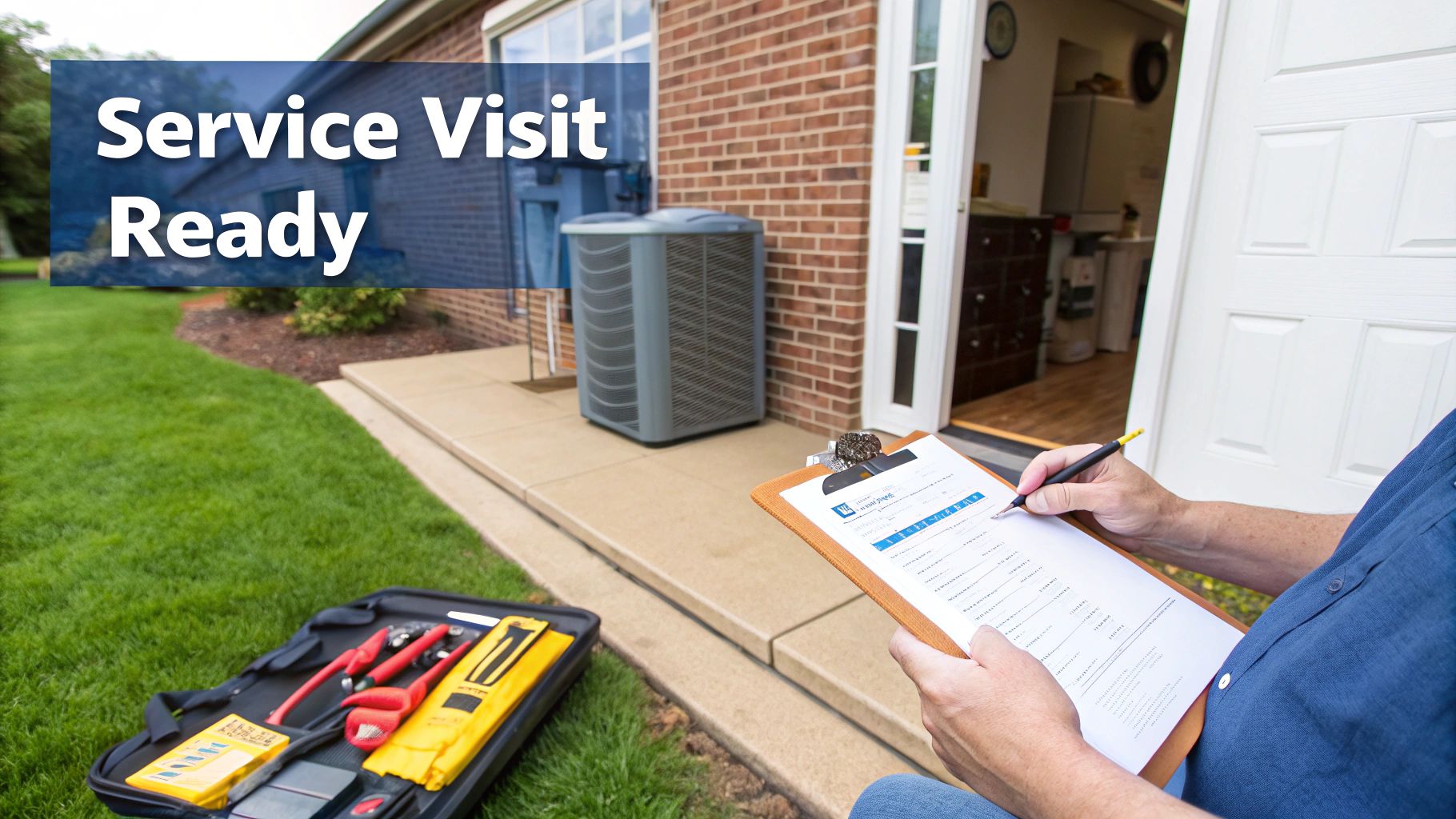
One of the best things you can do before we arrive is to make sure our techs can get to your equipment safely and easily. Every minute we spend moving boxes or pushing aside clutter is a minute we’re not spending on the actual repair.
- Indoor Unit Access: If your furnace or air handler is tucked away in a closet, attic, or basement, please clear a direct path. It’s also a huge help if you can move any items blocking the unit’s access panels.
- Outdoor Unit Space: Head outside to your condenser unit and trim back any overgrown bushes, weeds, or grass. We need a clear space of about two feet all the way around to work effectively and ensure the unit gets proper airflow once it’s running again.
Gather Key Information
Having a few notes ready can shave a surprising amount of time off the diagnostic process. Before your technician gets there, see if you can find and jot down these details:
Your observations are incredibly valuable. You live in the house and notice the small changes a technician might not see right away. A detailed symptom list is one of the best tools you can give us.
Try to put together a quick timeline. When did you first notice something was wrong? Did you hear any strange noises—like grinding, banging, or squealing? Any weird smells before the system gave up?
It’s also incredibly helpful if you can find the make and model number of your equipment. This is usually on a sticker or data plate on the side of both the indoor and outdoor units.
For an even smoother experience, you can provide these notes when you first schedule your service appointment online. This little bit of prep helps our team show up with the right tools and potential parts already in mind.
When your entire comfort system goes down, the questions start flying. It’s a pretty stressful spot to be in, but getting a handle on a few common issues can really clear things up and help you figure out what to do next. Here are the big questions we hear from homeowners all the time.
Why Did My Heat and AC Stop Working at the Same Time?
This is always the first question when a heater and ac not working problem pops up, and for good reason. It feels like a double disaster, but it almost always points to a single part they both share.
Instead of two separate systems failing, you’re looking at one point of failure. The most common culprits we find are:
- The Thermostat: It’s the brain of the whole operation. If the thermostat dies or loses power, it can’t tell either the heater or the air conditioner to turn on. No signal, no comfort.
- The Blower Motor: This is the powerful fan inside your furnace or air handler that pushes all the conditioned air—hot or cold—through the vents. If that motor gives out, the system might be trying to work, but no air is actually moving.
- A Clogged Drain Line Safety Switch: This is a big one. Your AC creates condensation, which flows out a drain line. If that line gets clogged with gunk, a safety float switch will trip and cut power to the whole system to prevent a nasty water leak in your ceiling or closet.
How Much Will an HVAC Repair Cost?
This is the million-dollar question, isn’t it? The honest answer is that it’s all over the map. A simple fix, like swapping out dead thermostat batteries, costs you virtually nothing. A basic service call for a tripped breaker or a minor electrical fix might just be our standard diagnostic fee.
Things get more serious when a major part fails. For instance, replacing a blower motor could run several hundred dollars. A failed outdoor compressor? That can easily get into the thousands. There’s just no way to know for sure without a hands-on diagnosis from a professional.
An honest technician will always show you exactly what’s wrong and give you a clear, upfront price before they pick up a single tool. That transparency is non-negotiable—it’s how you know you’re dealing with a pro you can trust.
Should I Repair or Replace My Old HVAC Unit?
Deciding whether to patch up an old system or invest in a new one is a tough call. A great rule of thumb we use in the field is the “$5,000 rule.”
Here’s how it works: Multiply the age of your unit (in years) by the estimated repair cost. If that number is over $5,000, replacement often makes more financial sense in the long run.
Beyond the math, it’s probably time to seriously consider replacement if your system is over 15 years old, you’re calling for repairs more than once a year, or it still uses the old R-22 refrigerant. That stuff is being phased out and is incredibly expensive to get. A modern, high-efficiency system won’t just be more reliable—it will also lower your energy bills and keep you more comfortable.
Your Trusted Partner for Phoenix Valley HVAC Solutions
When your whole HVAC system goes down, it’s more than a little stressful. But you don’t have to figure it out alone. While this guide gives you a solid place to start, some problems really do need a professional with the right tools and training.
Here at Comfort Experts, we’ve been serving the Phoenix Valley since 2011, building our business on honest work and treating customers right. Our licensed technicians have seen it all and are ready for everything from emergency repairs to installing a brand-new, high-efficiency system. For anyone curious about the bigger picture of our trade, this HVAC industry overview offers a good general look.
If you’ve run through the checklist and hit a dead end—and your heater and AC is not working—it’s time to let us take over. We’re here to get your home comfortable again and give you back your peace of mind.
When you need fast, professional help, trust Comfort Experts. Give us a call at 480-207-1239 or schedule service online to get your system back up and running.
Whether you require installation, repair, or maintenance, our technicians will assist you with top-quality service at any time of the day or night. Take comfort in knowing your indoor air quality is the best it can be with MOE heating & cooling services Ontario's solution for heating, air conditioning, and ventilation that’s cooler than the rest.
Contact us to schedule a visit. Our qualified team of technicians, are always ready to help you and guide you for heating and cooling issues. Weather you want to replace an old furnace or install a brand new air conditioner, we are here to help you. Our main office is at Kitchener but we can service most of Ontario's cities
Source link