Last month, a South Carolina college newspaper had an interesting piece on what people, particularly college students, could do to help reduce energy consumption –
changing thermostat settings when the space is unoccupied, taking shorter and cooler showers, unplugging devices when not in use, etc. While these actions certainly save energy, we as a country need to take a more holistic approach to reducing energy consumption. Four of the largest energy consumers are industry, data centers, buildings (residential, commercial, institutional), and transportation. For today, I want to focus on the energy consumption of commercial and institutional buildings.
We can basically break down the factors impacting energy consumption in commercial and institutional buildings into several categories: new construction, existing construction, system efficiencies, owner operation/maintenance, and life expectancy. Each of these would take volumes of explanation, so what is included in this piece is more of a general overview of each and should not be interpreted as an exhaustive explanation of their impact on energy consumption. What will become obvious is that this discussion is substantially more about the decisions engineers, architects, contractors, owners, and government entities make impacting the energy consumption of a building than about what an individual might be able to do.
New building designs for commercial and institutional buildings start with stakeholder discussions on such things as function, size, orientation, energy efficiency, and, of course, budget, among many other concerns. Budget considerations often impact some building components which are seen as slightly less important than others. Regarding energy efficiency, the building envelope and systems typically must meet current energy code requirements, with the designs often reduced to just barely meet or maybe slightly exceed the minimum code requirements. Some of the major factors impacting energy efficiency include building orientation (west and south exposures have a higher impact on energy than north and east exposures, given similar construction), size and type of glass (glass U-factor and shading coefficient), window external shading if any, insulation in walls and roof, tightness of a building (entrance vestibules, etc.), and the building’s mechanical, electrical, and plumbing systems.
The discussion regarding energy efficiency for existing buildings undergoing renovation is generally a little different than with a new building design, as many of the issues one might discuss with a new building are already predetermined for existing buildings. Building orientation in an existing building is one obvious characteristic that cannot be changed. Building renovations above a certain threshold must comply with the building codes or sometimes a liberal interpretation of building codes, depending on the type and quantity of work being performed on the building or building systems. There is often an effort made to bring the building more in line with the energy standards for new buildings, but this is sometimes very difficult to accomplish. If the building is a historic building (i.e., on the historic registry), there are limitations on what can be done, particularly with the building’s exterior. The windows may not be able to be modified or replaced to increase their energy efficiency. In other buildings, the windows are sometimes replaced, but this is a fairly expensive modification that is resisted by many owners. In many existing buildings, exterior wall insulation is often less than what one would find in new construction. Unless the interior of those walls is being replaced or can be easily disassembled, their insulating values cannot be increased. The result is that the building envelope of many existing buildings does not get improved, resulting in continued lower performance and higher energy consumption as compared with new construction. Whether a building remains occupied or partially occupied during the renovations can also impact options considered in the renovation. In older buildings, the extent of any hazardous materials such as asbestos, lead paint, etc. on walls, ceilings, piping, etc. can come into play regarding how a building is to be renovated. And of course, when all the above have been analyzed and discussed, budget is often a final determining factor in what can get done.
The next category applies to both new and renovated buildings and includes mechanical (HVAC) systems, plumbing systems (primarily water heating), and electrical systems (primarily lighting). If the renovation is only for a small portion of the building, it would be unusual for the project to include a wholesale replacement of systems unless the existing systems were in just horrible condition or have far exceeded their life expectancy.
Depending upon the size of the renovated area, we often see inefficient fluorescent lighting (3.0 W/SF) replaced with LED lighting (0.6 W/SF) for the renovated space, or maybe even for the entire building. If the building owner is paying all the utility costs and plans on continuing to own the building for any considerable length of time (maybe 10 years or longer), it would make financial sense to upgrade all the lighting from fluorescent to LED. Another benefit resulting from upgrading to LED lighting is that LED lighting contributes maybe 25% of the heat generated by fluorescent lighting, which helps significantly to reduce the cooling loads of the building. Obviously, you would not see a new building designed with anything but LED lighting for the reasons stated above.
Plumbing, or more specifically water heating, has a much lesser impact on a building’s utility costs depending upon the type of building and its hot water demand. In buildings where water is primarily heated for hand sinks or janitor sinks, water heaters are typically gas or electric and one of the following: large central water heaters serving multiple floors, smaller water heaters serving a floor or even part of a floor, or possibly small tankless water heaters serving one or more sinks. The closer the water heater is located to the location where the water is used, the more energy is saved, as heat loss in the piping system is reduced. Not storing the water, that is, using instantaneous water heaters, saves even more energy as there is basically no heat loss as is associated with a storage tank. However, some of the biggest consumers of hot water are buildings with large commercial kitchens or where there are numerous showers used on a regular basis. Although there does not seem to be an acceptable, automatic way to reduce energy in showering other than utilizing low flow shower heads, people can be asked to take shorter and cooler showers. Reducing water temperatures at the source is a good option to save energy as long as the temperature is not reduced to the level where people complain. At that point, it would likely not be considered a viable measure for energy savings. Water heating system upgrades are sometimes required by code when renovating a building but typically are not required except in cases where significant plumbing changes are made to the building.
One of the largest energy consumers in a building, and often the single largest energy consumer, is the mechanical system – the HVAC system providing the cooling and heating within the building. This system is also by far the most expensive system within a building and therefore often involves significant decisions when designing a new building or renovating part or all of an existing building. There are far too many different mechanical systems, each with their own factors impacting operating costs, to get into in this conversation. There are, however, a few concerns common to many of these types of mechanical systems that have a significant impact on long-term operating costs. Some of these are much more easily addressed in new construction or in extensive renovation projects, but many cannot practically be addressed in smaller renovation projects. A few important considerations are:
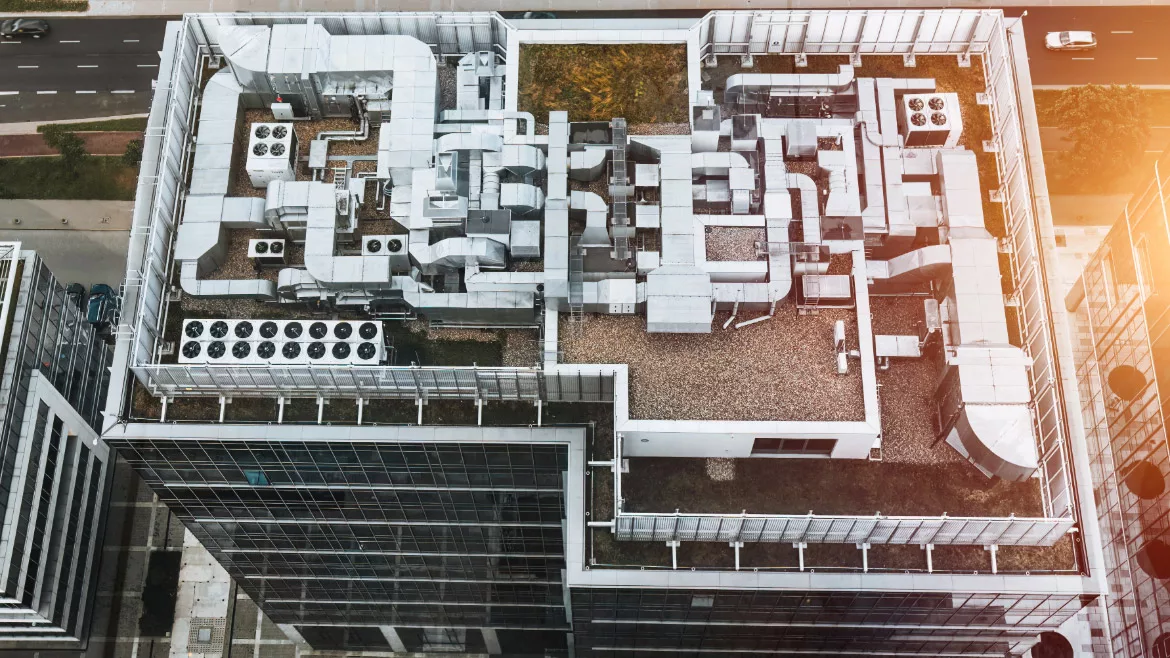
- Fan energy: The closer the air handler is to the space served, the lower the energy consumption. For example, a building with one or two air handlers per floor operates at a much lower cost than a building with numerous air handlers located on the roof of, say, a six-story building.
- Outside ventilation air: The amount of outside air brought into a building, and whether or not the raw outside air is pretreated (energy recovery coils, energy wheels, etc.), has a large impact on operating costs related to conditioning the outside air.
- Thermostat settings: Thermostat setpoints are one of the easiest ways to help reduce operating costs. Setpoints are sometimes changed whether the space is occupied or unoccupied, or even adjusted to one temperature for daytime operation and a different setpoint during nighttime operation. The occupied setpoints have a significant impact on energy consumption. Keeping thermostats at, say, 74°F in cooling allows the system to operate at a lower cost than keeping thermostats at maybe 70 or 72°F. In heating, keeping thermostats at 68°F allows the system to operate at a lower cost than keeping the thermostat at the cooling setpoint.
- Hot water boilers: Gas boilers providing heating water at 130 or 140°F typically operate at a much higher efficiency than boilers set to operate at 180°F.
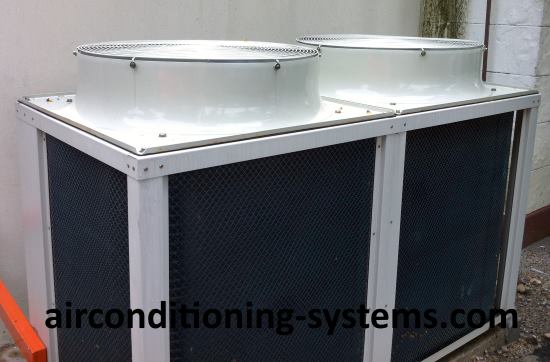
Another factor impacting more the lifecycle cost of systems than the operational cost is the location of the equipment—particularly the HVAC equipment. Although not directly related to energy cost, long-term owner costs increase with outdoor mechanical equipment versus indoor mechanical equipment. Outdoor equipment is typically expected to last 15 or so years. Indoor equipment is typically expected to last around 25 or more years. Obviously, replacement costs for outdoor equipment are much higher than for indoor equipment over the life of the facility.
In engineers’ and owners’ efforts to increase the efficiency of systems, again particularly the HVAC system, the cost of operating and maintaining equipment is sometimes overlooked or perhaps not given the attention needed. Looking at building energy consumption, sometimes the systems designed require more maintenance than owners anticipated or can afford. For example, a system such as a fan coil system with units located above the ceiling can have filters that are difficult to access and therefore often do not get changed on a regular basis. Sometimes energy devices, such as energy wheels in 100% outdoor air systems, have operational problems. The owner can either fix/replace the system components, which are often fairly expensive, or simply turn off the system. Turning the device off saves the cost of replacement as well as reduces operating costs, as ventilation air can be one of the largest consumers of energy related to the HVAC system. If the ventilation system is turned off, however, this is at the expense of the building’s air quality. Another cost factor is the cost of filters. Often, the design includes high-efficiency filters (MERV 13 or higher) to keep the air and the heating/cooling coils clean. Owners realize at some point that these higher efficiency filters cost 50% or more than the less efficient filters, at which point they begin to replace the high-efficiency filters with much less efficient filters.
In some states, such as South Carolina, there is one other major obstacle to designing a new facility or renovating an existing facility to be as energy efficient as possible, and that is the energy code currently in place. In South Carolina, the energy code is a 2007 energy code. Some states don’t even have an energy code. It is hard to understand why South Carolina has not moved forward to a newer version of the energy code, which would require new buildings and many renovated buildings to operate more efficiently. In South Carolina, the State Legislature decides which energy code designers and building owners must comply with. One thought is that possibly the legislators believe owners should not have to pay the higher initial costs associated with more energy-efficient buildings. While this could be the reason, it does not make all that much sense since the lifecycle cost –
the operating cost over the life of the building –
would be less with the more expensive, higher efficiency systems. The higher efficiencies actually save the taxpayers money over the life of the building.
Whether you require installation, repair, or maintenance, our technicians will assist you with top-quality service at any time of the day or night. Take comfort in knowing your indoor air quality is the best it can be with MOE heating & cooling services Ontario's solution for heating, air conditioning, and ventilation that’s cooler than the rest.
Contact us to schedule a visit. Our qualified team of technicians, are always ready to help you and guide you for heating and cooling issues. Weather you want to replace an old furnace or install a brand new air conditioner, we are here to help you. Our main office is at Kitchener but we can service most of Ontario's cities
Source link