
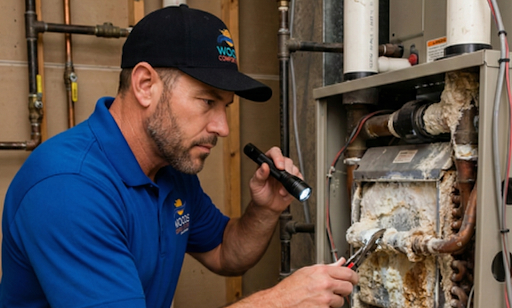
Most homeowners in San Antonio view hard water as a plumbing issue, not a threat to their heating system. But here’s the part that often gets overlooked. The same mineral-rich water that runs through a home can cause hard water furnace problems that slowly erode efficiency, damage internal components, and shorten the equipment’s lifespan. The furnace works harder, energy bills rise, and minor performance issues eventually lead to costly repairs.
This blog explains how mineral buildup forms in furnace systems, why it can become a hidden source of failure, and what homeowners need to understand when water hardness starts affecting more than just faucets.
What Causes Hard Water Furnace Problems?
Water becomes “hard” when it contains high levels of dissolved minerals like calcium and magnesium, and these minerals are the root cause of many hard water furnace problems. When dissolved minerals in water circulate through a home’s plumbing or heating system, they can precipitate, leading to mineral buildup in furnace components and other scale-related problems that interfere with proper operation.
Since many HVAC systems, including furnaces with water-fed humidifiers, boilers, or hydronic heating loops, rely on water or water-adjacent systems, hard water becomes a silent enemy.
What Damage Does Hard Water Cause Inside a Furnace?
The real trouble comes from the slow, steady accumulation of minerals that settles inside components connected to the heating system. As these deposits accumulate, they restrict water flow, raise internal temperatures, and force the furnace to operate beyond its design limits. Here’s how hard water breaks down key furnace components, step by step.
-
Mineral scale on heat-exchange surfaces
When hard water enters parts of a heating system that heat or circulate water, such as boilers, heat exchangers, humidifiers, or radiant-heat loops, calcium and magnesium can deposit as scale. That scale forms a crust-like layer that insulates the heat-exchange surface.
As a result, the system works harder and longer to maintain desired temperatures. Because the scale traps the heat (instead of passing it efficiently), it reduces energy efficiency and forces components to overwork, which shortens their lifespan. This buildup is also a common reason water heaters begin leaking or malfunctioning.
-
Clogging of water lines, valves, and condensate drains
Hard water minerals don’t only settle where the water is heated. They can accumulate in small passages, valves, solenoids, condensate lines, or humidifier pads tied to the furnace or HVAC system.
Over time, these blockages can restrict water flow or condensate drainage. That can result in reduced performance, inefficient operation, or outright failure, especially if drainage is blocked, causing leaks or moisture issues.
-
Corrosion and premature wear of metal parts
Minerals in hard water can combine with oxygen and other chemicals, accelerating corrosion, especially when metal parts are constantly exposed to heated or circulating water. Pipes, heat exchangers, and valves all become vulnerable.
This corrosion can cause pinhole leaks, weakened components, or even system breakdown. Over the long run, that means more frequent furnace maintenance for hard water, higher repair costs, or early replacement.
-
Increased maintenance frequency and repair risk
Once hard water effects begin, homeowners may notice more frequent maintenance needs, such as filter cleaning or replacement, drain flushing, valve servicing, or even complete component repair.
If left unchecked, the buildup can lead to loud noises, poor performance, unexpected shutdowns, or complete failure of furnace-related components.
How Does Hard Water Affect HVAC Systems Over Time?
Here’s a simple comparison to show how neglecting hard water can degrade a furnace or heating system over months or years:
| Time Period | Without Treatment or Maintenance | With Water Softener & Maintenance |
| 0–6 months | Scale starts forming on heat-exchange surfaces, and efficiency drops slightly. | The system operates at peak efficiency; scale buildup is prevented. |
| 6–18 months | Mineral deposits grow; valves and condensate lines begin to clog. | Annual maintenance clears slight sediment; the system runs clean. |
| 18–36 months | Metal parts begin to corrode; energy use rises; performance declines. | Occasional flushing/inspection preserves components. |
| 3–5 years | Risk of leaks, breakdowns, significant repairs, or complete replacement increases. | The system remains reliable and efficient in the long term. |
Final Thoughts!
Hard water can sneak up on homeowners. It may start as a chalky residue on faucets or soap that won’t lather. But left unchecked, those minerals will infiltrate furnace components and other HVAC system components. What begins as a minor annoyance can escalate into serious hard water furnace problems or even total system failure.
Staying on a regular maintenance schedule and working with experts makes all the difference. For homeowners seeking an air conditioning company that upholds high standards, employs skilled technicians, and delivers exceptional customer care, Woods Comfort Systems is the team to call.
Woods Comfort Systems has proudly served San Marcos, TX, as a dependable HVAC and plumbing company since 1956. We also offer a free second opinion on repair & replacement HVAC services. Contact us today or email [email protected].
Whether you require installation, repair, or maintenance, our technicians will assist you with top-quality service at any time of the day or night. Take comfort in knowing your indoor air quality is the best it can be with MOE heating & cooling services Ontario's solution for heating, air conditioning, and ventilation that’s cooler than the rest.
Contact us to schedule a visit. Our qualified team of technicians, are always ready to help you and guide you for heating and cooling issues. Weather you want to replace an old furnace or install a brand new air conditioner, we are here to help you. Our main office is at Kitchener but we can service most of Ontario's cities
Source link