
Is it true that indoor air quality in winter is worse than other times of year? Wildfire smoke (which is more common in warmer weather) notwithstanding, there are quite a few reasons why indoor air can become more uncomfortable and unhealthy during the winter months. Find out why that’s true and how you can improve your indoor air quality this winter.
Why indoor air quality can be worse in winter
Combustion heating systems, such as gas and oil furnaces, generate unhealthy byproducts including nitrogen oxides, carbon monoxide and carbon dioxide, methane, nitrous oxide, volatile organic compounds (VOCs), sulfur dioxide, and particulate matter (PM). (It’s one reason your heating system should be inspected yearly: to make sure it’s not producing unsafe levels of carbon monoxide.)
Wood-burning fireplaces and stoves release the same toxic emissions into indoor air as combustion heating equipment. And because they produce much larger quantities of fine particulate matter, they can significantly worsen indoor air quality.
Poor ventilation. When all the windows and doors are closed and sealed tight to keep out winter weather, contaminants such as particulate matter, VOCs, carbon dioxide can more easily build up in the air. Bacteria, viruses, mold spores, and odors can also linger longer in the air. In NYC highrises, where the windows may not open at all, the problem can be even worse.
Very low humidity. Did you know that humidity is considered a component of indoor air quality? That’s because humidity has a big impact on our comfort and our health. Indoor air becomes extremely dry when the heat is running day and night, leading to annoying static electricity, dry skin and hair, allergies and respiratory issues, and even dehydration. Low humidity is also part of the reason people get sick more often in the winter: dry air makes it easier for bacteria, allergens, and viruses to get into our bodies.
5 Ways to improve your home’s indoor air quality in winter
All the air in your home passes through your HVAC system (sometimes several times per hour, in fact). So remediating poor indoor air quality in winter should start with your heating system.
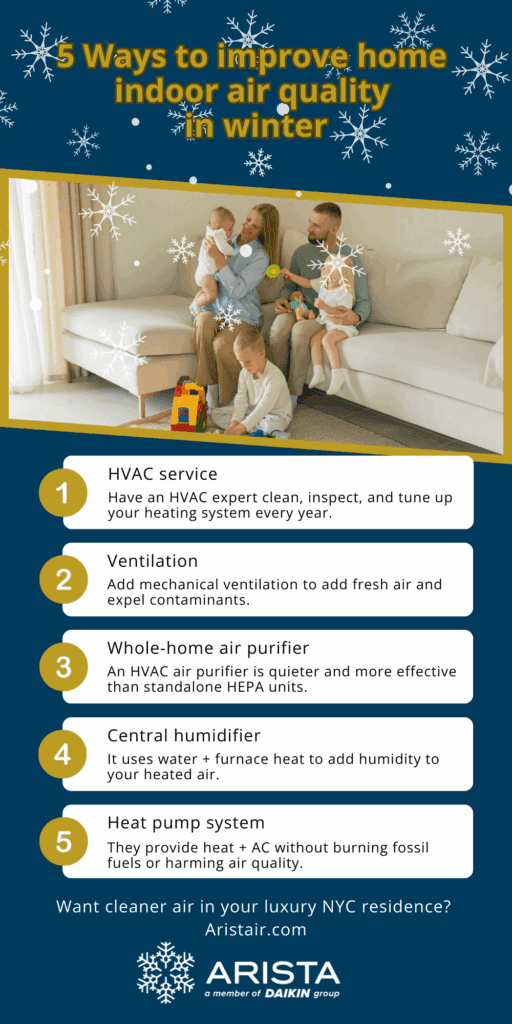
1. Get your HVAC system serviced
To help optimize indoor air quality, make sure your HVAC equipment is cleaned and serviced regularly. That includes:
- Changing filters
- Inspecting all components for proper operation
- Replacing worn parts
In addition to regular HVAC maintenance, it’s also a great idea to have your ducts inspected and cleaned periodically. Duct cleaning removes the buildup of dust and debris (and possibly mold) that can linger and re-enter the air in your space.
Learn more:
Heating Maintenance: 5 Tips to Keep Your System Safe & Reliable
Duct Cleaning Services: Why, When & How
2. Improve mechanical ventilation
This is where the “V” (for ventilation) in HVAC comes into play. To make up for a lack of natural ventilation, you can add more mechanical ventilation to expel contaminants and bring in fresh air from outside. That could mean adding or redesigning ducting and/or adding makeup air units.
Learn more:
What Is Ventilation: How Does It Impact Your HVAC Comfort?
3. Install a whole-home air purifier
If you’re concerned about poor indoor air quality, chances are you have one or more standalone HEPA filter units. These can help, but there’s a better option that cleans the air in your entire home more thoroughly, without annoying noise, and without having unsightly devices in every room.
A whole home air purifier is different. It’s installed inside your HVAC ducts, so it’s out of sight. It can remove more airborne particles that can evade or pass through a HEPA filter. And, when you choose the right system, it can actually deactivate the particles in the air AND on surfaces.
Learn more:
REME HALO: Best Whole Home Air Purifier
4. Add central humidification
Central humidification helps keep winter indoor humidity at comfortable levels (approximately 35 to 55 percent). The system uses water and heat from your furnace to generate humidity, and circulate it along with warmed air through your home via your air ducts. You never add water, since it’s attached to your plumbing, there’s no risk from hot steam, and it’s completely out of sight.
Learn more:
5 Reasons You Need Humidification In Your Luxury Residence
5. Consider a non-combustion heating system
If your furnace is older and it’s time for a replacement, consider switching to a different kind of heating system that doesn’t rely on combustion: a heat pump system.
A heat pump is a type of HVAC equipment that can provide both heat and cooling for your home. It’s basically an air conditioner that can work in reverse to provide heat. Heat pumps use electricity and refrigeration chemicals (in a closed system), but they do not burn fossil fuels or emit byproducts that harm air quality. They are also extremely efficient and cost effective to operate.
Learn more:
What is a heat pump and how does it work?
Arista can help you breathe easier
If you live in a luxury Manhattan high rise or brownstone, let’s talk about how Arista can help clean up the air in your space.
Whether you require installation, repair, or maintenance, our technicians will assist you with top-quality service at any time of the day or night. Take comfort in knowing your indoor air quality is the best it can be with MOE heating & cooling services Ontario's solution for heating, air conditioning, and ventilation that’s cooler than the rest.
Contact us to schedule a visit. Our qualified team of technicians, are always ready to help you and guide you for heating and cooling issues. Weather you want to replace an old furnace or install a brand new air conditioner, we are here to help you. Our main office is at Kitchener but we can service most of Ontario's cities
Source link