For many technicians, “old school” has become a badge of honor — shorthand for lived experience and lessons learned from the school of hard knocks. But there’s a difference between experience and entitlement. In today’s HVAC industry, that line is getting harder to ignore.
“Old-school kind of turns toxic when it becomes code for, ‘I’ve been doing this for 30 years, I don’t have to learn anything new,’” said David Holt, general manager of EGIA Contractor University. “When we as an industry kind of dismiss innovation just because it feels unfamiliar, we’re not really protecting ourselves from mistakes. We’re just protecting our comfort zone — and our ego.”
And in a trade built on precision, this mindset becomes increasingly dangerous.
“You can’t just slam a bunch of equipment in and expect it to work,” Holt said. “Adaptability is important. Lifelong learning is important. And that mindset of the guy who thinks he knows it all but doesn’t want to learn whatever is new — that can destroy a career, but it can also destroy a company.”
Joshua Griffin of HVAC Guide for Homeowners took to YouTube to denounce what he’s heard far too often: “Mr. Homeowner, Mrs. Homeowner, hey, that system that you’re interested in, that’s too complicated. Too many bells and whistles.”
And homeowners — even if they were shopping for a higher-end system in the first place — are likely to believe them, he added.
“Here’s my problem with all of this,” Griffin said: “A lot of the folks that I am dealing with from time to time, they’re just simply not even wanting to learn these new technologies. If you’ve been in this industry for more than 10 years and you are going to call tech support before you even look at a unit, that’s a problem. You are the problem. You’re not willing to even pick up the service manual and start to learn how to work on some of these systems.”
Looking for quick answers on air conditioning, heating and refrigeration topics?
Try Ask ACHR NEWS, our new smart AI search tool.
Ask ACHR NEWS
The Consequence Of Standing Still
That resistance shows up in familiar ways. Holt has seen technicians badmouthing smart technology to apprentices, service managers avoid selling ductless systems because they “don’t believe in it,” and business owners continuing to push single-stage equipment even as rebates, regulations, and consumer demand point clearly toward variable-speed solutions.
“It doesn’t matter what you believe,” Holt said. “You’ve got to solve the customer’s problem.”
Nate Adams, founder of Nate the House Whisperer, has seen the same pattern. Sometimes it’s as simple as skipping the manual. More often, he said, it’s habit.
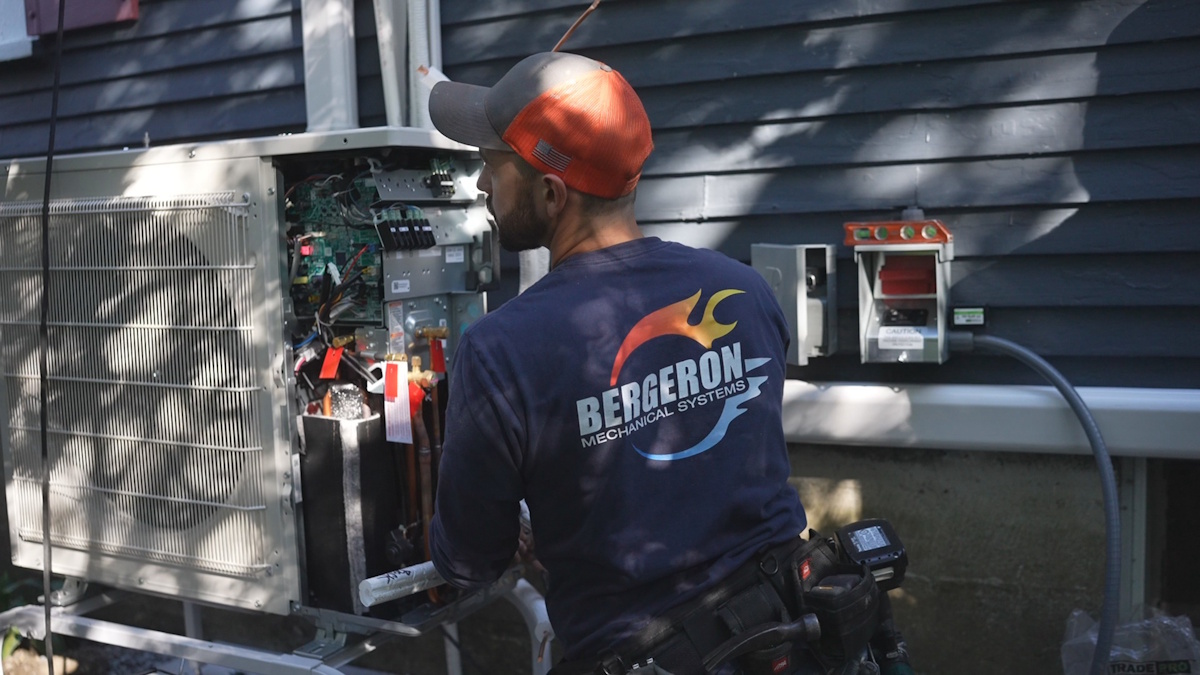
FORWARD THINKING: At K.E. Bergeron Mechanical Systems, younger technicians are encouraged to bring new forward ideas that can up the game for the entire team. (Courtesy of Bergeron Mechanical Systems)
“Part of that comes from not reading the manual,” Adams said. “But part of it just comes from kind of an old-school way of thinking: ‘I’ve always done this.’”
And it’s more than just losing out on potential sales revenue from higher-end systems. The problem, Adams explained, is that what once felt like the “safe choice” no longer is.
Adams is particularly concerned about dehumidification performance as equipment efficiency standards rise. As manufacturers chase higher SEER ratings, coil temperatures increase — and latent moisture removal often suffers.
“If you’re going to be old-school and say, ‘We’re just going to do single-stage,’ that’s getting risky,” Adams said. “The systems aren’t doing as good of a job at dehumidification … and average dew points are up quite a bit. In my mind, if I want reasonable control over comfort, the option is fully communicating or bust.”
Plus, older equipment didn’t demand quite the level of precision as today’s.
“You could do a pretty shoddy install, and it would still work,” he said. “That’s less and less the case.”
Kim Bergeron, owner of heat pump-based contractor K.E. Bergeron Mechanical Systems, sees the downstream impact on homeowners — and on contractor credibility.
“It perpetuates inefficiency,” he said.
He’s also concerned about contractors clinging to outdated refrigerants like R-410A until the last possible moment.
“Historically, when refrigerants change, costs go two or three times present-day pricing,” Bergeron said. His company stopped selling 410A equipment in August so customers wouldn’t get skunked down the line.
At the root of this entire issue, Holt argues, is not a technical gap but a mindset gap.
“‘That inverter stuff is too complicated’ really means ‘I don’t want to feel dumb while I learn something new, so I’m going to pretend they don’t matter,’” Holt said. “When you get technicians who see learning as a burden, these changes that we’re going through feel like chaos. But for those of us that see learning as an advantage, it’s really the greatest opportunity of our careers.”
5 Ways To Break The Cycle
Resistance to change may feel entrenched, but contractors who’ve tackled it say the solution isn’t complicated. It starts with changing what gets rewarded — and what doesn’t.
1. Remove or isolate the bad actors before they poison the well.
Every business has at least one employee who shuts down the moment something new appears. The danger here isn’t just their own stagnation — it’s how quickly that mindset can infiltrate the company and the next generation.
Holt saw this firsthand in his family’s company.
“We had one guy that just resisted stuff,” he said. The solution? Assigning him commercial maintenance jobs, where he was off by himself and not interacting with the company’s eight other service techs on the regular.
“We kept him on, but we kept him kind of in a cage … because this kind of thinking can spread real fast,” Holt explained. Apprentices stop asking questions, salespeople stop pushing upgrades, owners stop investing in training — all because one “old-school” employee thinks their job is to hold the line against change.
Bergeron put it succinctly: “We learned long ago, never be held hostage by a technician.”
2. Train your techs — then make them the trainers.
Most contractors agree that training is important. Fewer have a plan for what happens after class ends.
Holt believes accountability is what turns training from a cost into a force multiplier. In his former company, training wasn’t optional — and it wasn’t passive.
“Continuous education beats one and done,” he said. “Every Tuesday morning was training, rain or shine. It might be just an hour, but we’re in there learning something. It has to be a habit.”
And when technicians went off-site for training, they didn’t just return with a certificate.
“We had a training agreement that they signed,” Holt said. It went something like: “We’re getting ready to invest this much money in your education, so we need you to come back and teach at least one key lesson that you learned in that class at our next Tuesday morning meeting.”
That approach does three things at once: reinforces the learning, raises the bar for the rest of the team, and signals that training isn’t a perk. It’s part of the job.
3. Tie learning to recognition — and raises.
If there is one universal truth in HVAC, it’s that technicians love to prove themselves. Holt said shops can use that competitive instinct to drive learning.
“Technicians love stripes on their shirts,” he said.
Recognition works because it reframes training from a threat to a tech’s ego into a way to build status. In a trade where identity is tied to skill and pride in workmanship, visible proof of progress matters — especially when it’s tied to pay.
Dan Clapper, market director for HVAC and facilities at Interplay Learning, said he’s seen contractors build clear skill levels into technician titles — for example, Level One Technician, Level Two Technician, and Senior Technician — with specific training requirements attached to each step. As technicians complete training and gain new competencies, their titles — and compensation — increase.
That structure doesn’t just help with retention. It changes the conversation. When learning is tied to advancement, resistance becomes a choice. The technician who once dismissed ductless or inverter systems may suddenly see training not as an inconvenience, but as the path to the next raise.
4. Take the younger techs’ ideas seriously.
Companies that embrace change tend to be the ones where new voices are welcomed, not dismissed.
“It comes down to an openness,” Bergeron said.
When younger or less experienced techs are free to share what they’re learning, the entire staff benefits. It also reinforces a culture where innovation is expected, not resented. And incorporating those changes as a team demonstrates that resistance to change is not an age problem — it’s a mindset problem.
Bergeron shared an example of hiring an 18-year-old who quickly became one of their most forward-thinking techs.
“He’s bringing ideas to me — ‘Hey, have you heard about this?’ I’m like, ‘Tell me about it,’ because I’m not installing every day,” he said. “Our team has upped our game so much. … Small things like torque wrenches for putting flares together. I’m an old tech. I used to do it by feel, and now that we’ve implemented flare torque wrenches as of four years ago, our leak rate is even dropping.”
5. Let Techs Test New Technology in Their Own Homes
Nothing converts a skeptical technician faster than living with modern equipment.
“For the old guys, the best thing we can do is get one of these systems in their house,” said Adams, who has long advocated for electrification.
To techs on the fence, Adams’ advice is simple:
“Don’t knock it until you try it. Get one in your house and then see what you think — and size aggressive. Don’t leave that 4-ton in. Put a 3 in, or run the numbers to see what it needs to be.”
He’s seen firsthand how personal experience can flip even the most entrenched skeptics. One contractor he knows — once “Mr. Gas Everything” — finally installed a hybrid system.
“He stacked a heat pump on top of his existing furnace and said, ‘My basement is comfortable for the first time in 15 years … the heat pump runs all night, so it never wakes me up.’ That was him trying the new thing, and he completely flipped.”
That experience carries over to the sales conversation as well.
“If you can get it into your house, you stop sounding like your brochure and start sounding like a homeowner telling a story,” Adams said. “It’s much more genuine.”
Manufacturers have leaned into that idea. Many offer personal use programs (PUPs) that allow HVAC professionals to install their own equipment at steep discounts. Carrier alone processed more than 3,200 PUP orders in 2024.
“That means thousands of dealers and technicians are actively engaging with our latest innovations on a daily basis,” said Jeffery Howard, manager of product training at Carrier. “PUP isn’t just a perk — it’s a hands-on gateway to building confidence with the technologies shaping the future of HVAC.”
That shift — from abstract concept to lived experience — is often what gets even the most resistant technician over the hump.
Whether you require installation, repair, or maintenance, our technicians will assist you with top-quality service at any time of the day or night. Take comfort in knowing your indoor air quality is the best it can be with MOE heating & cooling services Ontario's solution for heating, air conditioning, and ventilation that’s cooler than the rest.
Contact us to schedule a visit. Our qualified team of technicians, are always ready to help you and guide you for heating and cooling issues. Weather you want to replace an old furnace or install a brand new air conditioner, we are here to help you. Our main office is at Kitchener but we can service most of Ontario's cities
Source link