
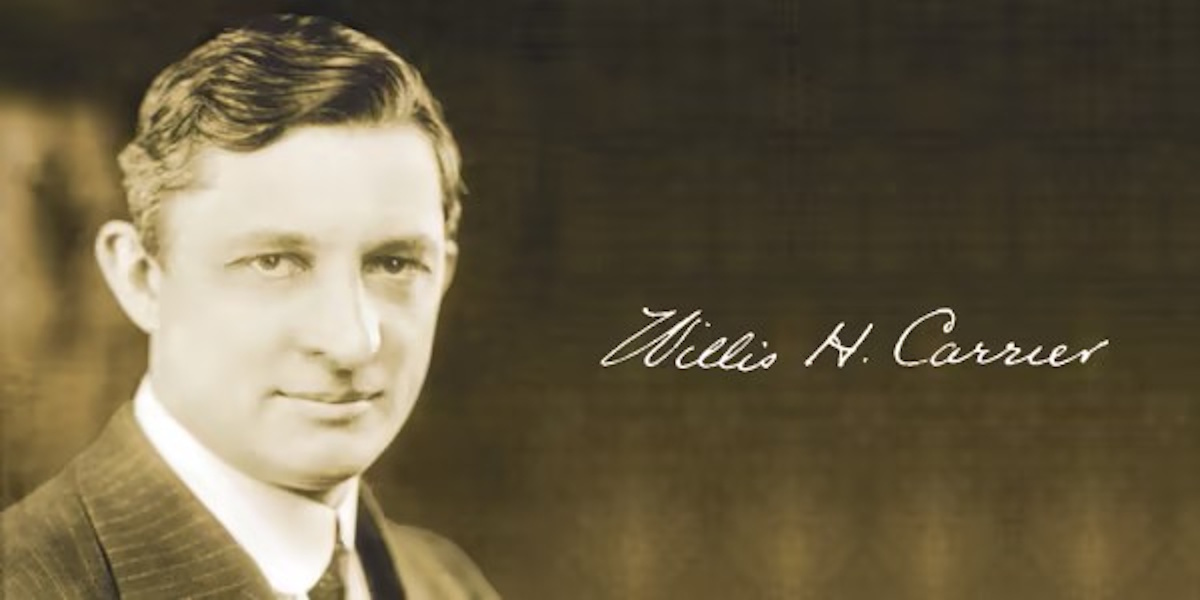
In the summer of 1902, a young engineer in Brooklyn found himself staring down a problem every HVAC contractor recognizes: materials behaving badly because of moisture. At Sackett & Wilhelms Lithography and Printing Company, paper kept swelling and shrinking as humidity shifted. Ink, applied one color at a time, refused to register consistently. Finished work became scrap. Deadlines slipped, and costs climbed.
The engineer was Willis Carrier, and what he was really being asked to fix wasn’t temperature — it was humidity control.
If that sounds familiar, it should. HVAC professionals today still chase the same gremlins, just with different tools: callbacks from underestimated latent loads, wrinkled finishes, corrosion, mold, or systems that “cool fine” but never quite solve the comfort complaint.
Ingenuity Before Electricity
Carrier wasn’t the first person to imagine cooling air. Long before compressors, coils, and control boards, people were already fighting the heat with whatever tools they had.
In the 1840s, Florida physician John Gorrie became convinced that artificial cooling could help people recover from diseases like malaria. His solution? Ice — shipped from northern lakes, then circulated through hospital rooms to relieve patients of “the evils of high temperatures.”
FOUNDER Willis Carrier, the “father of air conditioning.” He was just 25 when he sketched out the first a/c system for Sackett & Wilhelms, working as an engineer for the Buffalo Forge Company. (Courtesy of Carrier)
When that proved expensive and impractical, Gorrie went a step further, designing a machine that could make ice onsite using a compressor.
Looking for quick answers on air conditioning, heating and refrigeration topics?
Try Ask ACHR NEWS, our new smart AI search tool.
Ask ACHR NEWS
The power source? Take your pick: horse, water, wind-driven sails, or steam.
Gorrie even earned a patent in 1851, proving artificial cooling was possible. What he didn’t have was the infrastructure, financing, or market to sustain it. His idea didn’t fail because it was wrong — it arrived too early. Still, the foundation was laid.
1902: When A/C Becomes A/C
Carrier’s breakthrough at the Sackett-Wilhelms printing plant came from recognizing something fundamental — that cooler air wasn’t just about heat.
Like any good engineer, Carrier started with data-gathering and testing. He started off with a test recommended by a colleague, which involved a roller towel with loosely woven burlap saturated with a solution of calcium chloride brine. It worked at removing humidity, but it added heat, salt, and odor to the air, and that wasn’t conducive to the printing process.
So he tried an experiment of his own: as the official Carrier Weathermakers account describes it, “replacing steam with cold water flowing through heating coils, balancing the temperature of the coil surface with the rate of air flow to pull the air temperature down to the desired dew point temperature.”
This was the world’s first set of cooling coils.
And it worked. Cooling coils, combined with controlled airflow and an ammonia compressor, stabilized the air, keeping the print shop at 55% humidity year-round. Paper stopped warping, and the ink stayed true.
Carrier’s engineering drawings were dated July 17, 1902.
Late that fall, standing on a cold and foggy train platform in Pittsburgh, he had another flash of genius. Staring through the dense mist, he thought: “If I can saturate air and control its temperature at saturation, I can get air with any amount of moisture I want in it. I can do it, too, by drawing the air through a fine spray of water to create actual fog.”
In other words, instead of fighting moisture indirectly, Carrier realized it could be controlled by water — condense excess humidity out of the air in a predictable way, then reheat or temper as needed.
Sound familiar?
That principle is still baked into every cooling system installed today. Evaporator coils don’t just cool; they manage moisture by dropping air below its dew point. Latent control isn’t a “modern add-on.” It’s the original reason air conditioning exists at all.
From One-Off Fix to Repeatable System
Once the Sackett & Wilhelms system proved itself, word traveled fast. Textile mills, tobacco processors, and food manufacturers all had the same problem: inconsistent humidity was costing them money. Chocolate turned gray. Razor blades at the Gillette Safety Razor Company rusted before they were ready to sell.
Carrier’s “Apparatus for Treating Air,” patented in 1906, fixed that — from meat packing plants to a pharmaceutical company in Detroit, the Fuji Silk Spinning Company in Japan, a Pittsburgh ward for premature babies, and even film for the brand-new motion picture industry.
This is the point where HVAC stopped being clever tinkering and became a professional trade. Systems could now be designed, sold, installed, and maintained with repeatable results. Load calculations mattered. Airflow mattered. Coil surface temperature mattered. Miss any of those, and the job failed — just like now.
Moisture Control in the Modern Era
The problems that got Carrier his start are still driving callbacks today — as anyone who’s gotten a complaint like “The space is cool, but it feels clammy” can attest.
Today, more than ever, moisture control continues to be part of the HVAC conversation. This has Nate Adams, founder of “Nate the House Whisperer,” really worried.
“My biggest concern is we are not doing as good of a job with dehumidification on our systems anymore, and that is an existential risk to contractors and manufacturers,” he said in a recent interview with ACHR NEWS.
In a YouTube video called “The Coming Mold Explosion,” Adams explained the perfect storm that’s been unleashed on American homes. Across the country, summers are getting muggier, with rising dewpoints and frequent heavy downpours — the type with an inch of rain an hour. Meanwhile, engineered building materials (like plywood) introduced since the 1950s are more sensitive to moisture, there’s more tree coverage, and HVAC dehumidification isn’t what it once was.
“As we’ve moved to higher and higher SEER products, the easiest way to do that is to increase the coil temperature, which decreases dehumidification, and efficiency is primarily rated on how much cooling can it do per unit of energy,” he explained. “If you just don’t do the dehumidification, the numbers look great, but the dehumidification still needs to get done.”
In fact, he said, it needs to get done more, because of higher dew points.
“To narrow down, I’m talking primarily about single-stage equipment [creating this problem],” he clarified. “I’m not talking two-stage, and I’m definitely not talking multiple-stage or modulating equipment. … In my mind, if I want reasonable control over comfort, the option is fully communicating or bust.”
Installing a smaller multistage system is one solution: It’ll run longer, with more opportunity to dehumidify the air. A whole-home dehumidifier can also help, Adams said — although this only works if the house is not super leaky, so it might require an air sealing project first.
“You want the house as tight as possible,” he said.
But his top advice is the most basic: When it’s humid outside, keep the windows closed.
More than a century after the beginning of modern HVAC, the tools are smarter, the controls are tighter, and the equipment is more efficient — but the job hasn’t changed. Air still behaves like air. Moisture still moves the way it always has. Good HVAC work still starts with understanding both.
Whether you require installation, repair, or maintenance, our technicians will assist you with top-quality service at any time of the day or night. Take comfort in knowing your indoor air quality is the best it can be with MOE heating & cooling services Ontario's solution for heating, air conditioning, and ventilation that’s cooler than the rest.
Contact us to schedule a visit. Our qualified team of technicians, are always ready to help you and guide you for heating and cooling issues. Weather you want to replace an old furnace or install a brand new air conditioner, we are here to help you. Our main office is at Kitchener but we can service most of Ontario's cities
Source link