A few years ago, Jake Olsen, an accomplished engineer and entrepreneur, stepped in as CEO of Stratus following founder Todd Liebbe – who continues to play an active role on the board and in company leadership. SNIPS NEWS sat down with Olsen to check in on Stratus under his leadership.
You’ve led Stratus through a pivotal transition, both in leadership and market focus. With sophisticated investors now backing the company, how has your vision for Stratus – especially in HVAC sheet metal – evolved?
Our vision has matured from building individual tools to building a transformational workflow platform. Specifically, our mission is to transform the MEP industry by enabling data-driven contracting. Early on, Stratus helped contractors digitize fabrication workflows with cloud-based spooling, tracking systems, and machine integrations. Today, we’re helping the entire MEP industry operate efficiently and drive continuous improvement by digitizing their entire workflow and measuring throughput, quality, and efficiency with real data.
With Radian Capital’s backing, we’re doubling down on HVAC and sheet metal, where there’s enormous potential to apply the same continuous improvement, lean principles, and analytics that revolutionized traditional manufacturing industries. We’re not just supporting projects, we’re enabling contractors to run their fab shops like modern factories.
Many of the largest fab shops already rely on Stratus for their piping and plumbing operations. What’s been your strategy for expanding into sheet metal, and how do you approach building trust with teams used to “wet-side” workflows?
Like everything we do at Stratus, we start by learning from contractors. Sheet metal fabrication is precise, fast-moving, and deeply rooted in legacy workflows. Unlike piping, sheet metal fabrication has a history much closer to manufacturing. Our approach isn’t to replace what works – it’s to enhance it with data and integration.
We earn trust by spending time on the shop floor, understanding how BIM workflows feed shops, how coil lines are maximized, how plasma systems operate, and building tools that mirror those realities by augmenting and improving existing workflows. Once teams see that Stratus connects design, fabrication, and installation without adding friction, adoption becomes natural.
What’s one lesson you’ve learned from the Stratus founder, Todd Liebbe, that’s guided your approach to the unique challenges of sheet metal fab shops?
Todd taught me that success in fabrication software isn’t just about features; it’s about being insanely curious about the nuances that make shops successful. He built Stratus by walking shops, not whiteboarding in a conference room. That philosophy drives our product decisions today: real-world testing, direct feedback, and constant iteration based on how contractors run their businesses.
Can you share a recent example where a fab shop moved from using Stratus for plumbing and piping to rolling it out in sheet metal? What role did leadership or culture play in making that leap?
One example is a national contractor that began with Stratus for plumbing fabrication tracking. Although plumbing was a smaller part of their overall business, the success with Stratus in this workflow led them to expand Stratus to their piping shop, and then finally into their sheet metal division. Now they have consistent fabrication software across all three trades that allows them to coordinate, track, and measure their business. This has been a huge win for the multi-trade work they are doing – where Stratus has been a huge help in managing schedules across the shops. This turning point in the larger Stratus rollout wasn’t technology; it was leadership alignment. When executives view fabrication as a strategic capability, not a side operation, cultural adoption follows fast. Stratus becomes the system of record across disciplines.
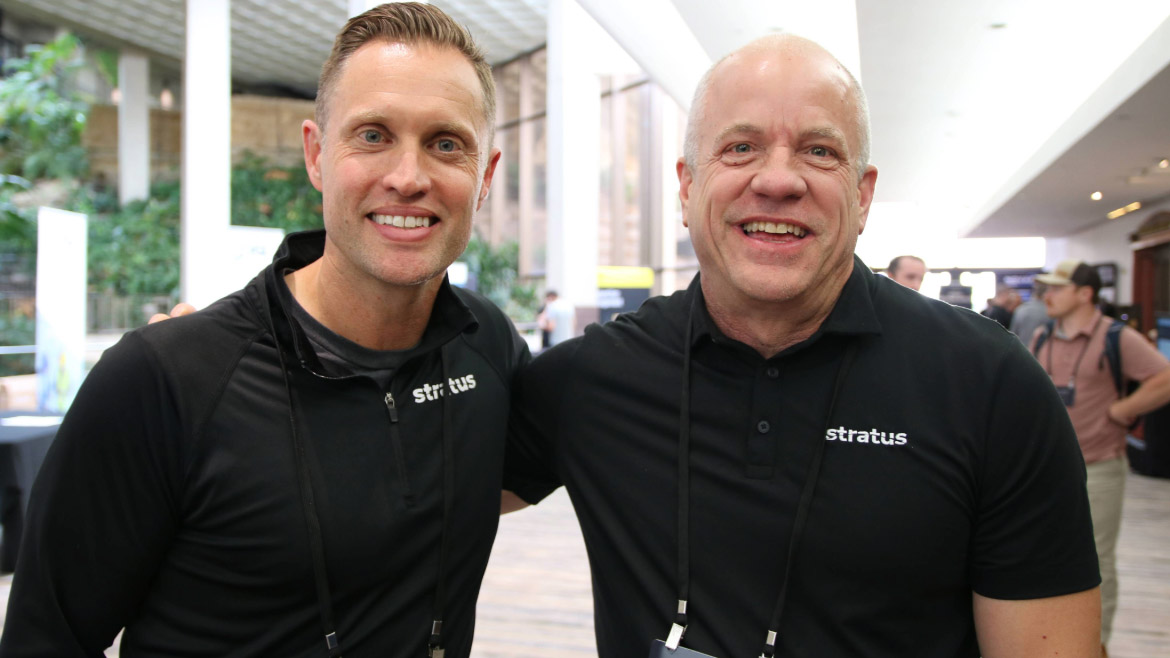
LEADERS: Todd Liebbe and Jake Olsen connect at the Stratus Annual User Conference, highlighting ongoing leadership collaboration and shared vision for the company’s future. (Staff photo)
With new investment behind you, are there specific innovations or integrations on the horizon designed just for sheet metal fabrication?
Yes – three major focus areas:
- Real-Time Productivity Tracking: We just rolled out a new time-tracking add-on for Stratus that allows workers to scan in and scan out – allocating their hours to Stratus packages. This allows shops to use Stratus for their time tracking in the shop for payroll, and also to establish real-time productivity rates.
- Field Orders: We launched a new tool called Field Orderz that allows field crews to input fab orders directly from an iPad into Stratus. This eliminates manual paper processes and results in a fabrication-ready package, complete with .MAJ files ready for the shop.
- Machine Connectivity: We have added a new team specifically focused on adding capacity to our machine integrations. For example, we just completed a new integration with the Mestek spiral duct machine to allow sheet metal contractors to digitally push fab packages and label information to the machine.
How do you approach unifying data and workflows across plumbing, piping, sheet metal, and even electrical so that shops can finally have a single source of truth?
This is a hot topic right now, with the boom in data-center construction creating a lot of demand for multi-trade offsite manufacturing. We have a lot of customers building these modules right now – and being able to track the unique aspects of fabricating each trade, and ultimately the assembly of these systems in modules, is increasingly important.
We treat data as a product. Every spool, fitting, and piece of duct should be born digital, carry its metadata through fabrication, and live on through installation and QA. Stratus’s role is to maintain that continuity – so shop managers, project engineers, and field teams are looking at one truth, not a pile of paper, reports, and spreadsheets.
For sheet metal shop managers who are hesitant or skeptical, what’s your message about what’s different with Stratus today, and what they can expect in the next year?
Stratus today is built by fabricators, for fabricators. We’ve hired trade professionals, partnered with SMACNA contractors, and designed features that reflect the realities of sheet metal production.
In the next year, you’ll see continued development on new machine integrations, customizable dashboards, and more offline-friendly tools that don’t require changing your current processes – just connecting them.
How has feedback from the sheet metal community shaped the product’s development – any features or pivots that stand out?
Absolutely. One of the more recent features was our direct CAMduct publish to Stratus. This is a unique workflow for sheet metal fab shops, and building out this publish process allows them to easily get packages from CAMduct directly into Stratus.
What do you hope the Stratus team keeps top of mind as they double down on the sheet metal segment, now with more resources and support?
That we’re guests in this trade. The best innovation happens when we listen more than we talk. Every product decision should make life easier for contractors, not harder. This is important both at the leadership level, all the way down to the person assembling duct in the shop or installing in the field. If we build with that humility, we’ll earn long-term trust.
Bringing on a major investor creates new opportunities and pressures. How do you see that changing the culture or pace of innovation at Stratus?
The investment gives us fuel, but it doesn’t change our DNA. We’ll stay disciplined, lean, and customer-obsessed. What does change is our capacity – we can now accelerate roadmap items, invest in integrations, and scale our customer success team to ensure every deployment succeeds.
What does the combination of the leadership transition and recent investment mean for Stratus’s culture, especially as you work to serve all facets of the MEP industry?
It means clarity. We’ve re-centered around one mission: transforming the MEP industry through data-driven contracting. The leadership transition was about continuity, not disruption. We’ve kept the heart of Stratus: trust, collaboration, and curiosity, but added the scale and structure to grow responsibly.
How are you balancing the need for innovation with the stability that large, established fab shops expect?
By treating stability as a feature. Contractors rely on Stratus to run mission-critical operations. So, we innovate in layers: stable core, modular extensions, and opt-in betas for cutting-edge features. That way, we can move fast without breaking the workflows our customers depend on.
Now that Stratus is positioned for broader market impact, what are you most excited to see in the next chapter for both plumbing and sheet metal fabrication?
I’m most excited to see fabrication data finally connect to business performance. When shop metrics like pounds per hour or feet per day start driving project outcomes and profitability, that’s when the industry makes its leap.
Stratus exists to enable that shift – to move from gut feel to measurable performance across every trade and ultimately drive continuous improvement. I think we all inherently know there is a lot of room for improvement in the way the MEP industry delivers work. I am hoping to help shed light on where to focus the improvement efforts.
Whether you require installation, repair, or maintenance, our technicians will assist you with top-quality service at any time of the day or night. Take comfort in knowing your indoor air quality is the best it can be with MOE heating & cooling services Ontario's solution for heating, air conditioning, and ventilation that’s cooler than the rest.
Contact us to schedule a visit. Our qualified team of technicians, are always ready to help you and guide you for heating and cooling issues. Weather you want to replace an old furnace or install a brand new air conditioner, we are here to help you. Our main office is at Kitchener but we can service most of Ontario's cities
Source link