Two Discrete Capacity Levels: Two-Stage Scrolls operate at either 100% or 65% capacity, providing load-matching capability without variable speed drives
Comfort-First Design: Longer run times at reduced capacity improve humidity removal and temperature consistency
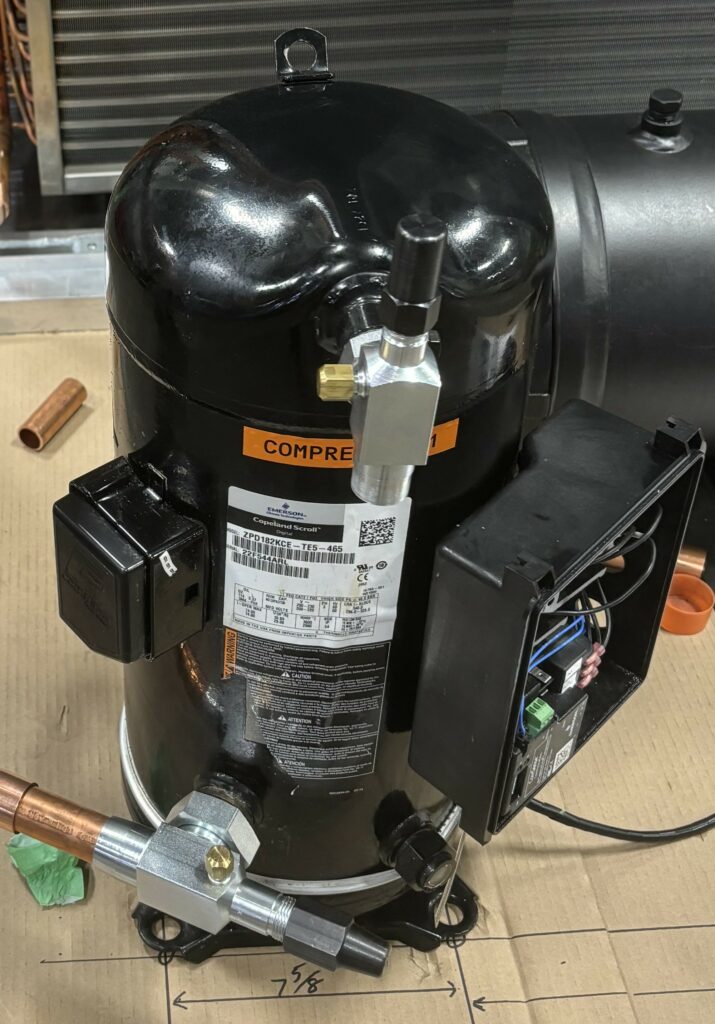
Field Identification: Look for the additional electrical box housing the Three-Way Solenoid Valve connections
Cost-Effective Modulation: Delivers capacity control at significantly lower cost than Variable Speed options
One Compressor, Two Capacities
There are Single-Speed, Variable Speed Scrolls, and, most unique in the Scroll market, Two-Stage Scroll Compressors. In my 2nd of 3 articles in the series, we will cover Two-Stage Scrolls.
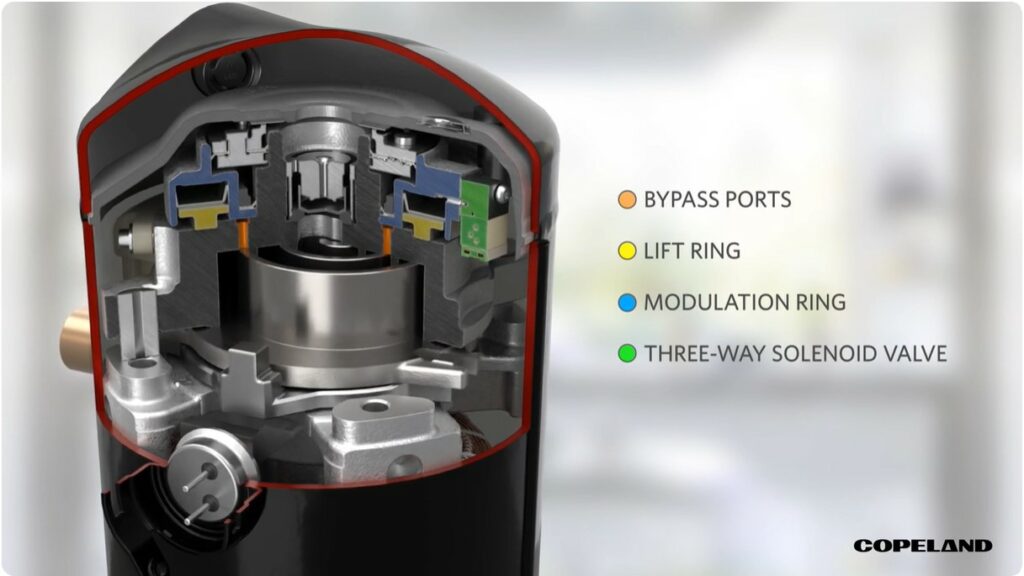
Most popular in this market is Copeland (article images courtesy of Copeland), offering the ability to run 100% capacity, or unload to 65% capacity with their “Digital” Scroll Technology. Internal Bypass Ports and related components can be seen in the cutaway image below.
In this writing, we will detail how Two-Stage Scrolls work and why they are a unique and valuable compressor in today’s market.
Loaded and Unloaded Operation
Capacity Control is an important topic related to Compressor Selection. The Two-Stage Scroll has a unique method of adjusting its Capacity utilizing its internal Three-Way Solenoid Valve: this can be seen in the article’s first image.
The first three images in this article are from this video by Copeland. It is a helpful video to begin understanding the Two-Stage Scroll internal components and operation.
The image immediately above represents the Compressor operating at 100% Capacity. This would represent the Compressor operating in response to “Full Load” conditions, and would run in this way until it has nearly met demand, often based on Suction Pressure. Once the Compressor has achieved matching capacity near demand, it will begin to unload to 65% Capacity.
To unload to 65%, this Two-Stage Scroll utilizes unloading in a method that I like to relate to Hot Gas Bypass. By activating the Three-Way Solenoid Valve at the desired Suction Pressure, the Lift Ring and Modulation Pin move to allow the Bypass Ports to open, so that some Compressed Gas is bypassed to avoid maximum compression. The compressor will run in this unloaded condition until it meets the required setpoint, at which point the compressor will turn off.
Traditional Hot Gas Bypass wastes energy by compressing refrigerant fully, then immediately decompressing it. Two-Stage Scrolls open Bypass Ports during compression itself – the motor does less work because less gas is fully compressed. This is why Two-Stage maintains high efficiency at part load. You may still encounter Hot Gas Bypass on older commercial equipment; Two-Stage is often the modern replacement solution.
When Does Unloading Occur?
What triggers the transition from 100% to 65%? Typically suction pressure control—as pressure drops toward setpoint, the controller energizes the solenoid to unload. Some applications use supply air temperature control instead. During transition, the Lift Ring repositions within seconds while the motor continues at full speed.
Podcast Episode: For more on Two-Stage vs Variable Speed operation, listen to the HVAC Know It All podcast with Joshua Souders from Copeland (January 2025).
Two-Stage vs Digital Scroll vs Variable Speed
These terms are often confused. They represent distinct technologies:
Two-Stage Scrolls operate at two discrete levels (100% and 65%) controlled by a solenoid valve. The motor runs at constant speed.
Digital Scrolls provide continuous modulation (10-100%) by rapidly cycling a solenoid to repeatedly load and unload the scroll mechanism in 20-second cycles. Effective capacity equals the loaded/unloaded time ratio.
Variable Speed Scrolls modulate capacity (15-120%) by changing motor speed via a VFD. Highest efficiency, but adds cost and complexity.
Quick Comparison
Feature
Two-Stage
Digital Scroll
Variable Speed
Capacity Range
65% – 100%
10% – 100%
15% – 120%
Modulation Type
2 discrete steps
Continuous (PWM)
Continuous (VFD)
Motor Speed
Constant
Constant
Variable
Relative Cost
Lowest
Medium
Highest
Part-Load Efficiency
Good
Better
Best
For most residential applications, Two-Stage provides the best balance of comfort, cost, and reliability.
Comfort Benefits and Humidity Control
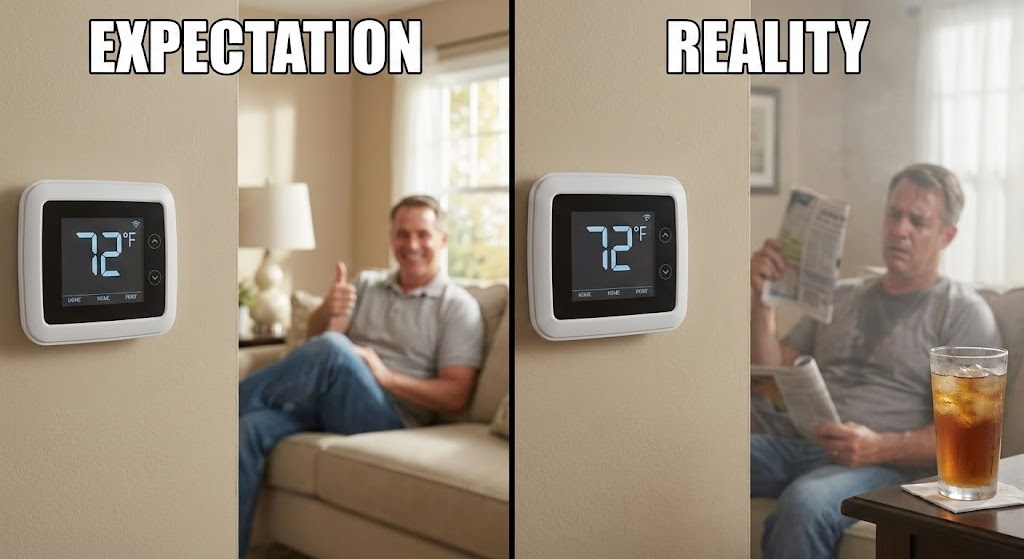
Single-speed compressors cycle frequently on mild days—sometimes every 10-15 minutes. Short run times mean reduced dehumidification (the coil never reaches peak moisture removal) and temperature swings as the system cycles.
By unloading to 65%, Two-Stage Scrolls run longer when single-speed would shut off. The evaporator stays cold longer, removing more moisture and keeping indoor dew point consistent. Fewer cycles also reduce contactor wear and inrush current events.
To verify: monitor indoor humidity over several days, observe run times on mild days, and compare amp draw between loaded and unloaded modes. Two-Stage equipment is a compelling upgrade for customers complaining about humidity despite adequate cooling.
Troubleshooting Two-Stage Scroll Compressors
Two-Stage Scrolls share most failure modes with single-speed scrolls, but the modulation system adds diagnostic considerations.
Verifying Unload Operation
The most common issue is failure to unload (stuck at 100%) or load (stuck at 65%). To verify:
Check solenoid voltage during unload call—no voltage indicates upstream control issue
Listen for the click when solenoid energizes
Monitor suction pressure—should rise slightly when unloaded
Compare amp draw between modes—should be measurably different
Solenoid Valve Failures
Stuck loaded (solenoid fails closed): compressor runs 100% only, may short-cycle on mild days. Stuck unloaded (solenoid fails open): cannot reach full capacity, struggles on high-load days. When replacing, follow proper brazing procedures to prevent contamination.
Internal components (Lift Ring, Modulation Pin) cannot be field-serviced. If the solenoid operates correctly but modulation doesn’t occur, compressor replacement is required.
From Youtube: Gary discusses installation and failure prevention guidance, listen to the HVAC Know It All podcast with Jeff Kukert on Scroll Compressor Best Install Practices (July 2024).
Using CoreSense Diagnostics
Many Copeland Two-Stage Scrolls include CoreSense protection. The Copeland Mobile app decodes flash codes and provides discharge temperature history, cycling events, and protection trips. Always check CoreSense data first—it often points directly to root cause.
Application of Two-Stage Scrolls
Two-Stage Scroll Compressors are utilized in modern Domestic, Commercial, and Industrial Refrigeration and Air Conditioning applications.
Their great benefit is operating with a Capacity Control built into the Compressor, allowing for full load or part load operation.
Although they do not offer the precise control that a Variable Speed Scroll does, they come at a significantly lower purchase cost since a Variable Speed Drive does not need to be purchased along with the compressor.
Two-Stage typically adds 15-25% to compressor cost versus single-speed, while Variable Speed adds 40-60% or more including the VFD. Two-Stage requires only an additional control wire; Variable Speed needs proper VFD mounting and often electrical upgrades. For most residential applications, Two-Stage provides meaningful improvement while keeping cost and complexity reasonable.
Copeland’s next-generation Two-Stage compressors are optimized for R-454B and R-32. When working with A2L systems, remember that charging procedures and leak detection requirements differ from R-410A.
From Instagram: Gary demonstrates Copeland 2-stage scroll compressors for residential applications, explaining 65%/100% capacity operation.
Two-Stage Scrolls can deliver 15-20 years of reliable service, but every system eventually reaches end of life. Showing up to a service call already knowing the equipment age and repair history changes your approach from reactive to proactive. Property.com’s “Know Before You Go” tool provides this intelligence automatically—helping you spot upgrade opportunities before emergency failures put customers in a bind.
Physical Appearance: Copeland Two-Stage Scroll
In the image above, you can see the traditional-looking Electrical Terminal Box for a Copeland Scroll open on the right side. Besides the three terminals for 3-phase wiring, this box also has Copeland’s CoreSense module.
On the left side of the above image, there is an additional Electrical Box for the Two-Stage Scroll. The image shows this box opened. Inside of this are the electrical connections for the Three-Way Solenoid Valve.
This dual-box configuration is your most reliable visual indicator. Single-speed scrolls have only the main terminal box; Variable Speed scrolls connect to an external VFD.
Summary
Two-Stage Scrolls occupy valuable middle ground—delivering capacity modulation without Variable Speed cost and complexity. Consider them for residential replacements where customers complain about humidity, light commercial applications with variable loads, and A2L transition installations where simpler technology reduces risk.
Whether you require installation, repair, or maintenance, our technicians will assist you with top-quality service at any time of the day or night. Take comfort in knowing your indoor air quality is the best it can be with MOE heating & cooling services Ontario's solution for heating, air conditioning, and ventilation that’s cooler than the rest.
Contact us to schedule a visit. Our qualified team of technicians, are always ready to help you and guide you for heating and cooling issues. Weather you want to replace an old furnace or install a brand new air conditioner, we are here to help you. Our main office is at Kitchener but we can service most of Ontario's cities