Key Takeaways
- Air distribution zoning eliminates bypass dampers entirely: Modulating dampers throttle airflow zone by zone while the indoor unit adjusts capacity to match demand. No recirculated air, no pressure spikes, no wasted energy.
- One ducted unit replaces multiple indoor units per floor: Fewer refrigerant circuits mean lower total charge in the building, directly helping meet tightening A2L limits under ASHRAE 15.
- Brand-agnostic compatibility through manufacturer protocols: Platforms like Airzone connect to 200+ equipment brands through dedicated communication gateways, controlling the indoor unit the same way the manufacturer’s own thermostat does.
- VRF zoning is a skill gap worth closing now: The North American VRF market is growing at roughly 11% annually, and no major HVAC educator is covering air distribution zoning specifically.¹
The global VRF market hit an estimated $25.94 billion in 2025, growing at nearly 10% per year.² In Europe and Asia, VRF represents 80 to 90% of commercial HVAC installations.³ North America is catching up, with the regional market at roughly $4.7 billion and climbing at about 11.5% annually.¹
That growth means more techs are encountering ducted VRF on service calls, and the zoning question is shifting from “do we need it?” to “how do we do it without bypass dampers?”
Christopher Rystedt, Technical Sales and Trainer at Airzone Control, joined the HVAC Know It All Podcast to break down how air distribution zoning works across any brand, and why the A2L refrigerant transition makes this technology more relevant than most techs realize.
The Bypass Problem
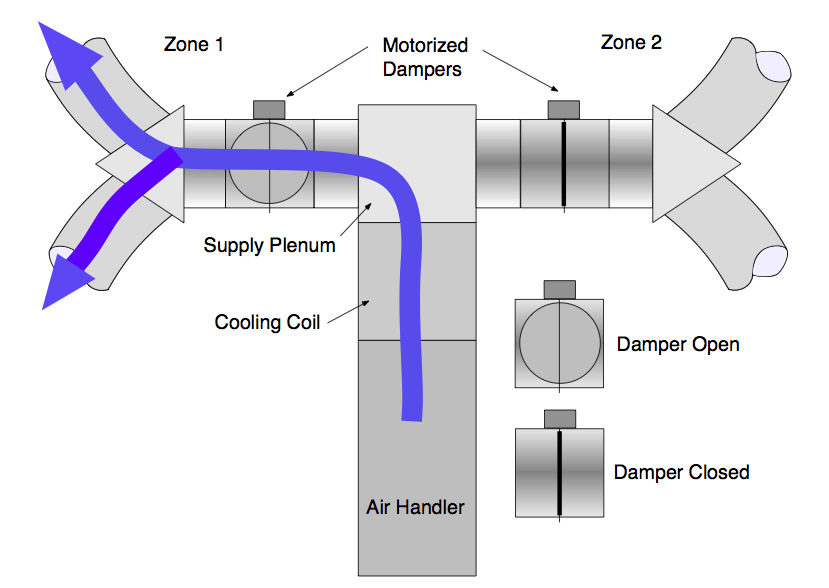
Traditional zoning is simple: when a zone satisfies, its damper closes and excess air routes through a bypass duct back to the return. The equipment keeps running at the same capacity, pushing conditioned air in a loop.
According to ACCA Manual Zr, a two-zone system with one zone satisfied hits a bypass factor of 0.50, meaning half your conditioned air is doing nothing useful.⁴ Static pressure climbs as dampers close, roughly 10% CFM loss for every 0.1 inches w.c. above 0.7 inches, with equipment damage likely above 0.8 inches.⁵
On VRF systems, this is even worse. VRF equipment modulates capacity through inverter-driven compressors. Forcing conditioned air through a bypass duct defeats the entire purpose of variable capacity. The multi-zone HVAC design fundamentals haven’t changed, but the equipment has outgrown the bypass approach.
How Air Distribution Zoning Works
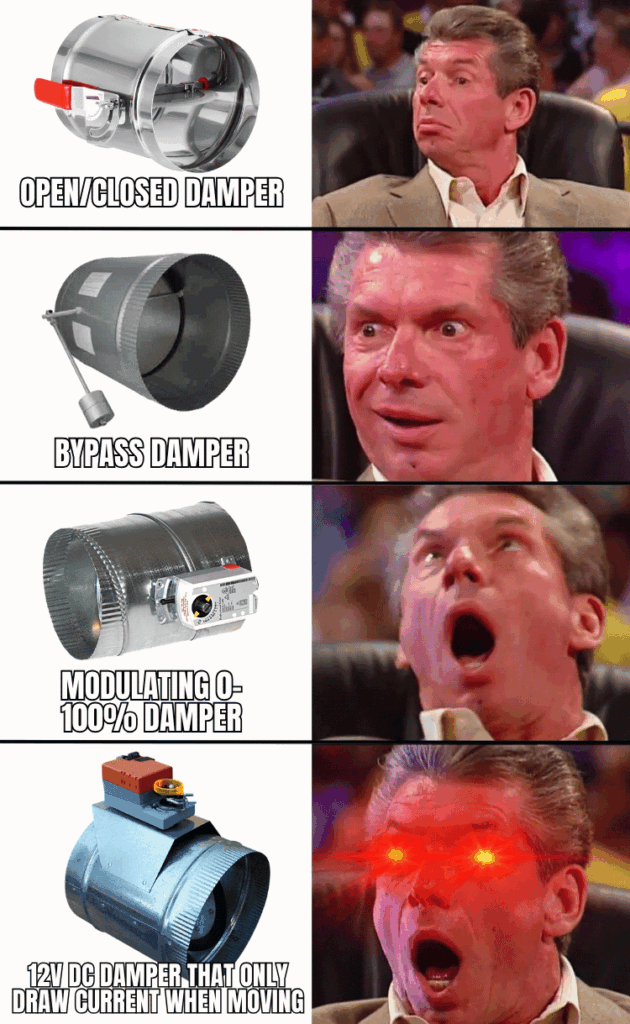
Air distribution zoning replaces the bypass with modulating dampers and a control system that communicates directly with the indoor unit. Here’s the hardware:
Modulating dampers (0 to 100% position control): 12V DC dampers that draw current only during position changes. Unlike 24V spring-return dampers that snap open or closed, these hold any position, producing gradual pressure response instead of abrupt spikes.
Communication gateway: This makes brand-agnostic compatibility possible. The gateway communicates using the manufacturer’s own proprietary protocol: Daikin’s DIII-NET, Mitsubishi’s M-NET, LG’s V-Net.⁶ Every major VRF manufacturer uses a proprietary, closed protocol.⁷ The gateway translates between the zoning system and the equipment.
Zone control board: Manages damper positions based on thermostat signals through a daisy-chain configuration.
Web server hub (optional): Enables BACnet, Modbus, and building automation integration.⁸
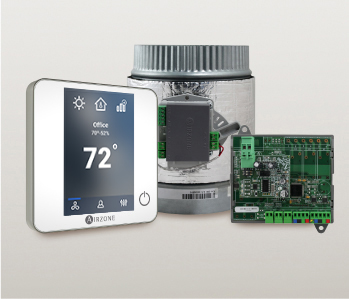
The critical point: the system doesn’t override the equipment’s controls. It communicates through the manufacturer’s own protocol. You can use Airzone thermostats, Lutron thermostats, or any 10K ohm sensor because the equipment communication is handled at the gateway level.
As zones approach setpoint, dampers modulate down while the control system tells the indoor unit to reduce fan speed and capacity. Fan power follows the cube law: a 20% speed reduction cuts power consumption by roughly 49%.⁹ That’s real energy savings, not air being recycled through a bypass duct.
An ORNL/DOE study confirmed VRF systems save 15 to 42% in HVAC site energy versus RTU-VAV systems across 16 climate zones, with savings reaching 47% at 50% load.¹⁰
Why A2L Charge Limits Make This Matter Now
ASHRAE Standard 15 sets the Effective Dispersal Volume Charge (EDVC): the maximum allowable refrigerant charge based on the served space volume and the refrigerant’s flammability characteristics.¹¹ For R-454B, the Refrigerant Concentration Limit is 3.1 lbs per 1,000 cubic feet.¹²
More indoor units means more refrigerant circuits and more total charge. Air distribution zoning changes the math: instead of five indoor units for five hotel rooms on one floor, you install one ducted unit and zone it with dampers. One circuit instead of five. Trane’s hybrid VRF documentation claims 30% lower refrigerant charge versus comparable standard VRF.¹³
With R-410A production for new systems prohibited since January 2025 and full split system replacements using R-410A equipment prohibited to manufacture as of January 2026, every new VRF installation is an A2L installation.¹⁴ Charge limits are now part of every design decision, and zoning is one of the most practical ways to stay compliant. This connects to the broader shift toward climate-focused contracting.
What This Means for Your Service Calls
You’ll see fewer indoor units but more dampers and control boards. Diagnostics shift from “which unit is down?” to “which zone isn’t responding?” Commissioning matters more: zone weights, damper calibration, and verifying communication between the gateway and the indoor unit are all part of proper startup.
The zoning controls and damper integration fundamentals still apply. Understanding inverter-driven equipment and variable speed compressors helps because air distribution zoning applies the same match-output-to-load principle on the air side.
With 420,000+ VRF units installed in the U.S. and double-digit annual growth, the techs who understand how to install, commission, and troubleshoot zoned ducted VRF systems won’t be waiting for the phone to ring.¹
Additional Sources
- “North America VRF Systems Market Size 2026 to 2033”, LinkedIn Pulse / Market Intelligence Brief, 2025.
- “Variable Refrigerant Flow (VRF) Market Size and Share Analysis”, Mordor Intelligence, Market Research Report, 2025.
- “Variable Refrigerant Flow (VRF) Market Strategies Report”, Northeast Energy Efficiency Partnerships (NEEP), Industry Report, 2019.
- “Manual Zr: Residential Zoning Systems”, Air Conditioning Contractors of America (ACCA), Technical Manual, 2023.
- “Managing Airflow in Zoned Applications”, ACCA HVAC Blog, Technical Article, 2023.
- “Building Automation Application Guide”, Daikin, Technical Documentation, 2020.
- “VRF Market Characterization for ADR Program Readiness”, California DRET/SCE, Research Report, 2020.
- “VRF and Building Integrations: Options and How to Choose Among Them”, Mitsubishi Electric, White Paper, 2023.
- “The Impact of Variable-Speed Drives on HVAC Components”, Trane, Engineers Newsletter, 2013.
- “Evaluation of Energy Savings Potential of Variable Refrigerant Flow (VRF) Systems”, Oak Ridge National Laboratory / DOE, Journal Article, 2017.
- “ASHRAE Standard 15-2024: Safety Standard for Refrigeration Systems”, ASHRAE, Safety Standard, 2024.
- “Understanding the Impact of Low-GWP Refrigerants”, York/Johnson Controls, White Paper, 2023.
- “HVRF: All-Electric, Two-Pipe Hydronic VRF”, Trane Technologies, White Paper, 2023.
- “Navigating the R-454B Refrigerant Transition”, Johnson Controls, Technical Guidance, 2025.
Whether you require installation, repair, or maintenance, our technicians will assist you with top-quality service at any time of the day or night. Take comfort in knowing your indoor air quality is the best it can be with MOE heating & cooling services Ontario's solution for heating, air conditioning, and ventilation that’s cooler than the rest.
Contact us to schedule a visit. Our qualified team of technicians, are always ready to help you and guide you for heating and cooling issues. Weather you want to replace an old furnace or install a brand new air conditioner, we are here to help you. Our main office is at Kitchener but we can service most of Ontario's cities
Source link