
Key Takeaways
- MCA and MOP Serve Different Purposes: Minimum Circuit Ampacity (MCA) determines minimum wire size while Maximum Overcurrent Protection (MOP) sets the maximum breaker size. For UL-listed equipment, these nameplate values supersede manual calculations.
- Inverter Equipment Changes the Rules: Variable-speed compressors eliminate traditional inrush currents through soft-start technology, making Locked Rotor Amps (LRA) irrelevant for breaker sizing calculations. LRA may still appear on nameplates for troubleshooting reference.
- NEC Article 440 Creates Specific Exceptions: HVAC equipment with hermetic motor-compressors follows different rules than general appliance circuits, allowing configurations that look wrong under standard wiring rules.
- Documentation Wins Inspections: Having nameplate photos, manufacturer installation manuals, and equipment spec sheets ready prevents conflicts before they escalate.
The 2025-2026 A2L refrigerant transition exposes a fundamental disconnect in the HVAC industry. Techs are caught between manufacturer specifications, updated equipment standards, and inspectors using calculation methods that do not apply to modern inverter-driven systems.
One contractor recently described failing inspection twice for opposite reasons: one inspector rejected the installation for an oversized breaker, while another rejected the same configuration for an undersized breaker.¹ Same equipment, same county, completely contradictory interpretations.
Why Traditional Sizing Rules Do Not Apply
Traditional HVAC electrical calculations were built around fixed-speed PSC compressors that draw 5 to 8 times their running current during startup.² This Locked Rotor Amperage (LRA) behavior drove sizing logic for decades, with breakers sized to tolerate that spike without tripping.
Modern variable-speed compressors change everything. Instead of connecting directly across the line, inverter-driven equipment uses a soft-start sequence, ramping from near-zero frequency up to operating speed over several seconds. A 3-ton inverter unit might never exceed 15 amps during startup, while its fixed-speed equivalent would spike to 80 amps or more.² VFDs can reduce starting current by up to 80%.³
This is why many inverter nameplates now display “Inverter Input” instead of LRA. The old metric is meaningless for equipment that never experiences a locked-rotor condition.¹
Note: If an inverter board fails and the system attempts a direct-line start, the traditional LRA condition could reappear. This is why some nameplates still include LRA for troubleshooting purposes.
Equipment designed to UL 60335-2-40 Edition 3 standards uses more conservative MCA calculations accounting for extreme conditions.⁴ These numbers are higher than actual operational draw because built-in protections prevent the system from reaching worst-case scenarios. Inspectors trained on legacy methods see these values, do their own math, and assume something is wrong when the numbers do not match.
The problem is not your wiring. It is a training gap.
Understanding MCA, MOP, and What the Nameplate Says
Every piece of multimotor equipment must display specific values per NEC 440.4(B):⁵
Minimum Circuit Ampacity (MCA) represents minimum wire size required. This value already includes the 125% safety factor. If the nameplate reads “MCA: 24.0A,” select conductors rated for at least 24 amps. Do not multiply it by anything.
Maximum Overcurrent Protection (MOP) is exactly what it says: maximum breaker or fuse size allowed. The manufacturer calculates this using NEC 440.22, permitting up to 225% of rated-load current for motor starting.⁶
You can use a smaller breaker than MOP (as long as it handles startup and exceeds MCA). Only a larger one is prohibited.
The code-compliant range sits between these two numbers. Any breaker from MCA up to MOP works, provided conductor ampacity meets MCA and breaker lugs accept the wire gauge.¹
NEC Article 440 (specifically 440.22(a) for overcurrent protection) and specifically amends general motor rules in Article 430.⁵ When inspectors apply Article 422 (appliances) or general wiring rules from Article 240 to split HVAC systems, they are using the wrong code sections.⁷
The “Small Wire, Big Breaker” Conflict
Picture a condenser with MCA of 22 amps and MOP of 40 amps. The installer runs 12 AWG wire (rated 25 amps at 75°C) protected by a 40 amp breaker. An inspector cites NEC 240.4(D), which limits 12 AWG copper to 20 amp maximum protection under general wiring rules.
The defense: NEC 240.4(G) exempts air-conditioning equipment conductors, directing to Article 440.⁸ Under Article 440, the wire is protected from overload by internal thermal protection while the 40 amp breaker handles short-circuit protection only. A short circuit draws thousands of amps and trips instantly. The wire never overheats.

What A2L Changes Electrically
Here is something that surprises techs: A2L refrigerants like R-454B and R-32 impose minimal direct electrical requirements. The flammability classification affects refrigerant handling and leak detection, but NEC Article 440 provisions remain unchanged.
Integrated refrigerant detection sensors draw almost nothing, with current requirements measured in milliamps.⁹ A complete leak detection system adds less than 25 VA, negligible compared to compressor loads. The real electrical changes come from UL certification requirements, not the refrigerant itself.⁴
Real-World Scenarios and Solutions
“Your Wire Is Too Small”: MCA is the MINIMUM, not a starting point for additional calculations. Point to NEC 440.4(B) and 440.6, which allow nameplate values for conductor sizing. Have a clear nameplate photo and installation manual ready.
“That Breaker Is Too Small”: MOP is the MAXIMUM allowed. Many manufacturers now include “recommended breaker” values specifically to help contractors avoid oversized protection on inverter equipment. Have the spec sheet showing both MOP and recommended size.
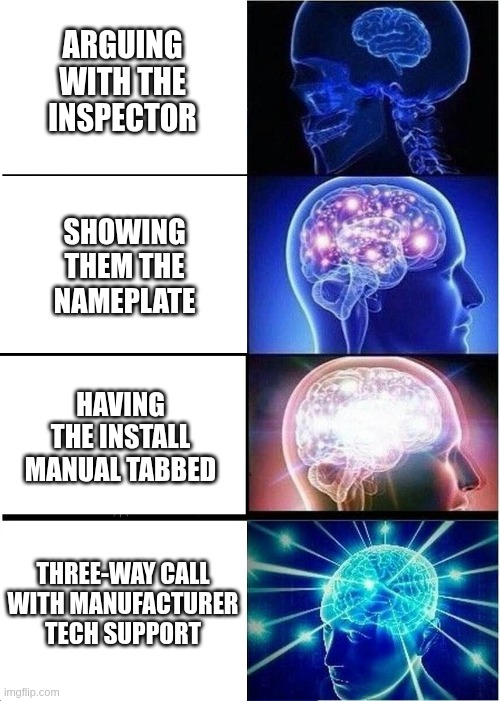
“Show Me the Load Calculation”: Nameplate specifications for UL-listed equipment supersede independent calculations. NEC 440.4(B) puts calculation responsibility on the manufacturer. If this does not resolve it, offer a three-way call with manufacturer technical support.
Documentation That Wins Inspections
Before the inspector arrives, gather a clear nameplate photograph showing MCA and MOP, the manufacturer installation manual with electrical sections flagged, and equipment spec sheets with complete electrical data. Understanding how to read HVAC wiring diagrams helps communicate requirements clearly.
Before you head to that inspection, Property.com’s “Know Before You Go” tool shows permit history and equipment records for the address. Knowing what was previously installed helps you anticipate inspector questions about system changes and avoid surprises from undocumented previous work.
Keep manufacturer technical bulletins, an NEC Article 440 reference summary, and manufacturer tech support contact info accessible via phone. Present information as collaborative problem-solving: “The nameplate specifies these values. Can you help me understand which code section requires different sizing?” This acknowledges authority while seeking clarification rather than challenging expertise.
If documentation fails, request the specific code citation, offer a manufacturer support call, or escalate to the chief electrical inspector. The goal is passing inspection, not winning arguments.
Looking Ahead
The transition will be bumpy. Equipment standards changed with UL 60335-2-40 Edition 3 took effect January 1, 2024, but inspector training has not caught up.⁴ That gap will close, but right now techs bear the burden of educating inspectors about provisions specifically written for HVAC equipment.
The fundamentals remain unchanged: wire to MCA, breaker to MOP, nameplate supersedes calculations. Techs who understand both the technical reality of modern equipment and the code provisions that address it will navigate this transition with fewer callbacks and failed inspections.
Additional Sources
- “Sizing Breakers and Conductors (for HVAC) – Have Things Changed?”, Bryan Orr, HVAC School Podcast, 2026
- “Variable Frequency Drive Compressor Technology”, Ahmed Aboqarn, LinkedIn Technical Articles, 2024
- “VFD Electric Motor Control: A Comprehensive Technical Guide”, Precision Electric, 2025
- “UL 60335-2-40 HVACR Equipment Transition”, Intertek Technical Blog, 2019
- “MCA and MOP HVAC Ratings Explained”, ExpertCE, 2024
- “MCA and MOP: What Are They and How Are They Calculated?”, York Central Tech Talk, 2013
- “Overcurrent Protection for Air-Conditioning and Refrigeration Equipment”, IAEI Magazine, 2000
- “Understanding Overcurrent Protection”, CSE Magazine, 2023
- “A2L Mitigation Controller Technical Data”, AAON Controls Literature, 2024
Whether you require installation, repair, or maintenance, our technicians will assist you with top-quality service at any time of the day or night. Take comfort in knowing your indoor air quality is the best it can be with MOE heating & cooling services Ontario's solution for heating, air conditioning, and ventilation that’s cooler than the rest.
Contact us to schedule a visit. Our qualified team of technicians, are always ready to help you and guide you for heating and cooling issues. Weather you want to replace an old furnace or install a brand new air conditioner, we are here to help you. Our main office is at Kitchener but we can service most of Ontario's cities
Source link