
Key Takeaways
- Free channels come before paid ads: Google Business Profile, Facebook page, Angie, Nextdoor, and Yelp cost nothing to set up and control what customers see when they search your name. Do all five before spending a dollar on advertising.
- Facebook ads work at $100, not $1,000: A single targeted ad with a specific service offer (ductless install, furnace inspection) pointed at your zip code generates qualified calls within days. Gary McCreadie has tested this repeatedly with consistent results.
- Your first happy customer is your best ad campaign: One satisfied homeowner posting in a local Facebook group carries more weight than a wrapped van. Ask for the review before you leave the driveway.
- 87% of homeowners reject companies rated below four stars: Your Google Business Profile, not your truck wrap, is the first impression most customers will have of your company. Get 10 five-star reviews before you spend money on anything else.
The question Gary hears more than any other from techs going out on their own: “How do I get my first customer?” It is the right question. But the answer is not a $5,000 marketing budget. The answer is a free Google Business Profile and a $100 Facebook ad.
Austin Wendel, Furman Haynes, and Gary recently broke down the full zero-budget marketing stack on the HVAC Know It All podcast. What follows is the specific sequence they recommended, starting with the channels that cost nothing and working up to the ones that cost a little.
Claim Every Free Listing Before You Spend a Dollar
Austin’s advice is blunt: before you spend any money on marketing, hit every free channel first. Google your own business name. What comes up? If the answer is nothing, that is problem one.
Here is the priority list, in order:
Google Business Profile is the most important free listing you will ever create. When someone in your area searches “HVAC repair near me,” Google shows the local map pack first, above every website and paid ad. Your GBP listing determines whether you appear in that pack. Fill out every field: services offered, hours, service area, photos of your truck and work, and a detailed business description. This is also where your reviews live, and review response speed directly affects your local ranking.
Facebook Business Page is next. Even if you hate social media, a professional Facebook page is not optional. It is a free listing that appears in search results, gives customers a way to message you, and serves as the launching pad for your first paid ad later.
Angie, Nextdoor, Yelp, and BBB each take 15 to 30 minutes to set up. The profiles themselves are free. You are not paying for leads or premium placement. You are making sure that when a potential customer Googles your company name, professional listings fill the first page of results instead of nothing.¹
Austin’s logic is simple: control what your customers see online, and almost all of it is free. If somebody sees your ad but then searches your name and finds zero listings, zero reviews, and no social presence, they move to the next contractor.
The $100 Facebook Ad That Actually Works
Gary has tested this personally and shared the exact approach on the podcast. Here is how it works:
Pick one specific service. Not “we do HVAC.” A furnace inspection for $89. A ductless installation consultation. A spring AC tune-up. The more specific the offer, the better the response.
Write the ad yourself. Two to three sentences, a price or offer, and your phone number. The copy does not need to be polished. It needs to be specific and local.
Target your geographic area. Facebook’s ad manager lets you draw a radius around your service area. For $100, a locally targeted ad with a specific offer will reach thousands of homeowners in your zip code. Gary has done this multiple times and reports that the phone starts ringing within days.
The key is that $100 goes far on Facebook when you target a small geographic area with a specific offer. This is not a brand awareness campaign. This is a direct-response ad designed to make the phone ring this week.
For contractors wondering how this fits into the broader visibility picture, answer engine optimization is becoming increasingly important as 22% of homeowners now use AI tools like ChatGPT to find local contractors.²
Google Reviews Are Your Actual Marketing Budget
Here is the stat that should change how you prioritize your first month in business: 83% of homeowners start their search for a contractor online, and 87% refuse to hire a company rated below four stars.²³
That means your Google Business Profile rating is doing more selling than your truck, your website, and your yard signs combined. Ten five-star reviews on Google outweigh a $10,000 truck wrap every time.
The process is not complicated:
Complete the job. Confirm the customer is happy. Ask them directly: “Would you mind leaving us a Google review? It really helps a small business like ours.” Most people will say yes if you ask in person, on the driveway, before you drive away.
How you respond to those reviews matters too. A public, thoughtful reply to every review, positive or negative, signals professionalism to every future customer who reads it.
If you are not sure whether starting your own business is the right move, that article walks through the full decision framework. But if you have already decided to go, reviews are the single highest-ROI activity you can do in month one.
Grassroots Tactics That Cost Almost Nothing
Before social media existed, contractors built businesses on grassroots marketing. Those tactics still work, and several of them cost less than a tank of gas.
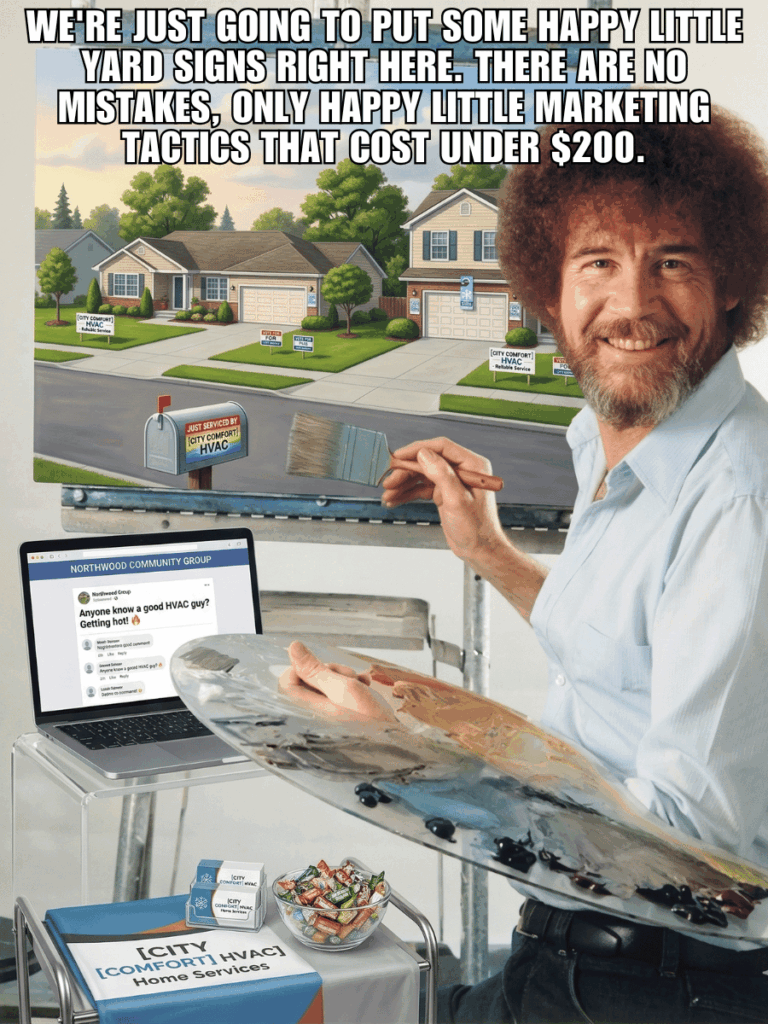
Yard signs placed at every job site are a passive referral machine. The neighbor sees your sign while you are inside working. If they have been putting off an HVAC issue, your sign just made their decision easier. A batch of 25 corrugated yard signs costs $75 to $150 from a local print shop.
Door hangers in the immediate radius around every completed job hit the exact audience you want: homeowners who live near a customer you just made happy. Leave them on the 20 nearest doors after every job.
Local Facebook groups are where Furman says the most effective early marketing happens. If you complete a job and your customer posts in the local neighborhood Facebook group saying “just had Austin’s HVAC out, highly recommend,” that post will generate more trust and more calls than any ad you could buy. You cannot force this, but you can ask happy customers if they would be willing to share their experience.
Community events and sponsorships put your name in front of homeowners in a non-sales context. Sponsor a little league team. Set up a table at the local home show. Bring business cards to the chamber of commerce mixer. These are not scalable, but for your first 10 customers, personal visibility is what builds the pipeline.
The consistent thread across all of these: personal branding does not require self-promotion skills. It requires showing up, doing good work, and making sure people know you exist.
Your Van Is Not Your Marketing Plan
Gary and Austin debated this on the podcast, and the takeaway is worth repeating: your first dollar should not go to a truck wrap.
A $500 decal with your company name, phone number, and website on a clean, reliable truck is enough. It looks professional. It tells the homeowner (or the spouse at home with the kids) who is pulling into the driveway. It does the job.
A $10,000 full wrap on a $60,000 brand-new truck is a branding expense, not a marketing expense. Branding matters when you have 50 employees and a fleet. When you are a solo operation trying to land your first 10 customers, that $10,500 is better spent on six months of $100 Facebook ads, 200 yard signs, 1,000 door hangers, and a professional Google Business Profile photo shoot.
This is also related to how you set your pricing from day one. If you undercharge to fill the schedule, you will never recoup the truck wrap investment. Price correctly from the start, and let your reviews and free listings bring in customers who value quality over the cheapest bid.
The First 90-Day Marketing Sequence
If you are launching a new HVAC business this spring, here is the specific order of operations that maximizes your marketing return with minimal cash:
Week 1: Set up Google Business Profile, Facebook page, and at least three directory listings (Angie, Nextdoor, Yelp). Add your logo (even a simple, clean one beats a generic flame-and-snowflake clipart), service descriptions, and contact info. Install a $300 to $500 decal on your truck.
Week 2: Run your first $100 Facebook ad targeting your zip code with a specific service offer. Place yard signs and door hangers on every job from this point forward.
Weeks 3 to 8: Ask every satisfied customer for a Google review and a post in their local Facebook group. Respond to every review within 24 hours. Your goal is 10 five-star reviews by the end of month two.
Weeks 9 to 12: Evaluate what is generating calls. Double down on what works. If Facebook ads are producing, increase the budget to $200/month. If a particular neighborhood Facebook group is active, focus your door hangers there.
Total cost for this 90-day sequence: approximately $500 to $800, not counting the truck decal. Compare that to a $10,000 truck wrap and a $3,000 website that nobody finds because you have zero Google reviews.
What Comes After the First 10
Once you have 10 satisfied customers, 10+ Google reviews, and a phone that rings without you chasing every lead, you have proven the model. Now you can start investing in growth marketing: a professional website with SEO, a Google Ads campaign targeting high-value keywords, and maybe that truck wrap.
But those investments make sense only after you have built the foundation of reviews, free listings, and local reputation. Spending $15,000 on a website and a wrap before you have a single review is like buying a $60,000 furnace for a house with no ductwork.
The techs who succeed as business owners are the ones who treat marketing like they treat diagnostics: start with the basics, verify what is actually happening, and do not throw money at the problem until you understand it.
Additional Sources
- “Local Consumer Review Survey 2024”, BrightLocal, Industry Report, 2024.
- “Home Services Consumer Trends Report”, Angi/HomeAdvisor, Industry Report, 2025.
- “87% of Homeowners Refuse Companies Below Four Stars”, Podium, Industry Report, 2024.
- “Google Business Profile Optimization Guide for Local Service Businesses”, Moz, Research Study, 2024.
- “Facebook Advertising Benchmarks for Home Service Companies”, WordStream, Industry Report, 2025.
- “HVAC Industry Marketing Trends”, Contracting Business, Trade Publication, 2025.
Whether you require installation, repair, or maintenance, our technicians will assist you with top-quality service at any time of the day or night. Take comfort in knowing your indoor air quality is the best it can be with MOE heating & cooling services Ontario's solution for heating, air conditioning, and ventilation that’s cooler than the rest.
Contact us to schedule a visit. Our qualified team of technicians, are always ready to help you and guide you for heating and cooling issues. Weather you want to replace an old furnace or install a brand new air conditioner, we are here to help you. Our main office is at Kitchener but we can service most of Ontario's cities
Source link