
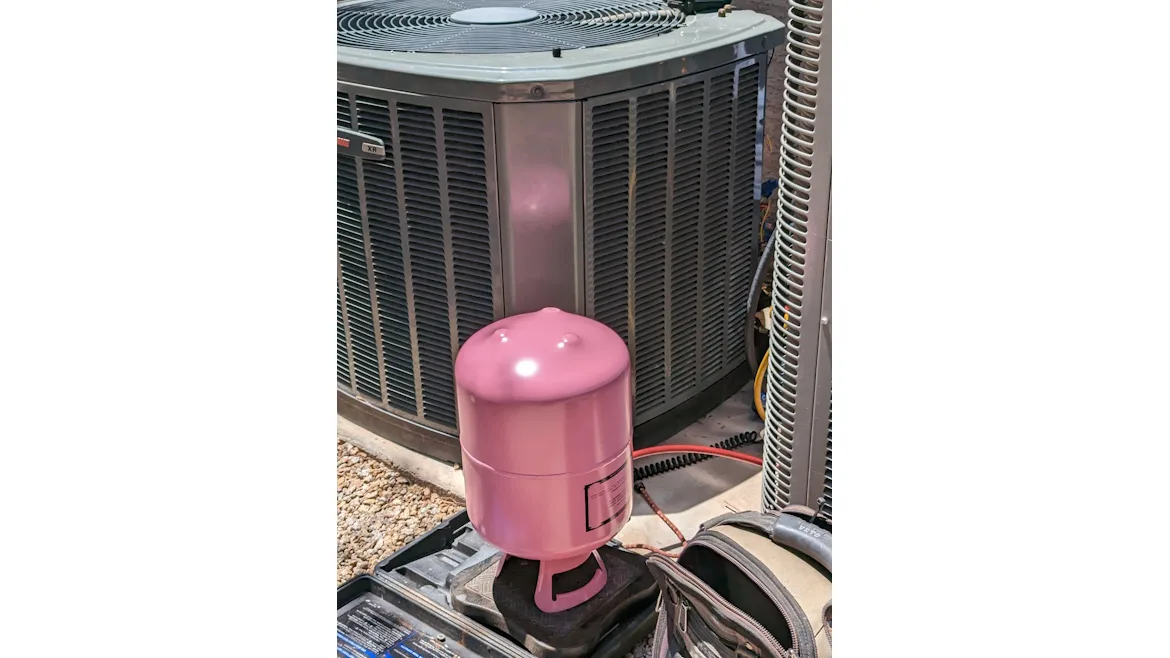
In terms of unusual refrigerant transitions that the HVAC-R industry has experienced, R-410A stands out among them.
R-410A entered the U.S. market in the mid-1990s, positioned as a non-ozone-depleting alternative to R-22.
“The best choice of refrigerants for residential air conditioning systems is R-410A,” said Bill Walter, then-manager of Industry Relations for Carrier Corp, in 2001. “That is the way the industry is going to go.”
By 2007, an Emerson survey showed that 23% to 26% of residential a/c equipment being manufactured and installed ran on R-410A.
In December 2009, the Environmental Protection Agency published two rules that would accelerate the transition away from HCFC-22 — also known as R-22 — and set the stage for R-410A to claim a larger market share.
The first rule complies with the 2010 phasedown caps set under the Montreal Protocol on Substances that Deplete the Ozone Layer.
The second rule banned the distribution and sale of pre-charged a/c and refrigeration equipment and components containing HCFC-22 or HCFC-142B in the U.S. beginning Jan. 1, 2010.
Looking for quick answers on air conditioning, heating and refrigeration topics?
Try Ask ACHR NEWS, our new smart AI search tool.
Ask ACHR NEWS
Peter Powell, then-refrigeration editor for The ACHR NEWS, reported in 2008 that the second rule didn’t appear to prohibit manufacturers from shipping R-22 units without virgin R-22, leaving it up to buyers to determine how to charge the system.
Manufacturers saw HFC refrigerants as a solution in the transition from R-22, including R-134a, R-404A, R-407C, and R-410A. R-410A emerged as the main choice for new residential a/c equipment.
Talbot Gee, then-vice president of Heating, Air Conditioning & Refrigeration Distributors International (HARDI), expressed concerns over the lack of adequate promotion of R-410A equipment as R-22 phaseouts began.
“Building and facility owners have no interest in R-410A. They still see R-22 equipment coming off the assembly line,” he said.
Educating both contractors and consumers became a priority, as a technical bulletin from ACCA noted in 2008.
“Contractors who are not installing and maintaining R-410A systems will soon find themselves unable to compete in the HVACR industry,” it warned.
Even so, contractors expressed hesitancy. In April 2009, an article noted 57% of contractors surveyed by Emerson Climate Technologies were trained on and quoting R-410A systems.
A Complicated Shift to R-410A
Several factors worked against R-410A despite its growing usage, as the EPA’s deadlines did not result in R-22 disappearing from the market.
Firstly, manufacturers were shipping R-22-compatible condensing units in mid-2010 without refrigerant for servicing systems. This gave contractors a potentially less expensive way to replace components of existing R-22 systems without converting them to R-410A. Some equipment could also legally be charged with R-22 during service. Both factors slowed the transition.
Converting to R-410A was an expensive process for contractors, as they needed to buy new equipment like manifold gauges. This preparation also included educating homeowners about the R-22 phase-down.
“While we expect it to be the industry standard for quite some time, we are always investigating other options,” said Doug Jones of Nordyne in 2009, saying R-410A was better than R-22, but not perfect.
By January 2013, one option emerged: Solstice L-41 from Honeywell, offering a 75% reduction in GWP compared to R-410A.
The transition also presented regulatory and technical challenges. Staci Gatika, then-rule co-author at EPA’s Stratospheric Protection Division, said that in the United States, R-410A was the most popular choice for home air conditioners and was sold under several trade names, but wasn’t allowed in certain retrofits.
In most cases, equipment designed for R-22 couldn’t use R-410A because of the differences in operating pressures.
“A specific HFC refrigerant must be found acceptable as a substitute for a specific end use by the [Significant New Alternatives Policy] Program,” Gatika wrote in 2010. “In addition … the venting prohibition applies to R-134a, R-410A, and all other HFC refrigerants, just as it does for HCFCs like R-22.”
The aftermarket for R-22 persisted well beyond the initial ban. In 2014, Peter Dinnage, then-commercial manager of IDS Climalife, was encouraging contractors to get their hands on R-22 while it was still available in preparation for the 2020 cutoff date.
Another Transition
In 2016, The Kigali Amendment to the Montreal Protocol was adopted. This is an international agreement designed to phase down the production and consumption of HFCs with higher GWPs, such as R-410A.
Though the U.S. didn’t ratify it when it took effect in January 2019, it took other actions that addressed HFCs.
Around 2016, the EPA finalized Significant New Alternatives Policy restrictions that would’ve prohibited certain high-GWP refrigerants, including R-134a and R-410A, so they could no longer be used in new chillers, effective Jan. 1, 2024. Subsequent court decisions complicated the agency’s authority.
In August 2017, the U.S. Court of Appeals for the D.C. Circuit limited the EPA’s authority to require replacement of some HFCs under the SNAP program. On April 5, 2019, the Washington, D.C., Circuit Court reinforced the regulatory uncertainty, though manufacturers could continue developing low-GWP refrigerants.
Even with this decision, industry interest in lower-GWP refrigerants continued. As of December 2018, more than 68 million air conditioners using A2L refrigerants were installed around the world. In August 2019, reports examined the lower-GWP refrigerants that could replace R-410A.
Contractors reported shifting to what worked best in their markets. In December 2019, Jason Ellington, then-president of Ellington Air Conditioning & Heat in Rockledge, Florida, said the majority of his customers use R-410A, but he stopped using R-22 due to environmental concerns and price volatility.
“It is our company policy with any leaking R-22 system we encounter to convert it to R-427A and then properly identify the unit so others will know it has the new refrigerant. It’s just one of the ways we act in a climate-friendly manner,” he said.
By 2020, the American Innovation and Manufacturing (AIM) Act of 2020 was enacted. This gave the EPA new authorities to address HFCs. The AIM Act directed the EPA to establish production and consumption phase-down limits that are consistent with the Kigali Amendment.
In 2020, not all HVAC manufacturers announced which lower-GWP refrigerant they intended to use. Two potentials emerged to replace R-410A: R-32 and R-454B.
“Both of these refrigerants are commercially available and classified by ASHRAE 34 as A2Ls, or lower flammability refrigerants,” wrote Philip Johnston, serving as the low-GWP program leader for Daikin Applied.
According to an article from Daikin Applied, the shift away from R-410A toward A2Ls occurred as stakeholders recognized the full environmental impact of operating air conditioners, both directly due to refrigerant released to the atmosphere and indirectly due to the carbon emissions from the generation of electrical power.
In 2023, the EPA finalized the Technology Transitions Rule, establishing a 700 GWP limit for most new residential and light commercial a/c and heat pump units. In 2025, the new equipment manufacturing and import restrictions took effect, boosting the transition to R-32 and R-454B.
In 2026, the EPA removed an installation deadline for qualifying R-410A equipment manufactured or imported before Jan. 1, 2025, giving the industry a chance to install remaining inventory.
Whether you require installation, repair, or maintenance, our technicians will assist you with top-quality service at any time of the day or night. Take comfort in knowing your indoor air quality is the best it can be with MOE heating & cooling services Ontario's solution for heating, air conditioning, and ventilation that’s cooler than the rest.
Contact us to schedule a visit. Our qualified team of technicians, are always ready to help you and guide you for heating and cooling issues. Weather you want to replace an old furnace or install a brand new air conditioner, we are here to help you. Our main office is at Kitchener but we can service most of Ontario's cities
Source link