
What to Do When You Have a Freon Leak in Your Air Conditioning Unit
A freon leak in your air conditioning unit is one of the most common and costly AC problems homeowners face, and ignoring it makes everything worse.
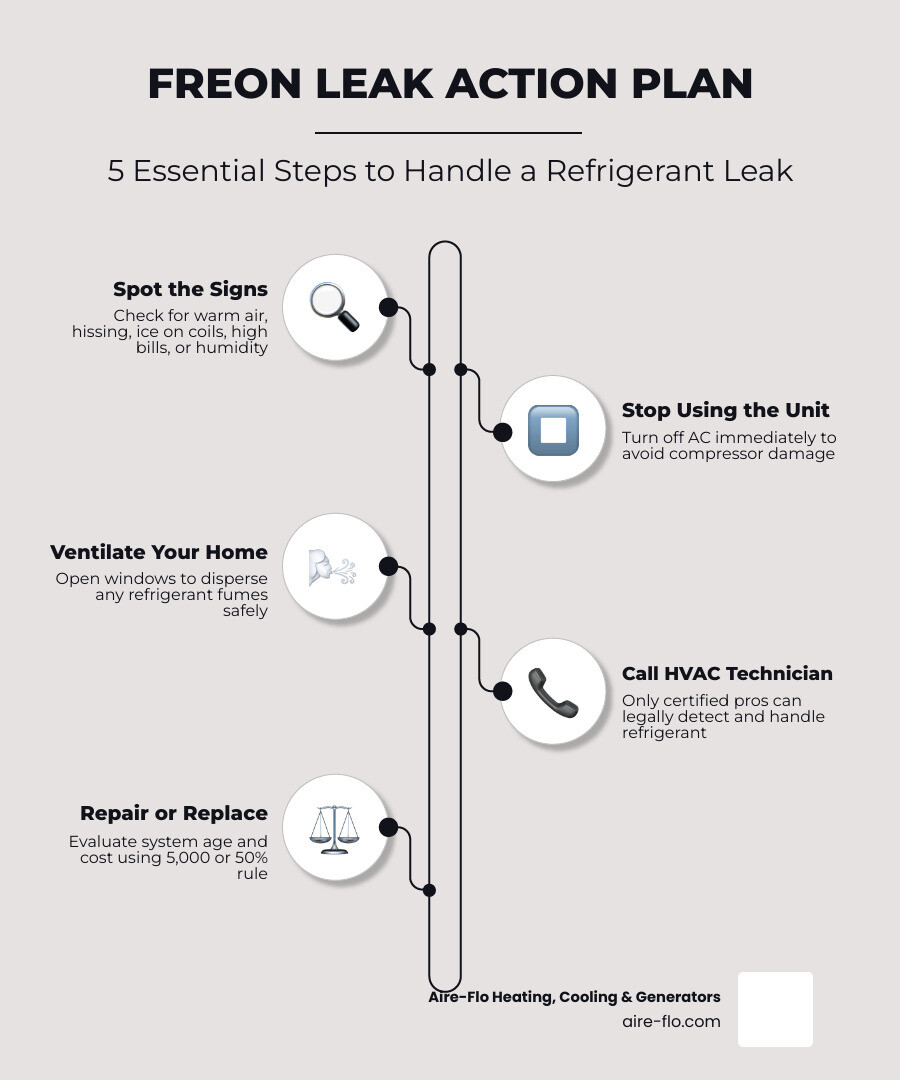
Here is a quick summary of what you need to know:
| Step | What to Do |
|---|---|
| 1. Spot the signs | Warm air from vents, hissing sounds, ice on coils, higher energy bills, or increased indoor humidity |
| 2. Stop using the unit | Turn off your AC immediately to prevent further damage |
| 3. Ventilate your home | Open windows to clear any refrigerant fumes |
| 4. Call a licensed HVAC technician | Only certified pros can legally handle and recharge refrigerant |
| 5. Repair or replace | Based on your system’s age and repair cost, decide with your technician |
Freon (also called refrigerant or coolant) does not get “used up” like gas in a car. If your levels are low, you have a leak. It will not fix itself, and simply topping off the refrigerant without finding and fixing the leak is a short-term patch that leads to bigger repair bills down the road.
Leaks can range from tiny pinhole leaks that take years to show symptoms, to large breaks that empty a system within days. Either way, the damage to your comfort, your energy bills, and potentially your health adds up fast.
If you suspect a freon leak in your air conditioning unit, this guide will help you understand what to look for and what to do next. We’ll cover the most common warning signs, why refrigerant leaks happen, and how to decide whether repairing the problem or replacing the system makes more sense for your home.
Introduction
To understand why a freon leak in air conditioning unit is such a big deal, you first have to understand what refrigerant actually does. Think of it as the lifeblood of your cooling system. It is a special chemical that changes from a liquid to a gas and back again to move heat.
Inside your home, the refrigerant absorbs heat from your indoor air. It then travels to the outdoor unit, where it releases that heat into the Ohio summer air. This cycle repeats until your home reaches the temperature set on your thermostat. When a leak occurs, the system loses its ability to transfer heat efficiently. Your AC has to work much harder to do the same job, which wears out the compressor and sends your electric bills skyrocketing.
Common Signs of a Freon Leak in Air Conditioning Unit
Detecting a leak early can save you thousands of dollars. While some leaks are loud and obvious, others are subtle. Here are the most common signs you need air conditioning repair now:
- Warm Air from Vents: If your AC is running but the air coming out of the registers feels lukewarm, the refrigerant levels are likely too low to absorb heat.
- Ice on the Coils: This is a classic symptom. When refrigerant levels drop, the pressure in the evaporator coil falls. This causes the coil to become much colder than intended, freezing the condensation on the outside of the pipes.
- Hissing or Bubbling Sounds: A large leak often sounds like a popped tire. A hissing sound usually indicates gas escaping, while a bubbling sound suggests the leak is happening in a section where the refrigerant is still in liquid form.
- High Utility Bills: If your June bill is significantly higher than last year without a rate hike, your unit might be “short-cycling” or running constantly to compensate for a leak.
- Increased Indoor Humidity: Part of an AC’s job is removing moisture from the air. A leaking unit struggles to dehumidify, leaving your home feeling sticky and gross.
- Sweet Odors: Some older refrigerants like R-22 have a faint, sweet smell that some people compare to nail polish remover.
These signs often appear gradually. If you notice any of them, the best move is to shut the system down immediately. Running a leaking unit can cause the compressor to overheat and fail, which is a much more expensive fix than a simple leak repair.
Physical Symptoms and Health Risks
While a freon leak in air conditioning unit is mostly a mechanical problem, it can become a health issue if the leak is large and located indoors. Refrigerant is a toxic chemical. Inhaling concentrated fumes can lead to “refrigerant poisoning.”
Symptoms of exposure include dizziness, nausea, headaches, and shortness of breath. In severe cases, it can cause coordination loss or even organ damage. If you suspect a leak inside your home, open the windows to provide plenty of ventilation and call a professional.
Beyond your health, these leaks hurt the environment. Older refrigerants like R-22 are ozone-depleting substances. When they leak, they contribute to the thinning of the Earth’s protective ozone layer, which is why the EPA has strictly regulated their use and phase-out.
Why AC Units Develop Refrigerant Leaks
You might wonder why a sealed system would start leaking in the first place. AC units are tough, but they face constant stress.
- Formicary Corrosion: This is one of the most common causes we see in Columbus. Formic acid, which can be created by household cleaners or even new building materials, eats tiny, microscopic holes into copper tubing. These are often called “champagne leaks” because they create tiny bubbles when tested.
- Vibration: The compressor and fans create constant vibrations. Over years of use, these vibrations can cause copper lines to rub against each other or metal brackets, eventually wearing a hole through the pipe.
- Poor Installation: If the joints weren’t soldered correctly or flare connections were overtightened during the initial setup, leaks can develop early on.
- Wear and Tear: Rubber seals and valves can dry out and crack over time. This is why common AC maintenance problems often involve small leaks at the service ports.
- Factory Defects: Occasionally, a brand-new unit comes off the assembly line with a weak weld or a thin spot in the coil.
Preventing these issues starts with proper coil maintenance. Keeping your coils clean and scheduling annual inspections allows our team to catch small signs of corrosion before they turn into a total system failure.
Repair or Replace: The 2026 Guide
Deciding whether to fix a freon leak in air conditioning unit or buy a new system is a big financial choice. It is currently April 2026, and the landscape for refrigerants has changed significantly over the last few years.
To help you decide, we often use the “5,000 and 50% rules.” If the cost of the repair multiplied by the age of the unit exceeds $5,000, or if the repair cost is more than 50% of the value of a new system, replacement is usually the smarter investment.
| Factor | Repair | Replace |
|---|---|---|
| Average Cost | $250 – $1,600 | $3,900 – $8,000+ |
| System Age | Under 10 years | Over 12-15 years |
| Refrigerant Type | R-410A or newer | R-22 (Freon) |
| Warranty | Still under parts warranty | Warranty expired |
| Efficiency | Lower (stays same) | Higher (saves on bills) |
The lifespan of an AC unit in Ohio is typically about 10 to 15 years. If your system is nearing that 15-year mark, spending $1,000 on a leak repair is often “throwing good money after bad.”
When to Repair a Freon Leak in Air Conditioning Unit
We generally recommend AC repair if the leak is minor and the system is relatively young. Some repairs are straightforward and affordable. For example, replacing a leaking Schrader valve (the port where we hook up our gauges) is a quick fix.
If the leak is at a joint, a technician can often “braze” or weld the area to seal it. As long as your unit uses a modern refrigerant like R-410A, the cost of the gas itself is manageable. According to research on leak detection, if the rest of the components like the compressor and fan motor are in good shape, a repair can buy you several more years of comfort.
When to Replace Your Freon Leak in Air Conditioning Unit
There are scenarios where we will almost always suggest a new AC installation.
- The R-22 Factor: If your system was installed before 2010, it likely uses R-22 refrigerant. R-22 is no longer manufactured or imported into the U.S. Because the supply is so limited, it can cost $100 per pound or more. A typical unit needs 2 to 5 pounds. Paying $500 just for the gas on top of labor is rarely worth it for an old machine.
- Evaporator Coil Failure: If the leak is deep inside the evaporator coil due to widespread corrosion, the entire coil must be replaced. This is an expensive part, and if the unit is old, the new coil might not even be compatible with the rest of your aging system.
- Multiple Leaks: If a technician finds three or four leak points, it is a sign that the metal is failing everywhere. Fixing one will just lead to another leak popping up a month later.
Upgrading to a modern AC system provides better humidity control and much lower energy bills, which helps offset the initial cost over time.
Frequently Asked Questions
Is it legal to just add more Freon?
In many cases, no. While federal law focuses on preventing the intentional venting of refrigerant, some state regulations and EPA guidelines for larger systems require leaks to be repaired. More importantly, it is bad practice. Adding refrigerant without fixing the leak is like trying to fill a bucket with a hole in the bottom. You are wasting money and harming the environment. Only EPA-certified technicians are legally allowed to buy and handle these chemicals.
How much does it cost to fix a leak?
The price varies based on the severity. A simple valve replacement might cost $250 to $400. However, a complex repair that involves cutting out a section of pipe, brazing a new joint, vacuuming the system to remove moisture, and recharging with several pounds of refrigerant can cost between $800 and $1,600. Regular AC maintenance is the best way to avoid these high costs by catching issues early.
Can I detect a leak myself?
You can look for visual clues, but you cannot “confirm” a leak without professional tools. You might see oily residue around a joint (refrigerant carries oil with it), or you can try the soapy water test on visible pipes to look for bubbles. However, many leaks are inside the cabinet or under insulation. Our team uses electronic leak detectors that can “sniff” refrigerant in the air, or we use UV dyes and nitrogen pressure testing to find the exact source of the trouble.
Conclusion
A freon leak in air conditioning unit is a serious problem, but it does not always mean you need a completely new system. If you catch the warning signs early, such as hissing sounds, ice on the coils, or higher energy bills, you can act before the leak causes bigger damage or puts extra strain on the compressor.
At Aire-Flo Heating, Cooling & Generators, we have spent 75 years helping our neighbors in Columbus, Dublin, Delaware, and the surrounding areas stay cool. We offer a 100% satisfaction guarantee, and our technicians are experts at diagnosing whether a repair or a replacement is the best financial move for your home.
If you suspect your AC is losing its cool, don’t wait for the hottest day of the year to find out. Explore our full range of HVAC services and contact our specialists to schedule an inspection today. We will get your system back to peak performance so you can enjoy a comfortable, worry-free summer.
Whether you require installation, repair, or maintenance, our technicians will assist you with top-quality service at any time of the day or night. Take comfort in knowing your indoor air quality is the best it can be with MOE heating & cooling services Ontario's solution for heating, air conditioning, and ventilation that’s cooler than the rest.
Contact us to schedule a visit. Our qualified team of technicians, are always ready to help you and guide you for heating and cooling issues. Weather you want to replace an old furnace or install a brand new air conditioner, we are here to help you. Our main office is at Kitchener but we can service most of Ontario's cities
Source link