Cause Two: Low Refrigerant Charge
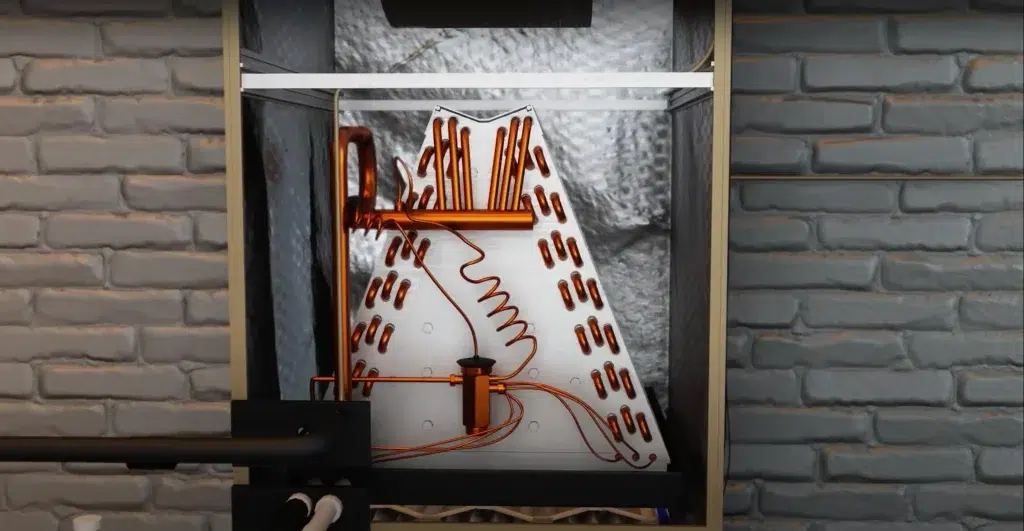
Less refrigerant means less pressure in the evaporator. Less pressure means a lower boiling temperature. Same 32 degree line, opposite approach.
Now the part that matters more than the physics. Refrigerant is not fuel. It is not consumed. It circulates in a sealed loop for the fifteen to twenty years the equipment is expected to run. If your system is low on R-410A or R-454B, that refrigerant left through a hole. Corroded evaporator tubing, a leaking Schrader core, a cracked braze joint, a line set rubbing a joist in a 140 degree attic. It went somewhere physical.
Why Just Add Refrigerant Is A Non-Answer
Topping off a low system without finding the leak books the same call again in four months, at a higher price, with more compressor hours burned. We wrote a whole piece on what being low on refrigerant actually means and why an annual top off is a subscription, not a repair.
Topping off a system that actually has an airflow problem is destructive. Suction pressure is low, which tempts a lazy tech into adding gas. Now the condenser is packed with liquid, head pressure climbs, and the coil still ices because nothing about the airflow changed. On a fixed orifice system that is how compressors die, because liquid refrigerant reaches a pump built exclusively for vapor.
There is a fingerprint and I find it constantly: low suction pressure paired with very high subcooling. That means somebody already stood where I am standing, saw a low number, and added refrigerant instead of diagnosing.
A frozen coil is a symptom. Refrigerant is a possible cause, not a treatment.
Why Running It Longer Makes Everything Worse
The instinct is reasonable. House is hot, leave it running, it will catch up. It will not. Every extra minute grows the ice and drives the loop harder.
Then the second problem arrives. Liquid refrigerant that should have boiled off inside the iced coil never does. It rides the suction line toward the compressor. Compressors compress vapor. Liquid does not compress. That is how a repair becomes a replacement. Shut it off.
What To Do In The Next Ten Minutes
- Turn cooling OFF at the thermostat. Not auto. Off.
- Set the fan to ON. Room temperature air across the coil is the fastest safe thaw.
- Put towels down and watch the drain pan. Melting ice sheds a lot of water and it does not always find the drain. It finds drywall.
- Wait one to four hours depending on how much ice you built.
- Change the filter while you wait. Correct size, arrow pointing the right way.
- Open every supply register and clear anything sitting on a return grille.
- Do not attack the ice with a heat gun, hair dryer, screwdriver or hammer. That tubing is thin. You will hole it and turn a service call into a coil replacement.
- Once the ice is gone, run cooling and watch. Frost back within an hour means stop and call.
Why A Technician Melts Every Bit Of Ice Before Reading Anything
This is what separates a diagnosis from a guess with a business card.
Ice is an insulator. A coil wrapped in ice stops transferring heat. Refrigerant leaving it is still saturated, still part liquid, so superheat reads at or near zero no matter what is actually wrong. Head pressure sags, so subcooling reads distorted too. Delta T is fiction because barely any air is getting through.
Hook gauges to a frozen system and you get a lovely set of numbers that describe the ice, not the fault. Undercharge, low airflow and a liquid line restriction all read roughly the same through a block of ice, and those three have completely different repairs. One needs a leak search. One needs duct work. One needs a filter drier and a valve.
So the sequence is not negotiable. Melt everything. Verify airflow. Confirm indoor and outdoor temperatures are both at or above 70 degrees F, because charge readings taken below that lie too. Run 10 to 15 minutes so pressures stabilize. Only then do gauges mean anything.
Any tech who hooks up to a coil that is still white and quotes you a refrigerant charge is reading tea leaves and billing you for it.
The South Bay Wrinkle
The marine layer keeps mornings cool and indoor humidity high, then a valley heat pocket in Almaden pushes the afternoon to 98 while Mountain View sits at 84. Systems that never froze in June start freezing in late August after a summer of pollen and ash loading the filter. Stack PG&E peak pricing from 4 pm to 9 pm on top and people run hardest in exactly the hours the coil is most likely to ice.
Whether you require installation, repair, or maintenance, our technicians will assist you with top-quality service at any time of the day or night. Take comfort in knowing your indoor air quality is the best it can be with MOE heating & cooling services Ontario's solution for heating, air conditioning, and ventilation that’s cooler than the rest.
Contact us to schedule a visit. Our qualified team of technicians, are always ready to help you and guide you for heating and cooling issues. Weather you want to replace an old furnace or install a brand new air conditioner, we are here to help you. Our main office is at Kitchener but we can service most of Ontario's cities
Source link