The Short Answer: Repair makes sense when your air conditioner is under 10 years old and the fix costs less than half of a new system. Replace it when the unit is past its AC lifespan, needs a compressor or evaporator coil, or has started stacking up frequent repairs.
Central Florida runs its air conditioning harder than almost anywhere else in the country. That changes the math on every repair bill you get handed, because a 12 year old system here has logged the runtime of a 16 year old system up north.
This guide covers how long an AC unit should last, the numbers that tip a decision toward replacement, and how to stretch more years out of the system you already own.
How Long Does an AC Unit Last in Florida?
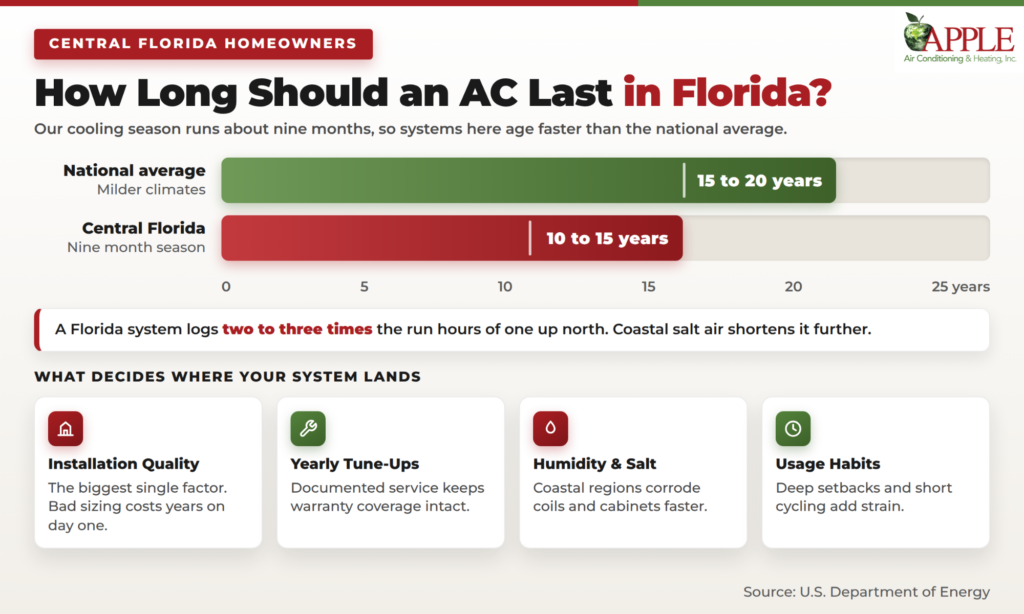
The Department of Energy uses an 18 year service life for central air conditioners, so the average lifespan nationally lands in the 15-20 years range. Florida is the exception. Most systems here run 10 to 15 years, and coastal regions closer to salt air can see even less. Heat pump systems land in the same range, since they run in both seasons.
Our cooling season stretches roughly nine months, so a Central Florida AC system racks up two to three times the run hours of one in a milder climate.
What actually determines lifespan
| Factor | Effect on AC lifespan |
| Installation quality | The biggest single factor. A poorly sized or badly charged unit loses years immediately |
| Proper maintenance | Documented annual service extends system life and keeps warranty coverage intact. |
| Local climate | High humidity and salt air in coastal regions speed up corrosion |
| Usage habits | Deep thermostat setbacks and constant cycling add unnecessary strain |
| Reputable manufacturer | Better parts availability and longer warranty coverage |
If you want a closer look at where your system sits, our AC lifespan guide for Florida homes breaks it down by age.
What Wears an AC Out Early
Most systems that die young were not defective. They were starved of airflow or run with a slow leak nobody caught.
- A dirty filter chokes airflow, which makes the compressor work longer for the same cooling
- A dirty coil on either the indoor evaporator coil or the outdoor condenser coil traps heat the system needs to move
- A refrigerant leak run for a full season burns out compressors, and low charge is the leading cause of compressor failure
- Blocked vents and closed registers cut proper airflow and raise pressure across the whole HVAC system
- Skipped routine maintenance lets minor issues like a weak capacitor turn into a full compressor replacement
None of these are dramatic on their own. Together they explain most systems that quit at year eight instead of year fourteen.
The Repair or Replace Math
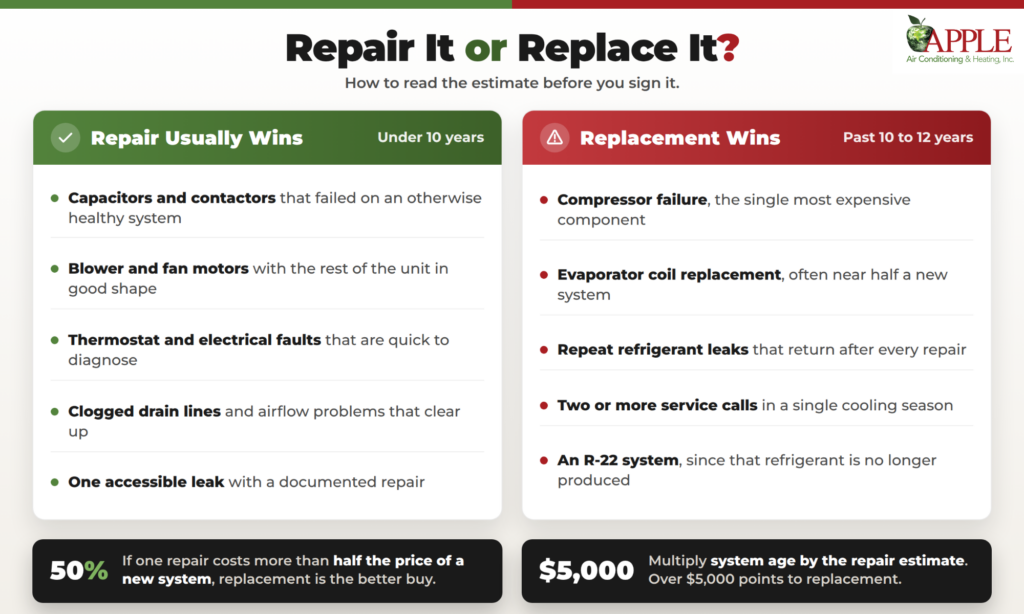
Two rules of thumb do most of the work here. Neither one is a law, but both are useful.
The 50 percent rule
If a single repair cost runs more than half the price of a new system, replacement is usually the better buy. You are pouring real money into equipment that still has the same remaining lifespan it had before.
The age times cost rule
Multiply the age of the AC unit by the repair estimate. If the result is over $5,000, lean toward replacement.
| Age of system | Repair estimate | Result | What it points to |
| 5 years | $600 | $3,000 | Repair |
| 8 years | $700 | $5,600 | Judgment call |
| 12 years | $1,400 | $16,800 | Replace |
| 15 years | $500 | $7,500 | Replace |
Neither rule accounts for how often you have already called for service. Two repairs in one cooling season is its own answer.
When Repair Is the Right Call
Repair usually wins when the system is under 10 years old, still holds refrigerant, and the failed part is inexpensive. Common repairs that make sense:
- Capacitors and contactors
- Blower motors and fan motors
- Thermostat faults and electrical system issues
- Clogged drain lines and weak airflow that returns cold air once cleared
- A single accessible leak with a documented fix
These parts fail on healthy systems. Fixing them buys real years. Our breakdown of AC repair costs in Central Florida covers typical ranges, and our residential AC repair team handles all makes and models.
When Replacement Makes More Sense
The case for replacing rather than repairing gets strong when any of these show up:
- Compressor failure on a system past 10 years. This is the single most expensive component, and an AC replacement often costs less than the repair plus the next one
- Evaporator coil replacement, which often approaches half the cost of a new system
- Repeat refrigerant leaks that keep coming back after each repair
- Frequent breakdowns, meaning two or more service calls in one cooling season
- An R-22 system, since that refrigerant is no longer produced and any recharge is expensive
There are other warning signs worth knowing before the system quits entirely. We handle AC replacement across Winter Garden and the surrounding area, along with commercial systems for local businesses.
The Refrigerant Question in 2026
This changes the math for a lot of homeowners, so it is worth understanding.
Under the AIM Act, the EPA is phasing down HFC refrigerants by 85 percent by 2036. Since January 2025, new residential systems are no longer built with R-410A. New equipment uses lower-impact refrigerants such as R-454B and R-32.
What this means for you:
- Your R-410A system is fine. It is still legal to service and recharge, and nobody is required to replace a working unit
- R-410A prices are climbing as production winds down, so large recharges on older systems get pricier each season
- You cannot convert an R-410A system to run the new refrigerant. The hardware is built differently
- R-22 systems are past due. If your unit still runs R-22, any refrigerant repair is hard to justify
Warning Signs Your System Is Near the End
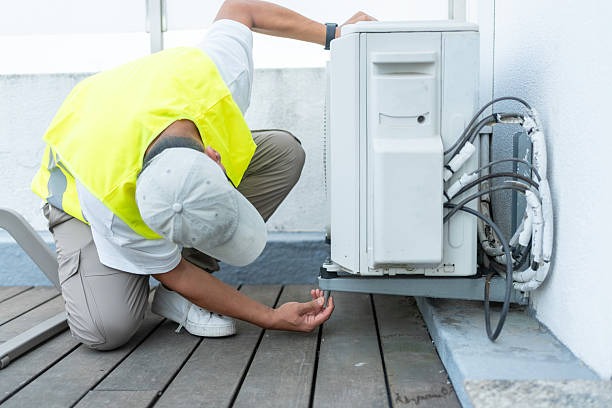
Air conditioners rarely fail without notice. Watch for these:
It runs in longer cycles
The system runs and runs without reaching the setting, and the air from the vents feels lukewarm instead of cold. That points to lost capacity, not a thermostat problem.
The house feels humid
Weak dehumidification is often the first sign of a struggling system. High humidity indoors while the temperature reads fine is a real warning sign.
The energy bill keeps climbing
A system losing efficiency pulls more power for the same cool air. Compare this July against last July.
Strange noises
Grinding, screeching, or hard clunking on startup usually means a motor or compressor bearing is going.
Getting More Years Out of the System You Have
Regular maintenance is the cheapest way to extend an AC’s lifespan. It also keeps warranty coverage intact, since most manufacturers require documented service.
- Change the air filter every 90 days, sooner with pets
- Book annual tune-ups before the cooling season starts
- Keep two feet of clearance around the outdoor unit
- Rinse the condenser coil during regular cleaning, since clean coils shed heat far better
- Use a programmable thermostat and hold steady settings rather than deep setbacks
- Check proper insulation in the attic, which lowers the load on the whole system
ENERGY STAR notes that sealing and insulating ducts can improve heating and cooling efficiency by as much as 20 percent. Our AC maintenance checklist covers what you can do yourself, a service agreement keeps the professional visits scheduled, and our AC service team handles the rest. There are more efficiency habits worth adopting during the hottest months.
What a Good Replacement Looks Like
If replacement is the answer, installation quality matters more than the badge on the unit. A properly sized system from a reputable manufacturer, installed correctly, outlasts a premium unit installed poorly.
Ask about sizing calculations, SEER ratings, warranty terms, and ductwork inspection. Higher energy efficiency lowers the operating cost every month, which softens the sticker price over the long run. Also ask what the quote includes, since pricing varies widely between companies.
Making the Call on Your System
Here is the short version. Under 10 years with a cheap part failure, repair it. Past 12 years with a compressor or coil problem, replace it. Anywhere in between, weigh the repair against the age of the AC unit and how many service calls you have made this year. Steady maintenance is what keeps most systems out of that decision for a few more seasons.
We would rather give you an honest answer than sell you a system you do not need yet. Apple AC has served Central Florida families since 1997, with NATE-certified technicians, 24/7 emergency service, and three generations of this trade behind us.
Ready to talk it through? Schedule service for a diagnosis, request a free estimate on a new system, or contact our team about financing and payment options.
Whether you require installation, repair, or maintenance, our technicians will assist you with top-quality service at any time of the day or night. Take comfort in knowing your indoor air quality is the best it can be with MOE heating & cooling services Ontario's solution for heating, air conditioning, and ventilation that’s cooler than the rest.
Contact us to schedule a visit. Our qualified team of technicians, are always ready to help you and guide you for heating and cooling issues. Weather you want to replace an old furnace or install a brand new air conditioner, we are here to help you. Our main office is at Kitchener but we can service most of Ontario's cities
Source link