Key Takeaways
- Private equity is buying HVAC fast, but it is still early: There were 149 HVAC deals in 2025, up nearly 13% in a year when overall industrial M&A fell a quarter.¹ Yet only about 11% of HVAC companies are private-equity owned, and most of a typical metro is still independents.²
- The AI headlines and the HVAC roll-up are two different stories: The Anthropic and OpenAI enterprise-AI ventures launched in 2026 are broad plays across many industries, not HVAC buyers. Do not let anyone tell you “AI is rolling up HVAC.”
- Scale efficiency is now rentable: The always-on front office that used to require a private-equity platform’s headcount is available to a two-van shop through automation paired with a human in the loop.
- Local trust is the moat capital cannot buy: Roll-ups win on procurement and financing. The independent wins on the relationship, the honest repair, and the hand the homeowner can actually shake.
If you own a small HVAC company, you have probably gotten the message: a cold email asking to buy your shop, or a competitor down the road that suddenly has new trucks and a corporate name behind the old one. Private equity (PE, investment firms that buy companies to grow and resell them) has discovered HVAC.
On the Business Edition podcast, Gary and co-host Furman Haynes of WorkHero asked Roland Ligtenberg of Housecall Pro to make sense of it:
The short version: the roll-up is real, the AI panic is mostly noise, and the independent has more leverage than the headlines suggest.
The Roll-Up Is Real, and It Is Accelerating
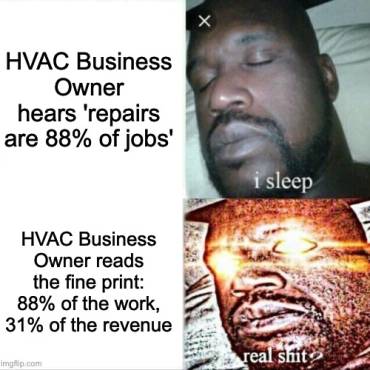
The numbers are not subtle. Capstone Partners counted 149 HVAC-services deals in 2025, up 12.9% year over year, in a stretch when broader industrial M&A dropped 24.6%.¹ PE add-on acquisitions of HVAC firms jumped 88%, and PE now drives more than half of all HVAC deals.¹
The marquee deals tell the story:
- Blackstone agreed to buy Champions Group for a reported $2.5 billion, around 18.5 times earnings.
- Bain Capital and Mubadala bought the 5,000-technician Service Logic.
- Alpine’s Apex Service Partners did roughly 60 bolt-on acquisitions in a single year before taking a $2 billion Apollo investment at about a $10 billion valuation.³
Here is the engine. A small residential HVAC shop trades around 6 to 9 times earnings (EBITDA, a rough proxy for operating profit). A scaled platform sells at 17 to 20 times. So a firm buys your shop at 7 times, centralizes the back office, grows the profit, and resells the platform at 18 times. That spread is the entire return. It is why PE wants a fragmented, cash-generating, recession-resistant trade with a retirement-age ownership base. HVAC checks every box.
The Two Stories Tangled Together
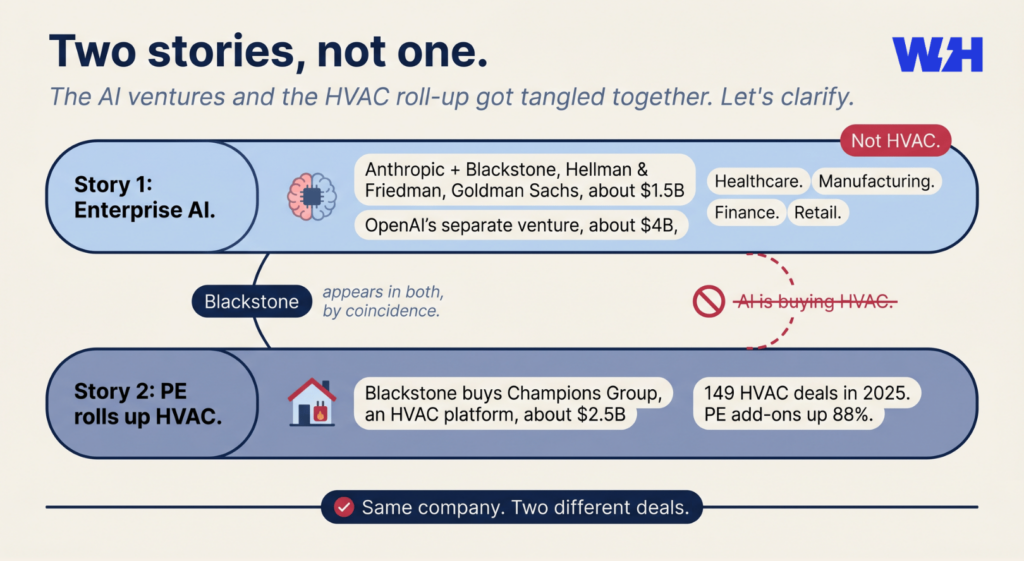
The podcast referenced news that AI companies had partnered with private equity to buy and AI-enable HVAC businesses. Two things are true and separate. First, both Anthropic and OpenAI launched enterprise-AI ventures in early May 2026. Anthropic’s roughly $1.5 billion venture partnered with Blackstone, Hellman and Friedman, and Goldman Sachs. OpenAI’s separate venture raised about $4 billion. Both are broad plays putting AI into large companies across healthcare, manufacturing, finance, retail, and real estate. Neither targets HVAC.
Second, and separately, Blackstone bought Champions Group, that $2.5 billion HVAC platform. That is where the wires crossed. Blackstone appears in two unrelated stories: a partner in the Anthropic AI venture, and the owner of an HVAC platform. Those are two different activities, not one “AI is buying up HVAC” deal. The podcast also had the pairing backwards: it is Anthropic, not OpenAI, that partnered with Blackstone. The scary narrative is not the real one. The real one is older and more boring: Wall Street likes HVAC’s cash flow, and AI is now a tool everybody has access to, including you.
The Leverage That Used to Require Selling Out
The operational advantage a PE platform builds by centralizing dozens of back offices is now something a single shop can rent by the month. Voice AI that answers and books calls is real and funded: Avoca raised more than $125 million at a $1 billion valuation in April 2026 and projects booking a billion dollars in jobs this year.⁴ Field service platforms now ship native AI, like Housecall Pro’s “AI Team,” a 24/7 CSR that answers, books, and escalates to a human.⁵ The capability a roll-up assembles with headcount, a two or three van shop can now switch on.
The adoption gap is the opportunity. In a 2026 survey, two-thirds of contractors expected AI to reshape the trade, but only 12% had actually embedded it.⁶ The early movers capture that gap, and you do not need a PE parent to get the tools. We laid out the practical side in our technician’s guide to navigating AI and automation, and how customers find you is shifting too, covered in what HVAC contractors need to know about AI search.
Your Shop
Why the multiple moves. Small residential HVAC shops trade around 6 to 9 times earnings; a strong maintenance book pushes you toward the top of your band. Consolidated platforms sell at 17 to 20 times. Buyers value EBITDA or seller’s discretionary earnings (with owner add-backs), which usually runs higher than net profit.
Quick Presets
Estimated shop value
—
at a small-shop multiple
Your EBITDA / SDE
—
revenue × margin
Your multiple
—
tier + recurring revenue
A platform sells at
—
18.5x, what you won’t get solo
You vs the Platform Multiple
The arbitrage. A roll-up buys shops like yours near the low end and resells the combined platform near 18.5x. That spread, about — on these numbers, is the engine of the whole game. You will not get the platform multiple as a single shop, but recurring revenue moves you up your own band and makes you a more valuable, more sellable asset.
This is a rough estimate, not an appraisal or financial advice. Real deals turn on add-backs, customer concentration, fleet and team, growth rate, and local market. Talk to a qualified M&A advisor before acting.
Automation Alone Is Not the Edge. The Human in the Loop Is.
Do not read this as “let the robot run the front office.” AI on its own is not ready to carry the customer relationship, and that is exactly where the independent wins. Automated self-service fully resolves only about 14% of customer issues today; the other 86% still need a person. Gartner’s projection that AI will handle 80% of routine service issues is a forecast for 2029, not today.⁷ And customers feel it: roughly 79% of Americans still prefer a human agent.⁸ The winning model pairs AI for speed and coverage with a trained human who owns judgment and the messy exceptions.

That hybrid is what a small shop can now assemble: automation that catches every call and books the easy ones, plus a human (the great office manager) for the calls that need a brain. A full-time CSR fully loads to roughly $60,000 to $70,000 a year and still covers only 40 hours a week, one call at a time. Meanwhile shops miss about 27% of inbound calls at roughly $1,200 of lost work each, and the after-hours emergency call is the highest-margin one of all.⁹ A blended back office gives a small operator 24/7 coverage at a fraction of a full-time hire, with the human escalation path the data proves you still need. The scale efficiency PE pays 18 times earnings to assemble, an independent can now rent by the month.
Local Trust Is the Asset Capital Cannot Buy
So what protects you? The relationship, the honest diagnosis, the reputation you built one driveway at a time. Be honest about both sides. Scale brings real advantages: better procurement, bigger marketing, and sophisticated financing (62% of homeowners are more likely to move forward when it is offered).¹⁰ Well-run roll-ups create value, and selling to one is a legitimate plan, covered in why how you leave matters more than when you leave.
But the other side is just as real. Technicians at acquired shops report the shift to sales quotas, commission pay replacing hourly, thinner benefits, and pressure to condemn equipment that still has life in it. That is the reputation gap an honest independent drives a truck through. Homeowners notice when the company that used to fix things starts selling a system on every visit.
Modern PE keeps local brand names and managers in place precisely because the local relationship is the value. That tells you what your real asset is: you hold what they are paying billions to acquire. Protect it by keeping your crew, training them well, and earning reviews the honest way. To grow without losing that, our piece on how to stop turning wrenches maps the path, and keeping the office and field rowing together is how you hold a team a roll-up would love to poach.
Three Moves for the Independent

You do not have to pick between getting steamrolled and selling out. First, close your coverage gap: make sure every call gets answered, days, nights, and weekends, even if that means AI booking with a human in the loop instead of voicemail. The missed call is the cheapest thing a roll-up beats you on. Second, rent the efficiency instead of building or selling for it: automate the repetitive back-office volume, keep a human on judgment, and get platform-grade operations without platform-grade overhead. Third, double down on the thing they cannot buy: keep your crew, train them to solve rather than push quotas, and earn reviews honestly. The roll-up is paying 18 times earnings for local trust. You already own it.
This is not a wave that washes the independent away. It is a market telling you, in dollars, what your relationships are worth. Build the operation that lets you keep them.
Additional Sources
- “HVAC Services Market Update” and “HVAC Deals Demonstrate Private Equity’s Appetite for Add-Ons”, Capstone Partners and S&P Global Market Intelligence, M&A Report, 2025.
- “The HVAC Industry Has Seen Consolidation, But It’s Not Over Yet”, Homepros, Trade Publication, 2024.
- “HVAC Platform Acquisition Announcements (Champions Group, Service Logic, Redwood Services, Apex Service Partners)”, Blackstone, Bain Capital, Altas Partners, and Apollo, Press Releases, 2025 to 2026.
- “Avoca Raises $125M at $1B Valuation”, PR Newswire, Press Release, 2026.
- “AI Team Overview”, Housecall Pro, Product Documentation, 2026.
- “2026 State of AI in the Trades”, ServiceTitan, Industry Survey, 2026.
- “Agentic AI Will Autonomously Resolve 80% of Common Customer Service Issues by 2029”, Gartner, Research Forecast, 2025.
- “Customer Preference for Human Agents”, SurveyMonkey and Twilio, Consumer Surveys, 2025.
- “The Cost of Missed Calls for Home Services Businesses”, Invoca, Industry Report, 2025.
- “The State of Home Service Spending”, Housecall Pro, Consumer Survey, 2026.
Whether you require installation, repair, or maintenance, our technicians will assist you with top-quality service at any time of the day or night. Take comfort in knowing your indoor air quality is the best it can be with MOE heating & cooling services Ontario's solution for heating, air conditioning, and ventilation that’s cooler than the rest.
Contact us to schedule a visit. Our qualified team of technicians, are always ready to help you and guide you for heating and cooling issues. Weather you want to replace an old furnace or install a brand new air conditioner, we are here to help you. Our main office is at Kitchener but we can service most of Ontario's cities
Source link