
Humidity, aside from temperature, is perhaps the most important property of air that an HVAC system can control. Willis Carrier is often credited as the father of modern air conditioning, yet his groundbreaking invention was not a modern air conditioner. It was a dehumidifier intended to solve moisture-related issues at a paper printing company in New York. To effectively fix and prevent issues related to moisture, all service technicians should have a basic understanding of humidity.
Water is one of the many constituents of air. It exists in liquid form, such as in clouds and fog, and also in gas form, typically referred to as water vapor. Humidity is defined as the amount of water vapor in the air, and can be expressed either in absolute or relative terms.
Absolute humidity is the actual amount of water vapor in the air, often expressed in grains of moisture per pound of air. It can also be expressed as a percentage of total volume. For example, climate monitoring data has found that in tropical regions, where water vapor concentration is highest on Earth, water vapor makes up about 4% of the total volume of air.
When it comes to weather forecasting, as well as HVAC systems that control indoor humidity, the more appropriate way of expressing humidity is in relative humidity. Defined as the amount of water vapor present in the air compared to what that air can hold, relative humidity is a useful measurement for predicting how comfortable the air will be. The range for relative humidity where people are most comfortable is 30-60%.
The Heat Content of Air and How it Determines Relative Humidity
While it may be abstruse to think about, it is useful to consider the fact that air has weight. As molecules that make up the air gain or lose heat, the air changes in density. Because heat is defined as fast molecular movement, warmer air, made up of fast-moving molecules, is less dense and, as such, weighs less than colder air. This is where the phrase “warm air rises” comes from. Cold air, made up of slower molecular movement, is denser and thus tends to sink below and displace warmer air.
When air is less dense, such as with hot air, it has more “space” for water vapor. When air is denser, such as with cold air, it cannot hold as much water vapor. An interesting consequence of this physical process is that winter air will typically have a higher relative humidity than summer air, or higher than what one would expect. This is not to say that winter air has more moisture than summer air. Instead, it has high moisture content compared to what it is capable of holding. Warm air in summer is capable of holding more water vapor, so its relative humidity is typically lower than winter air.
Another, somewhat counterintuitive, outcome of the physics of humidity is that dry air is denser and heavier than moist, humid air. This is because water molecules themselves are less dense than nitrogen and oxygen molecules, the main constituents of air.
Looking for quick answers on air conditioning, heating and refrigeration topics?
Try Ask ACHR NEWS, our new smart AI search tool.
Ask ACHR NEWS
With air conditioning and refrigeration, moisture is removed from the air and exits through the drain pan. In well-insulated spaces, mechanical cooling can even dry out the space, if the compressor is able to run long enough. Because the outdoor air has so many sources of moisture (lakes, rivers, ponds, etc.), winter air is more capable of maintaining higher relative humidity. In this regard, relative humidity does not necessarily reflect comfort. Yet it does explain why it is often recommended to use a humidifier during winter. When warming up cold air, the only way to maintain a comfortable range of humidity is to mechanically add water vapor into the air, such as with a whole-home humidifier mounted on the ductwork above the furnace.
What Causes Condensation?
Saturation is a useful concept to understand when it comes to condensation. Saturation, in the context of humidity, is the point at which air is holding the maximum amount of water vapor it can possibly hold for the temperature it is at. Condensation occurs whenever water vapor in the air comes in contact with surfaces that are colder than the dew point of the surrounding air. The dew point of air is the temperature at which the air becomes oversaturated with water vapor, causing the water vapor to “fall out of,” or condense from, the air. Another way to express dew point temperature is the temperature at which air is at 100% relative humidity.
Early in the morning, there may be dew on the grass or water droplets on cars parked outside because the air was warm and contained water vapor the previous evening, but then these surfaces became cold overnight, causing water from the air to condense onto these colder surfaces.
Condensation is what happens on the evaporator as it removes heat from air. Immediately after the evaporator coil, the air is actually at dew point, 100% relative humidity, though as it mixes with the warmer air in the space, the relative humidity drops.
Preventing Condensation
Condensation will not happen if the air is dry, nor if surfaces are above the dew point temperature of the surrounding air. Therefore, the only two ways to remove and prevent condensation are to decrease the dew point of the air or raise the temperature of the surface. For example, in pool room dehumidification, the air diffusers should always be aimed at the windows to create a “window wash” on glass surfaces. This is why heavy drapes drawn across cold windows can trap airflow and exacerbate condensation problems.
For service technicians troubleshooting situations like sweaty ductwork, the quickest and easiest solution for lowering the dew point is to first determine where the moist air is coming from. Often, it is the warm outside air or air from the attic that infiltrates into the conditioned space.
Outside air can leak into a space from poor insulation, but it can also infiltrate when the house is in a negative pressure, such as when exhaust fans are running all the time.
How Dehumidifiers Work
After eliminating sources of infiltration, the dew point temperature of air can be lowered using mechanical dehumidification. Air conditioning is a type of dehumidifier; however, the compressor usually shuts off when the space cooling set point is met, before an effective amount of water vapor is removed.
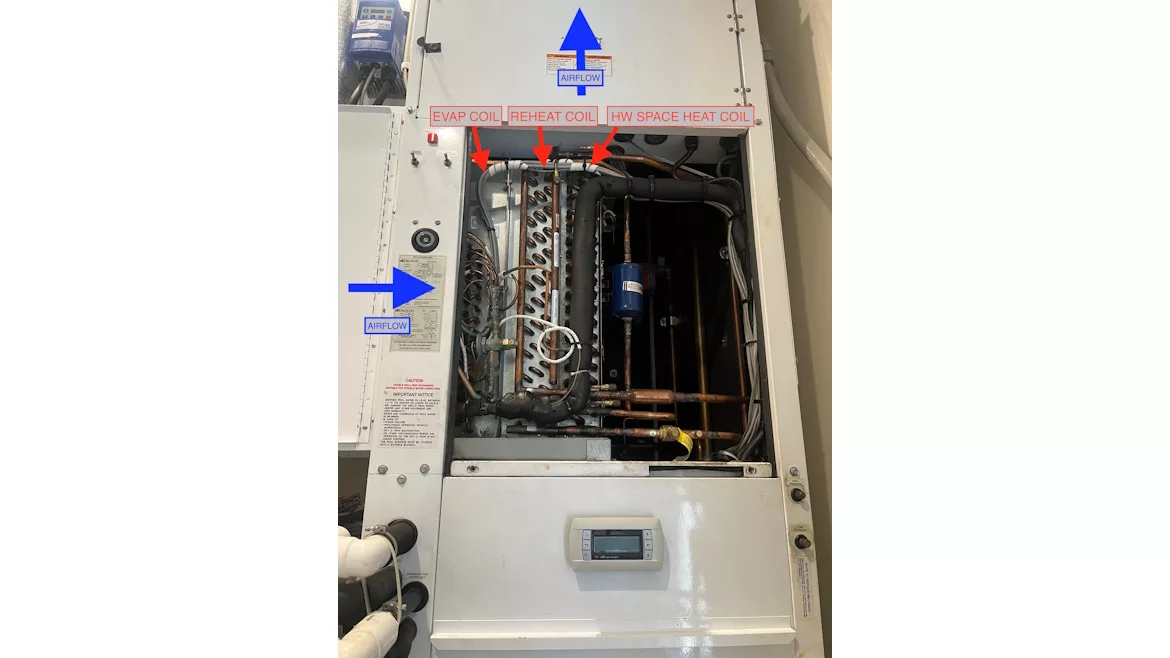
The basic operating principle of a dehumidifier is to remove water vapor from the air without overcooling the space. Dehumidifiers are designed to have longer compressor runtimes by immediately, after the evaporator coil, adding heat (“reheat”) back into the space. The cold evaporator coil, paired with the reheat coil work together to “wring out” as much moisture as possible without changing the temperature of the air.
Whether you require installation, repair, or maintenance, our technicians will assist you with top-quality service at any time of the day or night. Take comfort in knowing your indoor air quality is the best it can be with MOE heating & cooling services Ontario's solution for heating, air conditioning, and ventilation that’s cooler than the rest.
Contact us to schedule a visit. Our qualified team of technicians, are always ready to help you and guide you for heating and cooling issues. Weather you want to replace an old furnace or install a brand new air conditioner, we are here to help you. Our main office is at Kitchener but we can service most of Ontario's cities
Source link