Need to Know
- Oversizing cold storage heat rejection systems can increase water and energy use while creating efficiency and maintenance problems.
- Evaporative condensers are often suited to large, high-pressure refrigeration applications and very low-temperature cold storage.
- Cooling towers with heat exchangers can be a better fit for smaller systems, brownfield retrofits, and facilities with variable loads.
Cold storage warehouses can’t risk chiller downtime, as constant temperatures protect the bottom line and reduce waste. The result is that many of these facilities have an oversized cooling system in place, and the logic makes sense: Can’t risk an outage? Design in lots of extra capacity. This may explain why, traditionally, outsized cooling systems have dominated the industry.
However, this design doesn’t come without its challenges. While useful reserve capacity or a small excess capacity isn’t a bad thing, unnecessarily oversizing the heat rejection system to the point where it consumes excessive water can result in losses in efficiency and energy as well as contamination and other risks from temperature maintenance problems.
Defaulting to the traditional assumptions about cooling sizing rather than fitting a cooling solution to a specific use case may well be costing businesses in meaningful ways. Here are some of the things to help find a right-sized cooling solution.
Evaporative Condensers or Cooling Towers
Various pain points (such as actual heat load) and project qualities (such as footprint) can help determine the choice of cooling method.
Evaporative condensers are often best for large, single-purpose projects where it’s better to have a single, integrated piece of equipment for cooling, eliminating the need for a heat exchanger and keeping cooling to a single step. Evaporative condensers can handle high pressures with different refrigerants like ammonia and are great for cold storage warehouses that need very, very cold temperatures, such as large ice-making distribution operations.
While evaporative condensers do provide a lot of cooling, this comes at the cost of energy and water use. Older models have been known to develop fouling, sedimentation, and scale buildup, which reduce cooling efficiency and decrease cycles of concentration, requiring more frequent water purging and make-up to keep water chemistry within specifications.
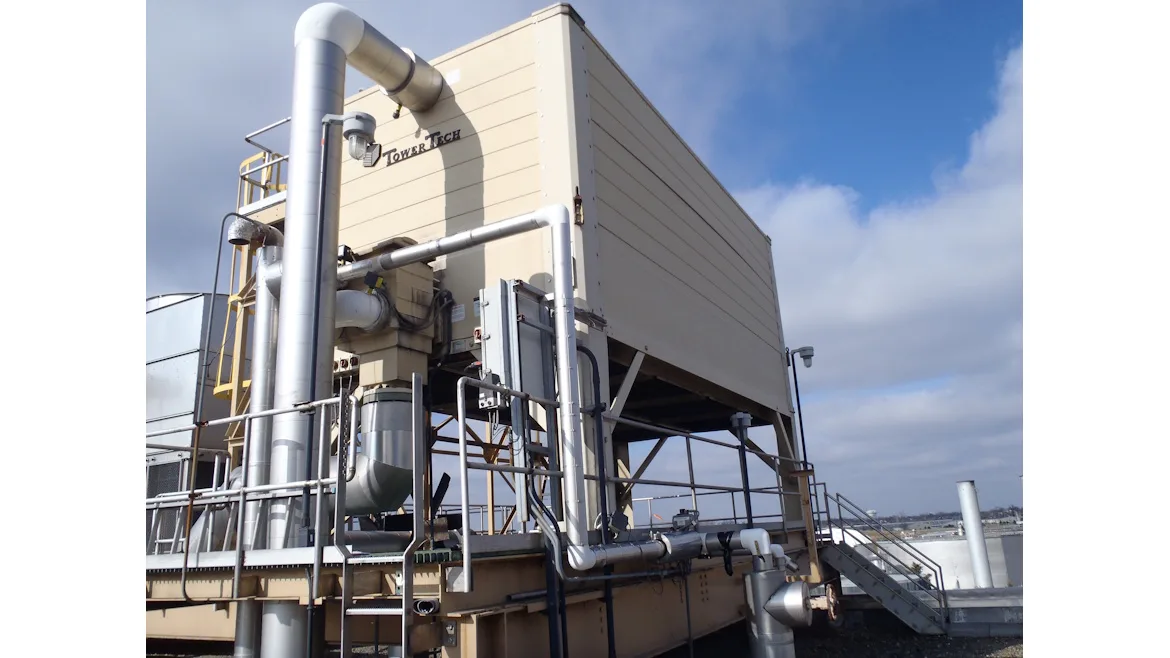
For smaller or mid-size systems, an evaporative condenser may not be necessary. Instead, a cooling tower with a heat exchanger can meet the cooling needs while cutting energy costs. Cooling towers can be ideal for brownfield retrofits, with modular or factory-preassembled towers being ideal for small footprints. Imagine a high heat-transfer application like an industrial ice cream freezer: a cooling tower with a high-efficiency heat exchanger keeps the product frozen at a fraction of the energy use of a conventional condenser system.
Looking for quick answers on air conditioning, heating and refrigeration topics?
Try Ask ACHR NEWS, our new smart AI search tool.
Ask ACHR NEWS
Cooling towers can also deliver advantages for high-scale-potential cold storage sites. Using an “N+1” capacity design builds redundancy, and modular, multi-fan towers that use a variable-frequency drive (VFD) can modulate depending on the facility’s actual load at any time throughout the year. This is a particular benefit for facilities that do not always run at peak load. A modular cooling tower design can also turn portions of the system off or on to meet seasonal conditions.
Choosing A Cooling Method
The number one factor in choosing a cooling method will always be heat load and cooling capacity. But for too long, those have been the only factors considered, costing businesses valuable resources through over-cooling.
Other factors or “pain points” to consider when choosing a cooling method include:
- Pressure requirements. Evaporative condensers directly handle refrigerant, making them the far superior choice for high-pressure refrigerants.
- Energy use. Evaporative condensers can be more energy efficient by keeping cooling in a single step, but a high-efficiency cooling tower can reduce energy use by increasing cycles of concentration.
- Water use. High-efficiency cooling towers offer higher cycles of concentration and ultra-low drift, minimizing water loss, especially with an N+1 design. A closed-circuit model removes splash-out and other opportunities for water loss.
- Contamination reduction. A cooling tower with a heat exchanger isolates the clean secondary loop that will touch the chiller. This reduces opportunities for contamination, scaling, sediment, and fouling by shifting it onto a less expensive, easier-to-replace part, compared to a single-step condenser, which sprays water directly onto pressure-rated, often costly refrigerant coils, protecting essential equipment in data centers, cold storage facilities, and frozen food processing.
- Ongoing maintenance/operation. Factor in the estimated costs of replacement parts, preventive maintenance, and emergency repairs. Purchase cost is only one part of the story; operating costs must always be considered.
- Ease of maintenance/personnel safety. Components that are easier to access during inspection and maintenance procedures can help speed maintenance and keep workers safer. This is especially important in facilities with limited maintenance staff.
- Growth capacity. Swapping out one solution for the other can be very difficult, as can expanding an evaporative condenser system once it’s in place, given the need for structural work, downtime, etc. A modular cooling tower solution is much easier to “daisy chain” additional cells as needed. An N+1 cooling tower design will allow production to continue as a tower is worked on or added.
Lead with Needs
An American business proverb that says, “Nobody ever got fired for buying IBM,” refers to the built-in “insurance” of choosing a large, trusted solution. For cold storage warehouses, this means that facilities frequently default to evaporative condensers. But when managing resources and ongoing costs are top-of-mind, a cooling tower may be able to match heat load within a broader use context. Rather than defaulting to a largest-size-fits-all approach, letting the project’s needs lead the decision-making process can result in a sustainable, long-term-benefit cooling solution.
Whether you require installation, repair, or maintenance, our technicians will assist you with top-quality service at any time of the day or night. Take comfort in knowing your indoor air quality is the best it can be with MOE heating & cooling services Ontario's solution for heating, air conditioning, and ventilation that’s cooler than the rest.
Contact us to schedule a visit. Our qualified team of technicians, are always ready to help you and guide you for heating and cooling issues. Weather you want to replace an old furnace or install a brand new air conditioner, we are here to help you. Our main office is at Kitchener but we can service most of Ontario's cities
Source link