Key Takeaways
- Every run capacitor wears out from the inside: The metallized film in a run capacitor repairs itself after each small internal fault, and every repair clears away a little more electrode area. Capacitance creeps down over the years until the motor it serves starts to struggle.
- Heat and voltage speed up that aging: Common run capacitors carry a rating of -40 to 70°C, and the voltage across a running capacitor often reads above line voltage. A capacitor mounted in a sun-baked condenser is working near both of those limits.
- The label sets the pass/fail line: Depending on the manufacturer, tolerance falls anywhere from ±5% to ±10%, with ±6% common. Match the µF, go with an equal or higher voltage rating, and never install a lower one.
- Replace on measured evidence: No published study shows that fixed-age capacitor swaps cut callbacks. Drift toward the tolerance limit on your meter, a bulged can, leaking oil, or an open interrupter is what justifies replacement, and logging µF on every visit builds that evidence.
Run capacitors are wear parts, and heat sets the wear rate. The difference between a data-backed replacement and an invoice that reads like a sales quota comes down to knowing how a capacitor ages.
What Happens Inside a Run Capacitor
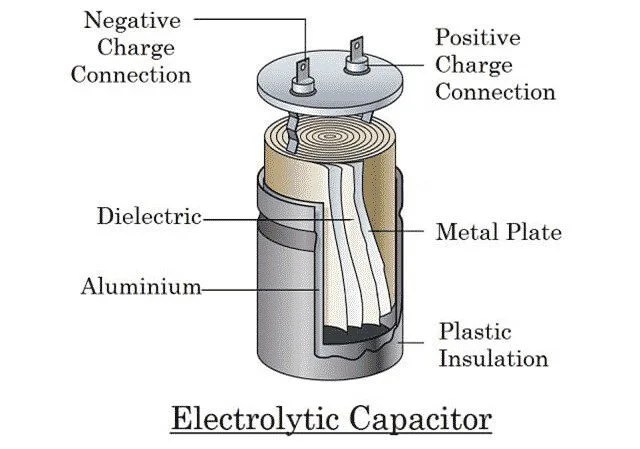
Inside a modern HVAC run capacitor is a roll of polypropylene film carrying a microscopically thin deposited layer of metal, sealed in an aluminum or plastic can that is either oil-filled or dry.
That film is self-healing. If a tiny weak spot gives out, the arc vaporizes the thin metal around the fault and isolates it. The capacitor keeps running, just with slightly less electrode area than it had before. Over the years, thousands of those clearing events add up to the slow microfarad drop you see on your meter.
Most run capacitors also carry a pressure-sensitive interrupter. At end of life, gas builds up inside the can, the can swells, the top pushes outward, and an internal connection breaks. A domed top tells you that safety has operated or is about to. Either way, that capacitor is done.
Manufacturers rate that aging in hours. Cornell Dubilier puts a rating of 60,000 hours at 70°C on its motor-run line.¹ IEC 60252-1 sorts motor capacitors into operating classes: Class A at 30,000 hours, Class B at 10,000, Class C at 3,000, and Class D at 1,000.² One Class B datasheet lists 10,000 hours at 94% survival.³ Numbers like these are survival probabilities under test conditions, and actual field life comes down to heat, voltage, and run hours. A condenser logging 2,000 hours a year passes 10,000 hours in its fifth season.
Heat and Voltage Do the Damage
Run capacitors typically carry a rating from -40 to 70°C, and 85°C and 90°C versions exist.¹ The capacitor usually lives in a control box a few inches from the compressor, often on a south or west wall sitting in full sun. Published field measurements of control box temperatures are hard to come by, but every degree closer to that rating ages the film faster.
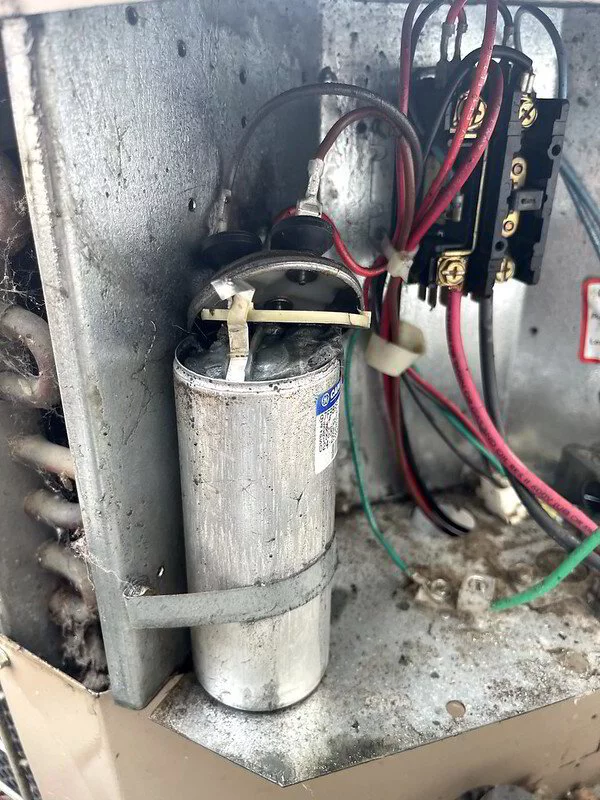
Voltage adds its own damage on top of heat. A run capacitor sits wired into the start winding circuit, and while the motor runs, the start winding generates a voltage of its own. What you end up with is voltage across a running capacitor that commonly measures higher than line voltage. That is the reason 240 V equipment uses caps rated 370 or 440 V. Put your meter across the capacitor terminals with the system running and you will see it.
High supply voltage drives that number higher still. Utility over voltage hits capacitors and motors at the same time, so verify line voltage before you blame the part.
Reading the Label: Tolerance, Voltage, and Microfarads
Tolerance varies by manufacturer. Genteq publishes a typical tolerance of ±6% for its caps, and the Class B datasheet above shows ±6% as well.³ ⁴ Cornell Dubilier’s standard is ±10%, and tighter tolerances are available as an option.¹ Other brands mark ±5%. Whatever the label on that capacitor says is your pass/fail line.
Anything from 32.9 to 37.1 µF passes on a 35 µF ±6% capacitor. See 32.5 µF on the meter and it gets replaced, even if the unit is still cooling.

Voltage goes up, never down. According to Genteq, the replacement’s voltage rating has to equal or exceed the original and never come in below it, and a higher rating is acceptable and often beneficial.⁴ At the same µF, a 440 V cap can replace a 370 V cap. The reverse never holds: a 370 V cap cannot stand in for a 440 V one. Plenty of current replacement caps carry a dual 370/440 V rating.
Match both sections on dual caps. The Herm and Fan sections are two independent capacitors sharing one can. Test each one against its own rating.
Test It Running
Your meter’s capacitance function checks the capacitor out of circuit, at low voltage. That catches dead caps and ones that have drifted badly. Testing under load shows you how the capacitor behaves at operating voltage and temperature.
At 60 Hz:
µF = (2,652 × amps) ÷ volts
Take the amp reading on the wire between the capacitor section and the motor’s start winding. Take the volt reading across that same capacitor section.
Passing example: The Herm section of a 35 µF ±6% cap pulls 5.2 A at 380 V. 2,652 × 5.2 ÷ 380 = 36.3 µF. That lands inside the 32.9 to 37.1 window.
Failing example: Same 380 V, but only 4.4 A. 2,652 × 4.4 ÷ 380 = 30.7 µF. About 12% low. Time to replace it.
Run your own numbers through the calculator below, along with readings from up to two earlier visits.
1 · Test it running
Calculated capacitance
—
—
Deviation from rating
—
—
3 · Replacement voltage check
—
Safety: lock out and verify power off. Discharge the capacitor with a purpose-made discharge tool or a suitable resistor, then confirm zero volts before touching terminals. Do not short the terminals with a screwdriver.
A weak capacitor can force the compressor or fan motor to draw more current and run hotter, and that is one of the quieter paths to premature compressor failure.
Safety: Lock the equipment out and verify the power is off. Discharge the capacitor with a purpose-made discharge tool or a suitable resistor, and do not touch the terminals until your meter confirms zero volts. Shorting across the terminals with a screwdriver can pit them and damage the tool.
Proactive Replacement vs the 15-Capacitor Invoice
Some fleet operators change out capacitors and contactors on a fixed cycle to keep no-cool calls down. The idea is reasonable, but no utility, manufacturer, or peer-reviewed study has published data showing that fixed-age replacement reduces callbacks. Plenty of techs also swap OEM caps for premium aftermarket brands because they believe those last longer. There is no controlled data either way, so the comparison that matters is what the labels actually publish: temperature rating, life class, and tolerance.
Condition-based replacement is what does hold up:
- Record µF on every maintenance visit. If a 35 µF cap reads 35.8, then 34.6, then 33.4 across three visits, it is trending toward the 32.9 limit. Replace it on a maintenance visit, put the readings on the invoice, and the customer gets a solution they can see.
- Replace on physical evidence. A domed top, oil leaking from the can, corrosion at the terminals, or an open section.
- Check the contactor while you’re there. Look for pitted or burnt contacts, voltage drop across closed contacts, and insects or debris. Continuity and voltage drop checks only take a minute.
The math is on the side of catching them early. ACCA’s worked example figures a service callback at about $650 and an install callback at about $850 once tech time, office overhead, and lost opportunity are counted in. At a 5% callback rate, that works out to roughly $80,000 a year for a $2 million contractor.⁵ In a repair-led market, a capacitor costing less than the drive out to the job is the cheapest callback insurance on the truck.
Fifteen capacitors in one house only makes sense when fifteen readings back it up. The trend line in a maintenance agreement record separates a replacement the customer thanks you for from one they post about online.
Additional Sources
- “Motor Run Capacitors Catalog,” Cornell Dubilier Electronics, Product Catalog, current edition.
- “AC Motor Capacitors, Part 1: General (IEC 60252-1),” International Electrotechnical Commission, Standard, 2010 with 2013 amendment.
- “PROLINE Motor Run Capacitor Datasheet (PLC 001-02/10),” PROLINE, Product Datasheet, 2010.
- “Genteq Capacitors,” Genteq (Regal Rexnord), Product Literature, current edition.
- “The True Cost of Callbacks and How to Stop the Bleeding,” Air Conditioning Contractors of America (ACCA), Industry Blog, 2025.
Whether you require installation, repair, or maintenance, our technicians will assist you with top-quality service at any time of the day or night. Take comfort in knowing your indoor air quality is the best it can be with MOE heating & cooling services Ontario's solution for heating, air conditioning, and ventilation that’s cooler than the rest.
Contact us to schedule a visit. Our qualified team of technicians, are always ready to help you and guide you for heating and cooling issues. Weather you want to replace an old furnace or install a brand new air conditioner, we are here to help you. Our main office is at Kitchener but we can service most of Ontario's cities
Source link