November is National Carbon Monoxide Awareness Month. Carbon Monoxide (CO) is commonly referred to as the silent killer. Often overlooked are the injuries resulting from low-level exposure. Anything that burns creates Carbon Monoxide. How are you protecting you and your customers from an odorless, colorless, and tasteless gas?
While the goal remains to have zero carbon monoxide in the ambient air, ASHRAE has determined 9ppm is the limit in a residence. First responders will evacuate a facility at 35 ppm’s. Home CO alarms that are designed to the UL2034 standard are not enough to protect from those lower levels of Carbon monoxide. They help prevent death but alert to low enough levels that can cause injury. The UL2034 standard states a CO alarm may NOT alarm until it has seen 70 ppm of CO for at least one hour and must alarm before the fourth. Since home CO alarms will not alert to those lower levels, it is important to carry a personal monitor or combustion analyzer when entering a residence.
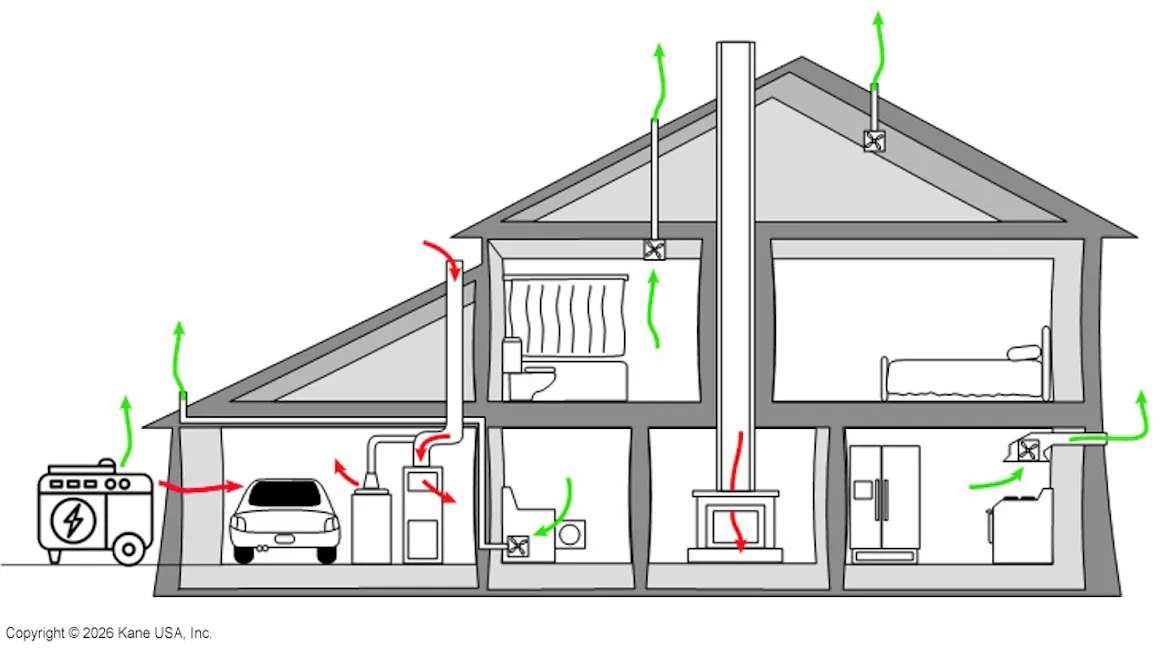
Carbon monoxide is a by-product of the combustion process, and there are many external sources to be aware of. For example, Portable generators should never be used inside a house or in a garage, and they should be placed at least 20 feet from any structure. Barbeques and smokers are another example that should also be used only outside and at least 10 feet from any structure.
There are many sources housed within a garage that can cause serious carbon monoxide risks. For instance, gas-powered lawn mowers, weed eaters, and chainsaws can all be culprits of CO. The most obvious and common are cars. Proper precautions should be taken when starting a car inside a garage. The first step is opening the garage door before starting the car. After the car is started, immediately back it outside. It is also important not to leave a car idling in the garage.
Inside the house, there are several more risks. Some that seem obvious, and some that are often overlooked. Furnaces, water heaters, and boilers tend to get the most attention. However, gas dryers, fireplaces (direct and unvented), wood burners, pellet stoves, ovens, and stovetops are also potential sources of CO. Following proper installation and maintenance of these appliances is crucial for mitigating the risks of CO poisoning.
Carrying a personal monitor is the first step in protecting yourself and customers. Carrying a properly calibrated combustion analyzer is the next step. Any appliance within a home can and should have a combustion test performed on it at least once a year. Visual inspections only tell us part of the story. Just because something looks right, doesn’t mean it is.
The start-up of a combustion analyzer is the first step in combustion testing. Analyzers should always be started outside in the ambient air. Take precautions not to start them near a running or recently turned off vehicle. This can lead to faulty readings when doing a combustion test. Verifying that the proper fuel source is selected is also crucial before the testing process can begin. A combustion analyzer is fitted with sensors and also performs calculations. If the right fuel source is not chosen, the calculated results may be incorrect.
Looking for quick answers on air conditioning, heating and refrigeration topics?
Try Ask ACHR NEWS, our new smart AI search tool.
Ask ACHR NEWS
Keeping your combustion analyzer calibrated is also critical for accurate results. O2 sensors can and will eventually fail. Upon start-up, an analyzer should ideally read near the 20.9 oxygen level. CO sensors can drift without notice. Manufacturers of combustion analyzers recommend having them calibrated at least once a year, if not more often.
While carbon monoxide itself is a colorless, tasteless, and odorless gas, exposure to it can lead to death, but it can also lead to a variety of short- and long-term injuries that often mimic other health issues. Early warning signs can include headache, dizziness, fatigue, and persistent flu-like symptoms. With continued exposure or at higher levels, convulsions, loss of judgment, hallucinations, heart issues, and even loss of mobility may occur.
If you have been exposed to levels of carbon monoxide, it is important to seek medical help. Carbon monoxide does not instantaneously leave the body just because the exposure has ended. Carbon Monoxide poisoning often goes untreated because it manifests differently in everyone. The road to recovery can be long and costly. Do you want to leave your customer or yourself at risk?
Protect yourself, protect your customers. Many homeowners rely on HVAC contractors to mitigate the risks of CO poisoning in the home. So, no matter if you are in an all-electric neighborhood or it is in the middle of summer, CO can be present. Take the time to educate your customers. Remember, just because you have said it 100 times doesn’t mean that it isn’t someone’s first time hearing it. HVAC professionals are the first line of defense against CO poisoning.
Whether you require installation, repair, or maintenance, our technicians will assist you with top-quality service at any time of the day or night. Take comfort in knowing your indoor air quality is the best it can be with MOE heating & cooling services Ontario's solution for heating, air conditioning, and ventilation that’s cooler than the rest.
Contact us to schedule a visit. Our qualified team of technicians, are always ready to help you and guide you for heating and cooling issues. Weather you want to replace an old furnace or install a brand new air conditioner, we are here to help you. Our main office is at Kitchener but we can service most of Ontario's cities
Source link