Why Columbus Power Outage History Matters for Your Home
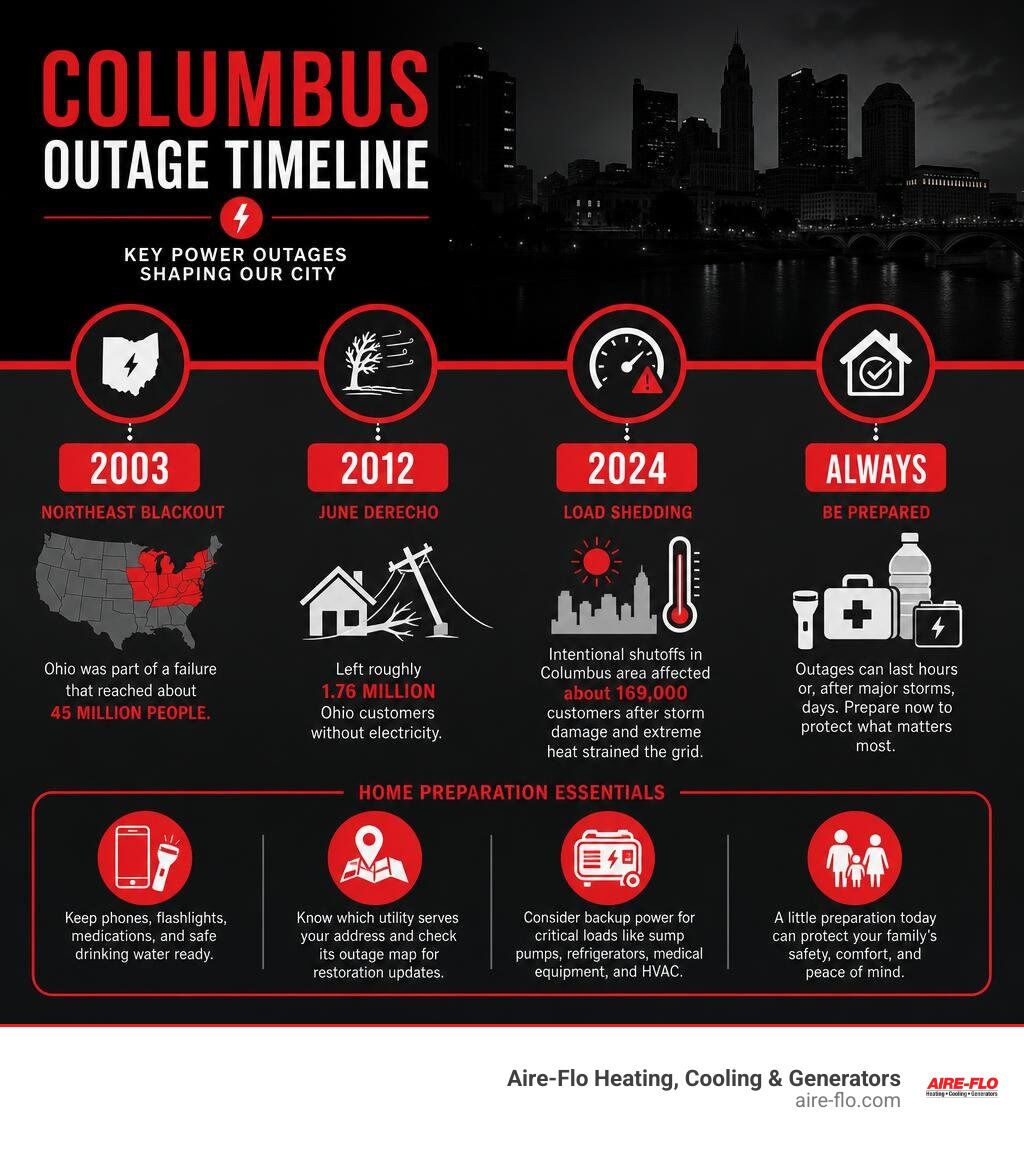
Columbus power outage history shows a clear pattern: major disruptions usually come from severe weather, grid failures, and high electricity demand. The 2003 Northeast Blackout affected Ohio as part of a failure that reached about 45 million people. The June 2012 derecho left roughly 1.76 million Ohio customers without electricity, and intentional AEP Ohio shutoffs in 2024 affected about 169,000 customers in the Columbus area after storm damage and extreme heat strained the grid.
For most homes, the practical lesson is simple: plan for outages that can last hours or, after major storms, days. Protect essential needs first:
- Keep phones, flashlights, medications, and safe drinking water ready.
- Know which utility serves your address and check its outage map for restoration updates.
- Consider backup power for critical loads, such as a sump pump, refrigerator, medical equipment, and heating or cooling equipment.
Reliability data also shows why preparation matters. Columbus Division of Power customers averaged 325.9 minutes of outage time in 2023, or more than five hours, while the utility recorded 1.31 interruptions per customer. That does not mean every Columbus household loses power for five hours each year, but it does show that fewer interruptions can still last longer when storms or equipment damage slow repairs.
At Aire-Flo Heating, Cooling & Generators, our team helps central Ohio households maintain comfort through severe weather and power disruptions. Our HVAC and backup power experience gives homeowners a practical view of Columbus power outage history and what it can mean for family safety, comfort, and home systems.
A Look at Columbus Power Outage History and Major Grid Failures
Understanding how our regional electrical grid behaves under stress helps homeowners anticipate risks. The power network serving central Ohio relies on an intricate balance of local generation, high-voltage transmission lines, and distribution networks. When one component fails, the consequences can cascade across city lines and county borders.
Over the last two decades, central Ohio has experienced the full spectrum of grid vulnerabilities, ranging from software errors and derecho winds to emergency load shedding during intense summer heat.
The 2003 Northeast Blackout and Cascading Grid Collapses
In August 2003, one of the most expansive blackouts in North American history began in northern Ohio. A software bug at a regional utility kept alarm systems from warning operators about overloaded transmission lines. When those lines sagged into overgrown trees and tripped offline, the sudden surge cascaded across the regional interconnect.
Within hours, approximately 45 million people across eight northeastern states and parts of Canada lost electricity. The blackout halted public transit, disabled municipal water pumping stations, and forced entire communities to navigate days without refrigeration or air conditioning.
Major system operation events show how vulnerable interconnected transmission systems can be when software, equipment, and vegetation problems overlap.

How Severe Storms and the 2012 Derecho Shaped Columbus Power Outage History
While software glitches can initiate grid collapses, severe weather remains the leading cause of prolonged power interruptions in Franklin County. On June 29, 2012, a catastrophic derecho storm swept across Ohio with hurricane-force winds, downing hundreds of high-voltage transmission lines, snapping utility poles, and leaving roughly 1.76 million Ohio customers in the dark.
The aftermath highlighted the physical fragility of overhead utility lines in established neighborhoods. Repairs required over a week in several areas because utility crews had to rebuild entire distribution corridors from scratch.
Extreme winter storms present a similar threat when heavy ice accumulations bring down tree limbs across lines. That creates prolonged sub-freezing outages where staying powered through winter storms can help prevent frozen plumbing, heating interruptions, and other home comfort problems.
Extreme Heat and Intentional Load Shedding Events
Not all major blackouts stem from physical storm damage. In recent years, grid operators have had to use intentional power cuts to protect high-voltage equipment from catastrophic failure. During a severe heat wave accompanied by storm damage, regional transmission systems faced high electricity demand as air conditioners ran continuously across central Ohio.
To prevent an uncontrolled regional blackout, utility operators initiated emergency load shedding. During these grid protection events, roughly 169,000 customers in the Columbus area experienced targeted service interruptions. Neighborhoods such as North Linden were heavily impacted, with thousands of households losing power for days while regional transmission lines were stabilized.
Controlled load shedding prevents regional grid collapse, but for individual households, losing cooling during triple-digit heat indexes poses serious health and safety challenges.
Grid Reliability Metrics and Regional Outage Patterns
To evaluate how reliable local electric service is, engineers and utility regulators monitor two standard benchmarks: the System Average Interruption Duration Index (SAIDI) and the System Average Interruption Frequency Index (SAIFI).
SAIDI measures the total number of minutes an average customer is without power over a year, while SAIFI tracks how many distinct interruptions occur.
Analyzing Columbus Power Outage History and Utility Reliability Trends
Federal benchmarks set by the U.S. Energy Information Administration show that typical nationwide utility customers experience between 120 and 180 minutes of total outage time annually. However, municipal data for the City of Columbus Division of Power shows a distinct upward trend in outage duration over recent years.
| Metric | Columbus Division of Power (2020) | Columbus Division of Power (2023) | National Benchmark Average |
|---|---|---|---|
| SAIDI (annual outage minutes) | 216.1 min | 325.9 min | 120 – 180 min |
| SAIFI (annual interruptions) | 2.35 | 1.31 | 1.00 – 1.40 |
| Average outage duration | ~92 min per event | ~248 min per event | ~100 – 120 min per event |
Based on municipal utility reporting, the average customer served by the municipal utility experienced over 5.4 hours of downtime in 2023. While the frequency of outages (SAIFI) decreased from 2.35 to 1.31 interruptions per customer, the duration of each event grew significantly longer. That means repairs and restoration took more time when disruptions occurred.
As of late 2026, real-time monitoring across Franklin County routinely records baseline disruptions. Even during quiet weather periods, routine maintenance, localized equipment wear, and vehicle accidents cause small pockets of outages across the metro area.
Neighborhood Vulnerabilities and Infrastructure Challenges
Power reliability is not uniform across central Ohio. Neighborhoods with mature tree canopies, aging substation transformers, and above-ground distribution lines experience longer restoration delays than newly developed communities with underground utility feeds.

Communities in Franklin, Delaware, and surrounding counties experience distinct vulnerability factors:
- Established urban corridors: Neighborhoods like North Linden, Clintonville, and portions of Upper Arlington feature mature trees intertwined with overhead wiring, increasing the likelihood of storm-related line snaps.
- Substation load constraints: Rapid population growth across suburban corridors like Dublin, New Albany, Hilliard, and Westerville increases baseline load on regional substations, heightening the risk of localized equipment overloads during seasonal peaks.
- Restoration prioritization: During widespread outages, utilities restore service to critical infrastructure, including hospitals, water treatment plants, and emergency dispatch centers, before turning to residential branch lines.
Protecting Your Central Ohio Home from Power Disruptions
Given our region’s weather patterns and grid history, taking proactive steps to protect your home’s infrastructure is essential. Extended power outages disrupt more than lighting. They shut down HVAC systems, disable basement sump pumps, spoil refrigerated food, and disrupt essential medical equipment.
At Aire-Flo Heating, Cooling & Generators, our team helps homeowners throughout Columbus, Grove City, Worthington, Marysville, and surrounding communities evaluate their home energy vulnerability and implement practical backup power strategies through our dedicated generator services.
Assessing Residential Backup Power Needs
A whole-home power plan starts with understanding which electrical circuits are essential for your family’s safety and property protection.
When selecting backup power, homeowners generally choose between portable generators and automatic standby systems. Standby units connect directly to your home’s natural gas or liquid propane supply and use an automatic transfer switch (ATS) to restore electricity within seconds of a grid interruption.
For homeowners comparing system sizes, fuel sources, and essential load management, home generators in Columbus explains how different backup power options support local homes during outages.

Key household systems that require power protection include:
- Heating and cooling systems: Furnaces, heat pumps, and central AC systems maintain safe indoor temperatures during freezing winter lows and humid summer heat waves.
- Water management: Sump pumps protect finished basements from flooding during heavy rainstorms, which frequently coincide with power cuts.
- Refrigeration and food storage: Preventing food spoilage during multi-day outages avoids expensive grocery losses.
- Medical and communication gear: Continuous power for oxygen concentrators, CPAP machines, home medical devices, and Wi-Fi networks keeps your family connected and safe.
Proactive Maintenance and Storm Season Preparation
A backup generator requires regular care to operate dependably during an unexpected emergency. Neglected equipment can suffer from dead starter batteries, dirty air filters, degraded oil, or clogged fuel passages.
Conducting routine generator maintenance before storm season ensures your system exercises automatically, starts smoothly, and handles the electrical loads of your home when the primary grid goes offline.
Homeowners should also bookmark local utility resources, including municipal and county outage dashboards, to report active outages, track field crew dispatches, and monitor estimated restoration times.
Frequently Asked Questions About Columbus Power Outages
Why does Columbus experience frequent power outages during extreme weather?
Central Ohio sits at the crossroads of active storm tracks, bringing severe spring thunderstorms, summer derechos, and winter ice storms. High wind gusts easily push mature tree branches into overhead power lines, while lightning strikes and extreme temperature spikes place heavy physical and thermal stress on aging transformers and substations.
How does Columbus utility reliability compare to national standards?
In 2023, the City of Columbus Division of Power reported an average annual outage duration (SAIDI) of 325.9 minutes per customer. This exceeds the typical national benchmark of 120 to 180 minutes per year. While Columbus customers experience relatively few individual outages each year, the time required to complete repairs and restore power is often higher than national averages.
Where can residents track active outages and restoration times?
Residents can monitor active disruptions via online tracking maps provided by their electric service provider. City of Columbus Division of Power customers can access the municipal outage dashboard, while regional investor-owned utility customers can view Franklin County outage counts through their respective online portals.
Reliable Home Power and Comfort for Central Ohio
Columbus power outage history proves that electrical grid interruptions are a regular reality of life in central Ohio. From severe regional storms and deep winter freezes to unexpected transmission emergencies, prolonged blackouts can disrupt your family’s routine and put your home’s critical systems at risk.
For 75 years, Aire-Flo Heating, Cooling & Generators has provided trusted, top-rated heating, air conditioning, and power generation services across Columbus, Dublin, Upper Arlington, Hilliard, Pickerington, and surrounding communities. We back every project with a 100% satisfaction guarantee to ensure your living space remains safe, secure, and comfortable through any storm.
To safeguard your home against future power disruptions, contact our professional generator technicians to discuss custom standby power solutions and maintenance services tailored to your household.
Whether you require installation, repair, or maintenance, our technicians will assist you with top-quality service at any time of the day or night. Take comfort in knowing your indoor air quality is the best it can be with MOE heating & cooling services Ontario's solution for heating, air conditioning, and ventilation that’s cooler than the rest.
Contact us to schedule a visit. Our qualified team of technicians, are always ready to help you and guide you for heating and cooling issues. Weather you want to replace an old furnace or install a brand new air conditioner, we are here to help you. Our main office is at Kitchener but we can service most of Ontario's cities
Source link