

An essential homeowner’s guide to evaluating equipment, installation quality, efficiency, warranties, and the true value of your HVAC investment.
Replacing your home’s heating and cooling system is a significant investment. Depending on the equipment you choose, its installation, and the conditions in your home, that investment will influence your comfort, energy expenses, and maintenance costs for many years.
If you’re comparing HVAC replacement quotes, you may already have several estimates—or you may be wondering where to begin.
Perhaps one contractor recommends replacing your current equipment with a similar model. Another suggests a higher-efficiency heat pump. A third presents three options labeled Good, Better, and Best, each with different features and prices.
How do you determine which proposal offers the best value?
It’s tempting to compare the bottom-line prices and choose the least expensive option. But HVAC proposals aren’t necessarily estimates for identical products or services. Even when contractors recommend similar equipment, their installation procedures, materials, system modifications, and warranty protection may differ considerably.
The most expensive proposal isn’t automatically the best, either.
The goal is to understand what you’re purchasing, why it has been recommended, and how that investment will serve your home over time.
A thoughtful HVAC replacement decision begins well before you compare prices. It begins with understanding your home.
1. Before Requesting Estimates, Evaluate Your Current HVAC System
Your experience with your existing heating and cooling system is valuable information.
Before inviting contractors to evaluate your home, take some time to consider how your current equipment performs, what you appreciate about it, and what you would like to improve.
You don’t need technical expertise to do this. Your observations can help identify issues that deserve investigation and establish priorities for your replacement.

What Do You Like About Your Current System?
Start with what works.
Does your existing equipment maintain comfortable temperatures throughout most of your home? Is it relatively quiet? Are the controls easy to operate?
Perhaps you’re satisfied with the temperature in your main living areas but have difficulty keeping an upstairs bedroom comfortable.
You may appreciate the simplicity of your thermostat or the way your current system maintains humidity levels.
Write these things down.
A successful replacement should preserve the qualities you appreciate while addressing the problems that concern you.
What Would You Like to Improve?
Think about the comfort issues you’ve experienced.
Are some rooms consistently warmer or cooler than others?
Does the system struggle during particularly hot or cold weather?
Is the outdoor unit noisy enough to disturb conversations on your patio or interfere with sleep near a bedroom window?
Perhaps the indoor blower seems unusually loud, or you notice excessive airflow noise at certain registers.
Other concerns might include high indoor humidity, uncomfortable drafts, poor air circulation, or temperatures that fluctuate more than you’d like.
These observations matter because not every comfort problem can be corrected simply by purchasing more sophisticated equipment.
An uncomfortable bedroom, for example, might be affected by ductwork, insulation, solar heat gain, or inadequate return airflow.
Describe the symptoms rather than assuming you already know the solution.
That gives the evaluating contractor an opportunity to investigate the underlying cause.
How Reliable Has Your Existing Equipment Been?
Repair history deserves particular attention.
An aging system that operates reliably and requires only routine maintenance presents a different situation from one experiencing repeated breakdowns.
Consider the following:
- Have service calls become more frequent?
- Are the same problems recurring?
- Have repair expenses increased over the past several years?
- Have major components required replacement?
- Does the system occasionally fail during periods of heavy heating or cooling demand?
- Are you concerned about its dependability?
If possible, gather your service invoices from the past three to five years.
These records may reveal patterns that aren’t immediately apparent from memory.
Repeated repairs can indicate deteriorating equipment, but they may also point to an unresolved installation, electrical, airflow, or maintenance problem.
For example, recurring blower motor failures might warrant investigation of excessive static pressure or restricted airflow.
Refrigerant leaks may suggest a different set of concerns.
Frequent repairs are a reason to investigate the system’s condition—not automatic proof that replacement is the only appropriate solution.
Routine preventive maintenance should also be distinguished from repair history. Regular inspections are part of responsible equipment ownership, not evidence that a system is failing.
Review Your Energy Consumption
Heating and cooling can represent a substantial portion of household energy use.
Before requesting replacement estimates, gather approximately 12 months of utility bills, if available. Two years of records may provide additional context.
Look beyond the total dollar amount.
Electricity is generally measured in kilowatt-hours (kWh), while gas and other heating fuels are measured in their respective units.
A higher utility bill doesn’t necessarily mean your equipment is becoming less efficient. Utility rates, weather conditions, household occupancy, and personal habits can all influence costs.
Compare energy consumption during similar periods, keeping those differences in mind.
If you’re considering higher-efficiency equipment, this information can help establish a more realistic starting point for discussing potential savings.
A contractor should not promise a particular reduction in energy expenses without considering the conditions that influence your home’s consumption.
2. Has Your Home Changed Since the Original System Was Installed?
Your home’s heating and cooling needs may be different today than when the existing system was installed.
Perhaps you’ve added a family room, finished the basement, converted an attic, or enclosed a porch.
Maybe you’ve installed replacement windows, upgraded insulation, or completed substantial air-sealing improvements.
Changes in household routines can matter as well.
A bedroom that was rarely occupied may now serve as a home office. A previously unused basement may have become a family entertainment area.
Some changes increase heating and cooling requirements. Others reduce them.
They may also change how conditioned air needs to be distributed throughout the home.
What About a Home Addition?
Imagine a homeowner who added a family room several years after the original HVAC installation.
During construction, additional supply registers were connected to the existing ductwork.
The room has never been particularly comfortable, especially during extreme weather.
When the original heating and cooling equipment eventually needs replacement, should the homeowner simply purchase a larger system?
Not necessarily.
The contractor should evaluate the heating and cooling requirements of the addition, the capacity of the existing equipment, the available airflow, and whether the duct system was appropriately modified.
Installing larger equipment without addressing inadequate ductwork may fail to correct the original problem.
In some situations, changes to the existing distribution system may be appropriate. In others, supplemental or separately controlled equipment could offer a better solution.
The appropriate recommendation depends on the home.

Is Replacing Like-for-Like Always the Right Choice?
Homeowners often assume that replacing their existing equipment with the same type and capacity is the simplest and safest approach.
Sometimes it is.
If the original equipment was properly sized, the home’s characteristics haven’t changed significantly, and the existing distribution system performs well, a similar replacement may be perfectly reasonable.
However, the capacity of the old equipment does not establish what the home actually requires.
A three-ton air conditioner, for example, shouldn’t automatically be replaced with another three-ton unit simply because that is what was installed previously.
The original system may have been incorrectly sized. The home’s insulation or windows may have changed. Additional living space may have been created.
The right replacement should be based on the home’s current needs—not merely the specifications of the equipment being removed.
3. Identify What Matters Most to You
Before discussing equipment models and prices, establish what you want from your new HVAC system.
Different households have different priorities.
Some homeowners are particularly concerned about reducing monthly energy expenses. Others place greater importance on quiet operation, consistent temperatures, uncomplicated controls, or protection against unexpected repair costs.
There isn’t a single equipment package that represents the best choice for every home.
Quiet Operation
If noise is an ongoing concern, mention it during the consultation.
Outdoor equipment may be located near bedrooms, patios, decks, or neighboring properties.
Indoor blower noise and airflow sounds can also affect comfort.
Equipment design, operating speed, installation location, ductwork, and airflow all influence perceived noise.
Ask how the proposed equipment compares with your existing system and whether published sound ratings are available for the recommended models.
Simple, Easy-to-Use Controls
Advanced thermostats can provide extensive programming, remote access, and system information.
For some households, these features are desirable.
For others, the ability to select a comfortable temperature and operate the system without complicated menus is more important.
Certain advanced equipment requires compatible communicating controls.
Before selecting a system, ask to see how its thermostat or control interface operates.
A feature provides value only if it serves your needs.
More Consistent Temperatures and Zoning
Multistory homes and properties with additions may experience significant temperature differences between rooms.
Zoning can sometimes help by allowing different areas of the home to receive heating or cooling according to their individual requirements.
However, zoning isn’t simply a matter of installing additional thermostats.
Depending on the system, it may require compatible controls, dampers, equipment capable of accommodating varying airflow demands, and careful duct-system design.
In some homes, correcting airflow restrictions, improving insulation, or balancing the existing system may be more appropriate.
In others, separately controlled equipment may provide an effective solution.
Ask contractors to explain the available options and the limitations of each.
Indoor Air Quality and Humidity
If dust, filtration, ventilation, or humidity is a concern, include those priorities in your discussions.
Some improvements can be incorporated into a replacement installation. Others may require separate equipment or modifications.
A more expensive heating and cooling system will not automatically resolve every indoor air quality concern.
Balancing Comfort, Efficiency, and Affordability
Consider whether your highest priority is:
- Keeping the initial investment affordable.
- Reducing long-term energy consumption.
- Improving comfort throughout the home.
- Obtaining quieter operation.
- Maintaining simple controls.
- Improving reliability.
- Minimizing unexpected repair expenses.
- Securing comprehensive warranty protection.
- Having manageable financing payments.
Try identifying your three most important priorities.
These preferences will help you evaluate whether a proposed system offers meaningful benefits rather than features you may never use.
4. Why Proper HVAC Equipment Sizing Is So Important
One of the most important considerations in a replacement project is choosing equipment with an appropriate heating and cooling capacity.
Larger equipment isn’t necessarily better.
An oversized system may reach the thermostat’s target temperature quickly but shut off before providing adequate comfort or humidity control.
Depending on its design and operating characteristics, frequent cycling can affect efficiency, comfort, and equipment wear.
Undersized equipment may struggle to maintain desired temperatures during extreme weather.
Proper sizing requires more information than square footage alone.
What Is a Heating and Cooling Load Calculation?
A residential load calculation estimates how much heating and cooling a home requires under established design conditions.
Factors can include:
- Home size and layout.
- Insulation levels.
- Window size, orientation, and performance.
- Air leakage.
- Local climate and outdoor design temperatures.
- Construction characteristics.
- Internal heat gains.
- Room-by-room requirements.
The Air Conditioning Contractors of America (ACCA) publishes Manual J, a recognized method for calculating residential heating and cooling loads.
Manual S provides guidance for selecting equipment based on those requirements and its actual performance characteristics.
These methods help contractors move beyond assumptions based solely on the capacity of the existing system or a general square-footage rule.
Does Every Replacement Require the Same Evaluation?
Not every replacement project involves identical circumstances.
However, homeowners should feel comfortable asking how the contractor determined the recommended equipment capacity.
If two contractors suggest significantly different sizes, ask each to explain the basis for the recommendation.
A meaningful explanation is more valuable than simply being told that a particular size is what the home has always used.
5. Don’t Overlook Your Existing Ductwork
When homeowners think about replacing an HVAC system, they naturally focus on the furnace, heat pump, or air conditioner.
But in a ducted system, the ductwork plays a major role in delivering comfort.
The supply ducts distribute conditioned air to the rooms. The return-air system provides a path for air to flow back toward the equipment.
Problems with either can affect comfort and efficiency.

Why Existing Ductwork Should Be Evaluated
Over time, ducts may become damaged, disconnected, restricted, or poorly sealed.
Some duct systems were never adequately designed for the equipment they serve.
A contractor evaluating a replacement should consider whether the existing distribution system can support the proposed equipment.
Depending on the circumstances, that assessment may involve examining:
- Accessible supply and return ducts.
- Duct sizing and configuration.
- Air leakage or disconnected sections.
- Crushed or damaged flexible ducts.
- Duct insulation in unconditioned spaces.
- Return-air capacity.
- Airflow restrictions.
- Static pressure.
- Air distribution to individual rooms.
Static pressure is particularly important because excessive resistance within the duct system can interfere with proper airflow.
Can New Equipment Solve an Existing Airflow Problem?
Not necessarily.
Suppose a second-floor bedroom has always been uncomfortable because inadequate airflow reaches the room.
Installing a premium air conditioner may not correct the problem if the underlying duct restriction remains.
Likewise, a new variable-speed system cannot automatically overcome every limitation of an improperly designed duct system.
ENERGY STAR identifies poor duct-system performance as a contributor to comfort problems and unnecessary energy consumption.
Why Ductwork Matters When Comparing Quotes
Imagine receiving two proposals for similar equipment.
One includes modifications to the return-air system and repairs to accessible ductwork. The other proposes replacing the equipment without addressing those issues.
The first estimate may be more expensive, but it also includes work the second does not.
That doesn’t automatically establish which recommendation is correct.
It does mean the proposals aren’t directly equivalent.
Ask why modifications are recommended, what problems they are intended to correct, and whether their cost is included in the written estimate.
An HVAC replacement should be evaluated as a complete system—not simply as the installation of new equipment.
6. Understanding Your HVAC Equipment Options
Once the home’s needs and the existing installation have been evaluated, it’s time to consider the available equipment.
This is where homeowners may encounter unfamiliar terminology, competing technologies, and substantial price differences.
A knowledgeable contractor should explain which options are appropriate for the home and how they differ.
Different Types of Heating and Cooling Systems
Depending on the property, available utilities, existing installation, and homeowner preferences, potential choices may include:
Central air conditioning with a furnace: A traditional arrangement in which the air conditioner provides cooling while a gas, oil, or other compatible furnace supplies heat.
Air-source heat pumps: Systems that provide both heating and cooling by transferring heat rather than generating it through combustion.
Dual-fuel systems: Configurations that combine a heat pump with a compatible furnace, allowing different heating sources to operate under appropriate conditions.
Ductless mini-splits: Systems that can provide heating and cooling without conventional duct distribution, sometimes useful for additions, individual rooms, or homes without suitable existing ductwork.
Cold-climate heat pumps: Equipment designed to maintain useful heating performance at lower outdoor temperatures. Appropriate sizing, low-temperature capacity, and backup-heating needs should be evaluated for the specific home.
Each arrangement has potential advantages and limitations.
The existing heating fuel, available electrical capacity, local energy prices, climate, ductwork, and homeowner preferences all influence which options deserve consideration.
Understanding Energy Efficiency Ratings
Efficiency ratings help homeowners compare the energy performance of different equipment.
Common ratings include:
SEER2: Seasonal Energy Efficiency Ratio 2, used to describe seasonal cooling efficiency. Higher ratings generally indicate greater efficiency under standardized test conditions.
EER2: Energy Efficiency Ratio 2, reflecting cooling efficiency at specified test conditions.
HSPF2: Heating Seasonal Performance Factor 2, used to describe the seasonal heating efficiency of heat pumps.
AFUE: Annual Fuel Utilization Efficiency, used for furnaces and certain other fuel-burning heating equipment. It represents the percentage of fuel energy converted into useful heat over a typical heating season.
These ratings provide a useful basis for comparing equipment within appropriate categories.
However, published efficiency ratings do not guarantee a particular reduction in household energy expenses.
Actual performance depends on equipment selection, installation quality, climate, ductwork, thermostat settings, and how the home is used.
Efficiency ratings must also be considered alongside the complete installed cost.
What About Matched Equipment?
Many central heating and cooling systems use separate indoor and outdoor components.
Their compatibility affects the performance of the overall system.
For split air conditioners and heat pumps, homeowners can ask for the AHRI Certified Reference Number or applicable certificate identifying the matched equipment combination and its certified performance ratings.
This can help verify that the quoted efficiency corresponds to the proposed combination of components—not simply an advertised rating for one piece of equipment.
7. Understanding “Good, Better, Best” HVAC Proposals
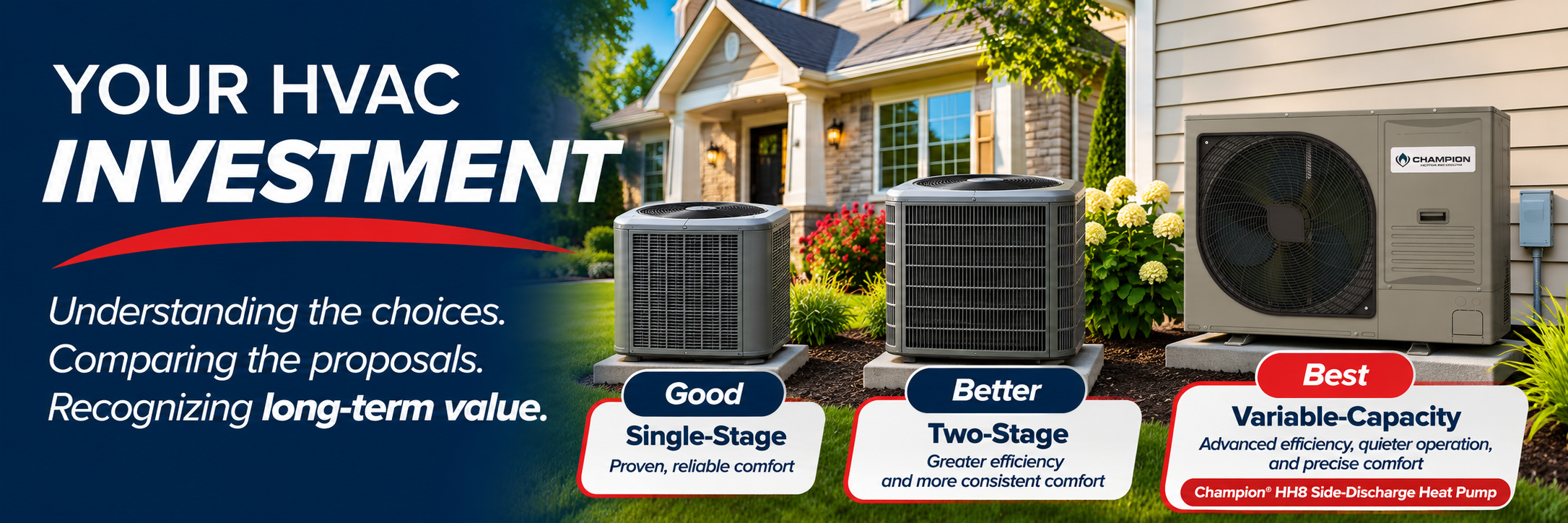
Many HVAC contractors present several replacement packages organized as Good, Better, and Best.
This approach gives homeowners a range of equipment and pricing options.
However, these labels are not standardized industry classifications.
One contractor’s Better package may contain equipment another contractor places in a different category.
The important consideration is what each option actually includes.

What Might Be Different?
A basic equipment package may provide dependable heating and cooling with relatively simple operating technology.
A midrange option might offer improved efficiency, additional comfort features, or multi-stage operation.
A premium package could incorporate higher efficiency, variable-capacity technology, quieter operation, or advanced controls.
These are general examples, not guarantees about any particular equipment tier.
Single-Stage, Two-Stage, and Variable-Capacity Equipment
Single-stage equipment generally operates at one primary heating or cooling output when running.
Two-stage equipment can operate at a lower or higher output, potentially improving temperature control and comfort during moderate conditions.
Variable-capacity equipment can adjust output across a broader operating range, allowing it to respond more gradually to changing heating and cooling demands.
Some systems also use variable-speed indoor blowers, which can offer additional control over airflow. A variable-speed blower and a variable-capacity compressor are not the same feature.
The benefits depend on the specific equipment, its controls, proper installation, and the characteristics of the home.
Is the “Best” Package Always the Best Choice?
No.
A premium system may offer excellent efficiency and comfort, but that doesn’t automatically make it the most appropriate investment for every household.
A homeowner who values simple operation and has relatively modest heating and cooling needs may find an appropriately selected midrange system entirely satisfactory.
Another homeowner may place substantial value on quieter operation, improved humidity control, and lower long-term energy consumption.
The contractor’s definition of “Best” should never replace the homeowner’s definition of value.
Ask what each upgrade provides, how it addresses your priorities, and whether the benefits justify the additional investment.
8. Could Higher Efficiency Be a Better Long-Term Investment?
Higher-efficiency equipment often carries a higher initial price.
That difference can lead homeowners to dismiss a more advanced option before considering potential energy savings or available incentives.
But the original quoted price may not tell the entire story.
Consider the Net Installed Cost
Some qualifying heating and cooling systems may be eligible for utility incentives, manufacturer promotions, or state energy-efficiency programs.
Depending on the program, these incentives may be applied as an upfront discount or provided through a rebate process.
For example, a higher-efficiency system might initially cost substantially more than a basic replacement.
If it qualifies for a meaningful incentive that the lower-efficiency option does not, the difference in actual purchase cost could narrow.
That doesn’t automatically make the upgraded system the better financial choice, but it changes the comparison.
Homeowners should ask:
- Does the recommended equipment qualify for an available incentive?
- What are the eligibility requirements?
- Must the equipment be installed by a participating contractor?
- Is the incentive already reflected in the quoted price?
- Who submits the required documentation?
- Are there application deadlines or funding limitations?
- Can multiple incentives be combined?
Eligibility should be confirmed before making a purchase decision.
Programs can change, and incentives offered by one utility or jurisdiction may not apply to another.
Maryland residents, for example, can consult their participating utility’s energy-efficiency programs through the Maryland Public Service Commission.
A note about federal incentives: The federal Energy Efficient Home Improvement Credit previously available for certain qualifying HVAC improvements ended for property placed in service after December 31, 2025. Homeowners should verify current federal, state, utility, and manufacturer programs rather than relying on older advertisements describing expired incentives.
Evaluate Potential Operating Savings
After accounting for confirmed incentives, compare the actual additional investment with the equipment’s potential energy savings.
A useful comparison should consider the home’s existing energy consumption, heating fuel, cooling demands, local utility rates, and expected equipment performance.
For example, someone with significant annual heating and cooling expenses may have more opportunity to recover the cost of an efficiency upgrade than someone with relatively low energy consumption.
Projected savings should be presented as estimates, not guarantees.
Consider How Long You Expect to Remain in Your Home
The homeowner’s circumstances also matter.
Someone planning to remain in a home for many years may place greater value on long-term operating savings.
Someone anticipating a move in the near future might prioritize different factors.
The best investment depends on the balance between cost, anticipated benefits, and individual priorities.
9. What Is Actually Included in an HVAC Replacement Quote?
Two estimates that appear similar at first glance may represent substantially different installation projects.
A homeowner should understand not only which equipment is being provided, but also the work required to install it correctly.
Equipment Specifications
A written proposal should clearly identify the principal equipment being offered.
Depending on the installation, that may include manufacturer names, model numbers, capacities, efficiency ratings, and the indoor and outdoor components.
Ask for clarification if the proposal identifies only a brand or general equipment series.
Specific models make meaningful comparisons easier.
Installation Materials and Modifications
Replacing HVAC equipment can involve considerably more than removing an old unit and connecting a new one.
Depending on the project, the installation may require:
- Refrigerant piping or modifications to existing line sets.
- Electrical connections or upgrades.
- Equipment pads, brackets, and supports.
- Condensate drainage improvements.
- Venting or combustion-air modifications.
- Duct transitions or airflow improvements.
- Thermostats and controls.
- Removal and disposal of old equipment.
- Necessary safety devices and installation accessories.
Not every installation requires every item.
The important point is that homeowners should understand what work is included, what is excluded, and whether the proposed materials and modifications are appropriate for the selected equipment.
Permits and Inspections
Applicable permit and inspection requirements vary by location and scope of work.
Before accepting a proposal, establish who is responsible for obtaining required permits and coordinating inspections.
Those responsibilities should be clear in the written agreement.
What Happens If Unexpected Problems Are Discovered?
Some installation conditions cannot be fully evaluated until equipment is removed or work begins.
For example, previously concealed damage or an unsuitable connection may require additional work.
Ask how unexpected conditions will be communicated and how any additional charges will be approved.
A written change-order process helps prevent misunderstandings.
Look Carefully at Exclusions
A proposal’s exclusions can be just as important as its list of included services.
If electrical upgrades, ductwork repairs, or other necessary modifications are excluded, those items may represent additional expenses.
Compare the complete scope of work—not simply the equipment description and final price.
10. Why Professional Expertise and Installation Quality Matter
A replacement proposal represents more than a selection of equipment.
It also reflects the contractor’s assessment, technical recommendations, installation methods, and ability to support the system after installation.
Professional expertise is valuable because homeowners face numerous choices, some of which have consequences they may not immediately recognize.
A knowledgeable contractor should be able to explain not only which equipment is recommended, but why it is appropriate for the home.
What Does a Thorough Consultation Look Like?
Consider whether the contractor:
- Listens to your comfort concerns and priorities.
- Asks about previous repairs and reliability problems.
- Evaluates the existing installation.
- Considers changes to the home.
- Explains the basis for equipment sizing.
- Assesses relevant ductwork and airflow conditions.
- Discusses reasonable alternatives.
- Explains differences in efficiency and technology.
- Identifies necessary installation modifications.
- Provides clear answers without unnecessary pressure.
Not every home requires the same work, but recommendations should have an understandable technical basis.
Quality Installation Matters After the Contractor Leaves
Even excellent equipment can deliver disappointing results if it is improperly installed.
Important installation practices may include verifying airflow, checking refrigerant charge according to manufacturer procedures, confirming safe electrical operation, evaluating condensate drainage, and testing equipment controls.
For fuel-burning appliances, appropriate combustion and venting checks are essential.
The necessary tests depend on the equipment and installation.
ENERGY STAR emphasizes proper sizing, airflow, and refrigerant charge as important elements of HVAC installation quality because deficiencies can affect comfort, efficiency, and equipment performance.
Ask About Startup and Performance Verification
Homeowners should ask what procedures will be completed before the installation is considered finished.
Will the contractor verify that the system operates properly in the available operating modes?
Will airflow or relevant system measurements be evaluated?
Will the installer explain the thermostat, filter maintenance, and any special operating features?
Will equipment documentation and warranty information be provided?
A well-executed installation should include appropriate startup procedures and a clear handoff to the homeowner.
Evaluating Contractor Qualifications
Licensing, insurance, relevant experience, and reputation are all reasonable considerations.
Ask whether the contractor is properly licensed for the work in your jurisdiction and carries appropriate insurance.
Customer reviews may offer useful insight, particularly when they describe installation quality, communication, follow-up service, and how problems were resolved.
However, reviews and advertised credentials should complement—not replace—an evaluation of the actual proposal.
Professional expertise should be demonstrated through the quality of the assessment, clarity of the recommendations, and standards of installation—not assumed from the price alone.
11. Understanding the True Long-Term Value of Your HVAC Investment
This is where all the considerations we’ve discussed come together.
The installation price is important. Every homeowner has financial priorities and limitations.
But the purchase price represents only one part of the investment.
A replacement system may serve your home for many years. During that time, its efficiency, reliability, maintenance requirements, warranty protection, and everyday comfort will influence the value you receive.

Initial Investment Versus Total Ownership Costs
A useful way to think about the financial side of a replacement is:
Initial installed cost − confirmed incentives + future energy expenses + maintenance and repair costs.
This isn’t a precise prediction of what a system will cost over its entire life.
It is a framework for understanding why the lowest installation price doesn’t necessarily produce the lowest long-term expense.
A less expensive system might have a lower initial cost but consume more energy.
A premium system might reduce operating expenses but cost considerably more to purchase.
Necessary ductwork improvements could increase the initial investment while addressing comfort problems and supporting proper system performance.
Every proposal should be evaluated in context.
Reliability and Future Repairs
No contractor can guarantee that equipment will operate indefinitely without requiring repairs.
However, proper equipment selection, installation quality, appropriate maintenance, and warranty protection can influence the homeowner’s exposure to future expenses.
When comparing proposals, consider whether the recommended equipment and installation address known problems that could otherwise continue after replacement.
A system that repeatedly requires service because an existing airflow problem wasn’t corrected may become more expensive and frustrating than the original estimate suggested.
Warranty Protection Helps Protect Your Investment
Warranty coverage is an important component of long-term value.
Two systems with similar installed prices may provide very different protection against future repair expenses.
A manufacturer’s parts warranty does not necessarily cover labor, refrigerant, or every cost associated with repairing a covered component.
Additional protection may be available through qualifying labor and refrigerant coverage arrangements.
Homeowners should also understand registration requirements, maintenance obligations, exclusions, transferability, and how claims are handled.
Rather than repeating the details here, we’ve prepared a separate educational resource:
Related Reading: A Homeowner’s Guide to Getting the Most from Your HVAC Warranty
That guide explains the different types of HVAC protection, potential repair expenses, common exclusions, and the importance of maintaining proper documentation.
Warranty terms should always be evaluated using the actual documents applicable to the proposed installation.
Comfort Is Also Part of Long-Term Value
Some of the most meaningful benefits of an HVAC replacement cannot be measured solely in dollars.
Consider the value of a bedroom that remains comfortable during summer.
Or an outdoor unit quiet enough that you can enjoy your patio without excessive noise.
Perhaps your priority is a simple thermostat that everyone in the household can operate confidently.
Maybe improved temperature consistency or humidity control is more important than obtaining the highest available efficiency rating.
These benefits may contribute to your satisfaction every day.
Long-term value includes what the system costs to own—and how well it serves the people living in the home.
Financing Is Part of the Comparison
If you’re financing your replacement, review the financial terms as carefully as the equipment specifications.
Consider the annual percentage rate (APR), repayment period, total amount financed, total repayment amount, and any promotional conditions.
A low monthly payment may be attractive, but it doesn’t necessarily represent the lowest total cost.
For promotional financing, confirm when the promotional period ends and whether interest or other conditions apply.
Ask whether the financing arrangement affects the quoted purchase price and whether a separate cash-price option is available.
Compare the full financial commitment rather than focusing exclusively on the monthly payment.
12. How to Compare HVAC Replacement Quotes Side by Side
Once you’ve reviewed the available proposals, it’s time to compare them systematically.
This is where the information you’ve gathered about your home and priorities becomes especially valuable.
Start by confirming that each contractor understands the same concerns.
If one contractor evaluated an uncomfortable addition and another did not, that difference deserves attention before comparing prices.

Step One: Compare the Proposed Equipment
Identify the system type, capacity, efficiency, operating technology, and principal components.
Are the systems reasonably comparable?
Does one include features the others do not?
Are the advantages of those features meaningful to your household?
Step Two: Compare the Installation Scope
Review the proposed materials, modifications, permits, and installation procedures.
Does one proposal include necessary ductwork improvements or electrical modifications that another excludes?
Are the reasons for those differences explained?
Step Three: Compare the Contractor’s Evaluation
Consider how each contractor approached the project.
Were your concerns investigated?
Did the recommendations address the conditions in your home?
Were alternatives explained?
Can you understand why the proposed equipment was selected?
Step Four: Compare Warranty Protection
Review the actual parts, labor, and refrigerant coverage offered with each proposal.
Identify any differences in registration responsibilities, maintenance requirements, and exclusions.
Refer to our HVAC Warranty Guide when you need a more detailed explanation.
Step Five: Compare the Financial Investment
Consider the installed price, confirmed incentives, financing terms, potential energy savings, and identifiable future expenses.
If one system costs more initially, determine what additional value it provides.
The answer may involve higher efficiency, installation improvements, enhanced comfort, or better protection against certain repair expenses.
Step Six: Compare the Proposals Against Your Priorities
Return to the three priorities you identified before requesting estimates.
Which proposed solution best addresses them?
A system with the highest efficiency rating may not be the best match for someone whose primary concerns are quiet operation and simple controls.
Likewise, a homeowner particularly concerned about long-term energy expenses may place greater value on an efficiency upgrade.
The goal isn’t to find a universally superior system.
It’s to identify the proposal that provides the most appropriate combination of performance, comfort, protection, and value for your home.
13. Why Three Different Quotes May All Be Reasonable
Consider a hypothetical homeowner with an aging air-conditioning system.
The home has two stories. Upstairs bedrooms tend to be warmer than the main floor, the outdoor unit is noisy, and a family room was added several years ago.
The homeowner requests three replacement estimates.
Contractor A recommends replacing the existing equipment with a similarly sized, standard-efficiency system.
Contractor B recommends higher-efficiency equipment and includes modifications to improve the return-air system.
Contractor C recommends a variable-capacity system with advanced controls and additional comfort features.
The prices vary considerably.
Which proposal is best?
There isn’t enough information to answer that question based on price and equipment descriptions alone.
Contractor A’s recommendation might be entirely appropriate if the existing system and ductwork have been evaluated and found suitable.
Contractor B’s proposal may provide additional value if the recommended airflow improvements address a genuine limitation.
Contractor C’s equipment may offer meaningful comfort and efficiency advantages, but those benefits should be weighed against the additional investment and the homeowner’s preferences.
The homeowner should ask each contractor to explain the recommendations and the expected benefits.
If the proposals differ substantially in equipment capacity or necessary modifications, those differences should be resolved before making a decision.
A higher price doesn’t automatically establish greater value.
A lower price doesn’t automatically indicate an inferior installation.
The best-supported recommendation is the one that appropriately addresses the home’s needs and provides a clear explanation of the investment.
14. Warning Signs That Deserve a Closer Look
Most homeowners aren’t expected to understand every technical detail of an HVAC installation.
They should, however, feel confident that their questions are being answered and that the proposal accurately describes the work.
Some situations warrant further clarification:
Vague equipment descriptions. If a quote identifies only a general brand or equipment category, ask for the actual proposed models.
Unexplained sizing recommendations. If equipment capacity is based solely on the existing unit or square footage, ask how the home’s heating and cooling requirements were evaluated.
Ignored comfort concerns. If a contractor doesn’t investigate the problems you’ve described, ask how the proposed replacement will address them.
Unclear installation scope. Establish which materials, modifications, permits, and services are included.
Incomplete warranty explanations. Request written details rather than relying on broad promises of comprehensive coverage.
Unverified incentive claims. Confirm eligibility and determine whether the advertised incentive is already reflected in the price.
Pressure to make an immediate decision. A significant home investment deserves enough time to review the proposal, understand the terms, and ask questions.
None of these circumstances automatically proves that a contractor is unqualified.
They do indicate that additional information may be necessary before committing to the project.
15. Two Practical Tools for Making a Better Decision
The information in this guide becomes more useful when you can apply it to your own home.
Two simple worksheets can help organize the process.
Your Home Comfort & HVAC Replacement Planning Worksheet
📄 Download Your Free Home Comfort & HVAC Replacement Planning Worksheet (PDF)
📄 Download Your Free HVAC Replacement Quote Comparison Worksheet (PDF)
Complete this worksheet before meeting with contractors.
Record:
- The type and approximate age of your existing equipment.
- What you like about its current performance.
- Rooms that are consistently uncomfortable.
- Noise, humidity, and airflow concerns.
- Previous repairs and recurring problems.
- Available utility consumption records.
- Additions, renovations, or insulation improvements.
- Your three most important priorities.
- Questions you want to discuss during the consultation.
Bring the completed worksheet to each appointment.
Providing the same information to every contractor helps establish a consistent starting point.
You don’t need to diagnose the problems yourself.
Your job is to describe what you’re experiencing and what you’d like to improve.
Your HVAC Replacement Quote Comparison Worksheet
Once you’ve received written proposals, use a second worksheet to compare:
- Equipment type and model.
- Recommended capacity.
- Efficiency ratings.
- Basis for sizing recommendations.
- Ductwork assessment and proposed modifications.
- Installation materials and included services.
- Permits and inspection responsibilities.
- Startup and performance verification.
- Warranty coverage.
- Available incentives.
- Installed price.
- Financing terms.
- Estimated operating-cost differences.
- Exclusions and potential additional expenses.
- How well each proposal addresses your personal priorities.
This process helps shift the comparison away from a simple list of prices.
It allows you to see what each contractor is proposing—and what additional information you may need before deciding.
16. Making an Informed HVAC Replacement Decision
Replacing your home’s heating and cooling equipment is about more than selecting a brand or choosing among several quoted prices.
It’s an opportunity to evaluate how your home performs, address longstanding comfort concerns, consider advances in heating and cooling technology, and make an investment that can serve your household for years.
Start by understanding your existing system.
Document what you like, what you’d improve, and how reliably the equipment has performed.
Consider changes to your home and identify the features that matter most to you.
Then evaluate the recommendations you receive.
Does the proposed system fit your home’s current heating and cooling needs?
Has the existing ductwork been considered?
Are equipment differences and efficiency ratings explained?
Does the proposal clearly describe the installation, materials, and services included?
Are rebates and potential operating savings presented realistically?
Does the contractor demonstrate the knowledge and attention necessary to recommend and install an appropriate system?
And does the warranty protection adequately address your expectations for long-term ownership?
Most importantly, consider the complete investment.
The lowest installation price isn’t necessarily the best long-term value. And the highest-priced system isn’t automatically the best investment.
The right choice is the one that appropriately serves your home, reflects your priorities, and offers a well-supported balance of initial cost, performance, comfort, reliability, and protection.
An informed homeowner is better prepared to recognize that value—and make a decision with confidence.
Continue Planning Your HVAC Investment
For a more detailed understanding of parts, labor, refrigerant coverage, and protecting your investment, explore our companion article:
A Homeowner’s Guide to Getting the Most from Your HVAC Warranty
You can also use Air Doctor’s Personalized HVAC Replacement Planner to organize your equipment information, comfort concerns, priorities, and replacement considerations before requesting professional guidance.
The better you understand your home’s needs and the options available, the more effectively you can evaluate the proposals you receive.
Whether you require installation, repair, or maintenance, our technicians will assist you with top-quality service at any time of the day or night. Take comfort in knowing your indoor air quality is the best it can be with MOE heating & cooling services Ontario's solution for heating, air conditioning, and ventilation that’s cooler than the rest.
Contact us to schedule a visit. Our qualified team of technicians, are always ready to help you and guide you for heating and cooling issues. Weather you want to replace an old furnace or install a brand new air conditioner, we are here to help you. Our main office is at Kitchener but we can service most of Ontario's cities
Source link