
Dual-fuel residential systems that pair a modern heat pump with a natural gas furnace are driving the evolution of the household thermostat.
For decades, the thermostat was essentially a switch that turned an HVAC system on in response to a call for heating or cooling and off when the setpoint was reached. Over the years, programmable and Wi-Fi thermostats have added features such as scheduling, remote access, and advanced temperature management. But their fundamental job has remained the same: controlling HVAC equipment to maintain desired indoor temperatures.
Now, thermostats optimized for dual-fuel systems can operate as the brains of the system. Using contractor and homeowner settings as well as data such as outdoor temperature and equipment performance, they can decide which heating source to use and when.
“Dual-fuel systems are transforming the thermostat from a simple temperature controller into an intelligent platform for energy management and equipment optimization,” said Raheel Chaudhry, director of systems engineering and architecture at Rheem Manufacturing Co.
“Modern smart thermostats, including ecobee, provide configurable thresholds that allow contractors to fine-tune changeover temperatures, staging behavior, runtime limits, and auxiliary heat operation,” said Eric Della Ventura, technical sales engineer at thermostat maker ecobee. “These controls help ensure that the system operates efficiently while maintaining homeowner comfort across a wide range of climates and applications.”
Compatibility vs. Optimization
Not all thermostats capable of controlling dual-fuel systems offer the same level of sophistication, and thermostats that offer only basic dual-fuel compatibility may limit contractors’ ability to maximize comfort and efficiency for their customers.
“Compatibility gets the system operating. Optimization helps it perform as intended,” said Marissa Kocaman, senior product manager for Honeywell Home at Resideo Technologies Inc. “A dual-fuel thermostat must explicitly support a heat pump paired with a fossil-fuel furnace and control the changeover correctly. A thermostat designed with more configuration options lets the contractor tailor the balance point to the heat pump’s capabilities, the home, and the climate.”
Looking for quick answers on air conditioning, heating and refrigeration topics?
Try Ask ACHR NEWS, our new smart AI search tool.
Ask ACHR NEWS
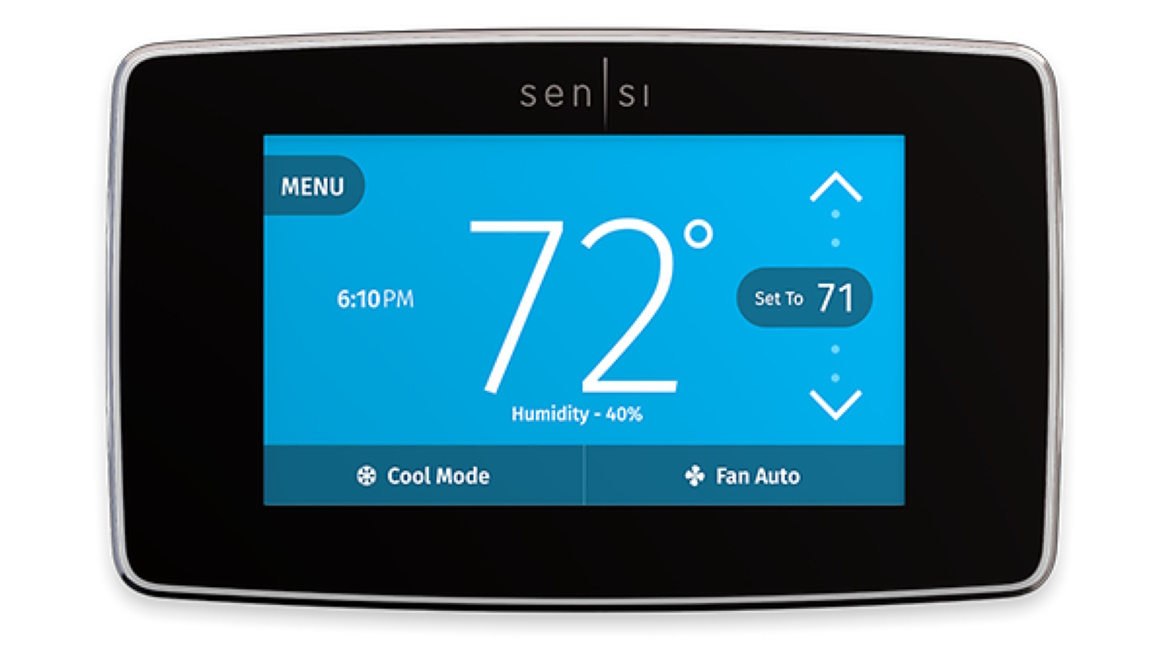
IN TUNE: The Copeland Sensi Touch thermostat offers features for running a residential dual-fuel system that go beyond basic compatibility. (Courtesy of Copeland)
Honeywell Home has FocusPRO and ElitePRO thermostats that support dual-fuel systems. Resideo Pro-IQ Analyze, a remote HVAC system-monitoring and diagnostic service, lets contractors assess how equipment is running and spot problems. The Pro-IQ platform also provides remote access that, where supported, allows contractors to adjust equipment lockouts without sending out a technician.
“Those capabilities help contractors refine the strategy as they learn how the system performs in the home,” Kocaman said.
Basic dual-fuel-compatible thermostats may also lack features that simplify commissioning and servicing, Chaudhry said.
“A non-optimized thermostat may provide fewer system diagnostics, less visibility into equipment operation, limited remote troubleshooting capabilities, and fewer opportunities to demonstrate the full value of high-efficiency or variable-capacity equipment,” he said.
Dual-fuel-optimized thermostats can also provide custom compressor and auxiliary heat lockouts and coordinate with the heat pump’s defrost cycle, said Divya Darshini Piskala, product manager at Bosch Home Comfort.
“An optimized thermostat can activate the furnace during the defrost cycle to maintain comfort,” she said.
Balance Point Flexibility
With a system in heating mode, dual-fuel thermostats have typically used a fixed outdoor-temperature changeover point to determine when to switch from the heat pump to the furnace. The changeover temperature may be based on the system’s thermal balance point, the outdoor temperature at which the heat pump’s heating capacity equals the home’s heating load. Contractors have also selected changeover temperatures based on manufacturer recommendations, homeowner comfort expectations, and conventional installation practices.
Some cold-climate heat pumps can maintain 100% of their rated heating capacity at outdoor temperatures as low as 5°F, or even lower, potentially allowing them to meet a home’s heating needs under conditions that would have required backup heat with older equipment. Meanwhile, advances in thermostat technology are expanding the range of information that can be considered when determining when to switch heating sources.
The economic balance point — the outdoor temperature at which the cost of providing heat with the heat pump equals the cost of providing the same amount of heat with the gas furnace — can also influence the selection of a changeover temperature. That point can differ substantially from the thermal balance point and may shift as electricity and natural gas prices change. Another factor that could influence the decision is heat pump performance.
“The changeover point could be dynamic rather than permanently fixed,” said Tom Lorenz, director of product at Copeland. “For example, the heat pump might remain the preferred source at a lower outdoor temperature when electricity is comparatively inexpensive or when it continues to operate efficiently. The furnace, however, might become preferable sooner when natural gas is less expensive, or the heat pump cannot effectively meet the home’s heating demand.”
“Rather than prescribing one method, a modern thermostat should provide flexibility to match the strategy to the equipment combination and homeowner priorities,” said Sri Swaminathan, director of residential controls and solutions at Daikin Comfort Technologies.
Getting the Setup Right
Dual-fuel systems with communicating equipment can simplify installation and commissioning, Swaminathan said, but technicians should also verify the thermostat wiring and system configuration and test the system.
“Also, talk with the homeowner about their comfort and preferences so that they are matched with the thermostat’s configuration,” he said.
When installing a thermostat for a dual-fuel system, Lorenz said, technicians should:
• Verify that the thermostat can control both the heat pump and furnace while preventing improper simultaneous operation. (Simultaneous operation of the heat pump and furnace during a normal heating call, outside of a defrost cycle, could overheat the indoor coil and damage the compressor, Piskala noted.)
• Verify that the thermostat can accept or support information about the outdoor temperature.
• Confirm that the thermostat can handle the required staging logic.
“From a commissioning standpoint, technicians need to verify that the thermostat has been configured for a dual-fuel system rather than a conventional heat pump with electric auxiliary heat,” Lorenz added.
“Contractors should recognize that the optimal dual-fuel configuration can vary significantly from one installation to the next,” Della Ventura said. “Even when two systems are technically dual-fuel systems, the ideal settings may differ based on equipment capabilities, climate conditions, utility costs, and homeowner preferences.”
Whether you require installation, repair, or maintenance, our technicians will assist you with top-quality service at any time of the day or night. Take comfort in knowing your indoor air quality is the best it can be with MOE heating & cooling services Ontario's solution for heating, air conditioning, and ventilation that’s cooler than the rest.
Contact us to schedule a visit. Our qualified team of technicians, are always ready to help you and guide you for heating and cooling issues. Weather you want to replace an old furnace or install a brand new air conditioner, we are here to help you. Our main office is at Kitchener but we can service most of Ontario's cities
Source link