
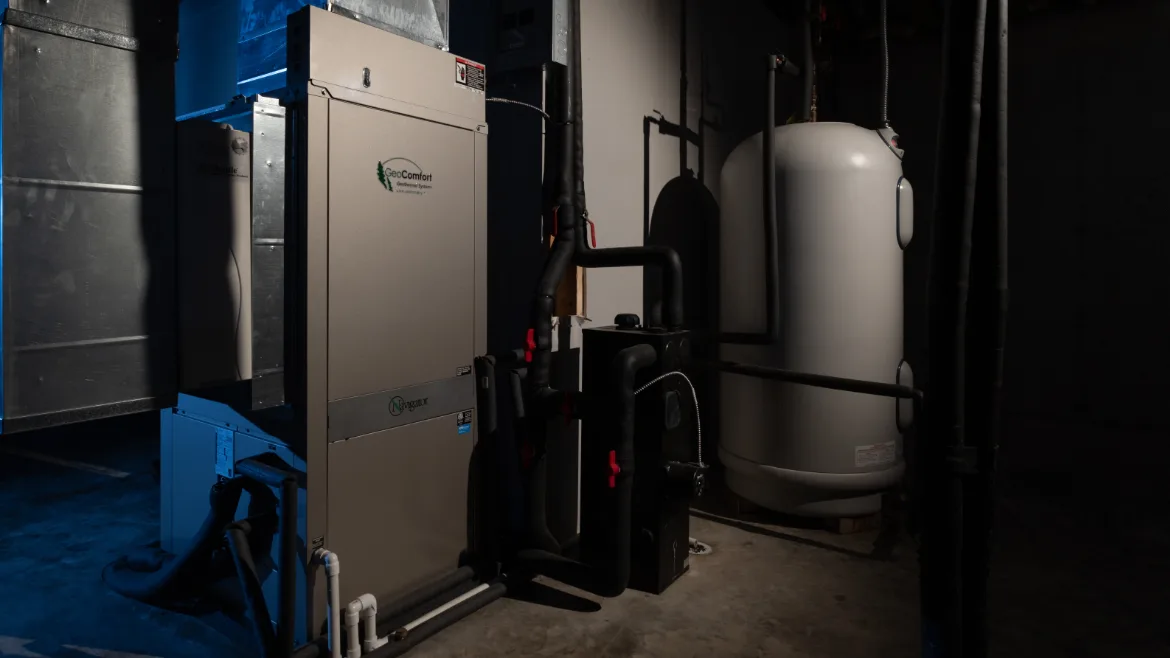
Upfront cost has always been a major roadblock to geothermal HVAC going mainstream. Now Enertech Global LLC is aiming to remove that obstacle with a brand-new program: a geothermal lease, with no money down and a fixed monthly payment.
Enertech is partnering with Palmetto, a clean energy financing company, to offer a 10-year residential geothermal lease that includes maintenance and repairs. Separately, the company is also partnering with Figure for a home equity line of credit to finance geothermal installations.
By removing upfront cost from the equation, the leasing option could open the door to an entirely new group of geothermal customers: homeowners who want the efficiency and energy savings of geo technology but have been dissuaded by the initial cost.
A Tax Credit Twist Opens the Door
Launching the leasing program was primarily driven by changes afforded to the industry by the One Big Beautiful Bill Act, passed in July 2025.
While the OBBBA canceled the residential tax credit for geothermal, it kept the commercial credit and added an important caveat: allowing the leasing of geothermal systems, previously disallowed under an IRS tax principle called the limited-use doctrine.
“The lease transaction that is now allowed in a residential structure falls under Section 48 of the IRS code, which makes available to the leasing company the tax credits and domestic content credits,” explained Rob Derksen, director of business development at Enertech
In other words, commercial tax credits can now be brought to bear on the residential side if run through a commercial owner.
Looking for quick answers on air conditioning, heating and refrigeration topics?
Try Ask ACHR NEWS, our new smart AI search tool.
Ask ACHR NEWS
It’s a new concept for geothermal, but it’s not the first renewable technology to use this model. After the federal solar investment tax credit took effect in 2006, companies like Sunrun and SolarCity began offering residential solar through third-party ownership arrangements, helping fuel the industry’s rapid growth in the early 2010s by reducing or eliminating upfront costs for homeowners. By 2014, 72% of U.S. residential solar installations were third-party owned through leases and power purchase agreements, according to GTM Research.
But the solar business model doesn’t necessarily translate cleanly to geothermal, cautioned Joe Parsons, vice president of thermal energy networks at Transformative Technologies. Solar is modular and largely plug-and-play, he said, while geothermal is permanent infrastructure and requires site-specific engineering.
Then there’s the sales side, another place he said doesn’t align with HVAC.
“The rooftop solar boom was driven heavily by aggressive, commission-based direct-sales companies roaming neighborhoods with multipage, fine-print contracts, closing deals quickly and brokering the work off to third-party subcontractors,” Parsons said. Contrast that with most established HVAC contractors, he said, who build their reputations on equipment reliability, craftsmanship, and local trust.
No Money Down. More Buyers?
Geothermal leasing creates the opportunity to address one of the industry’s most persistent challenges: the disparity between its long-term operating savings and its higher initial installation cost.
“Upfront cost has always been a factor in the demographic of a geothermal buyer,” said Derksen. “The irony is that those who need to have access to the most efficient systems often could not afford to fund the upfront cost, so they made a decision to buy a less efficient ordinary system with a lower initial cost.”
Leasing will provide access to geothermal to homeowners that have not had the cash to fund a project, Derksen said. The lease option comes with no upfront cost to the buyer, and monthly payments include all the required maintenance and 100% coverage under warranty for the term of the lease.
“Our new buyer will be those who have previously had to opt for an air-source heat pump due to a lower first cost but a higher energy cost,” he said. “This gives the buyer the peace of mind that their budget is fixed, they will never have a surprise increase in maintenance costs, and any needed repairs are fully covered.”
Parsons agreed with that customer assessment.
“The customer saying yes is someone who was already planning an equipment replacement, wants ground-source efficiency, but simply cannot or will not write a $30,000 to $50,000 check upfront,” he said.
Realistically, emergency replacements are still out of the picture, Parsons said, because homeowners with an a/c or furnace out in the middle of a heat wave or frigid winter will still want their HVAC restored immediately. More likely customers, he said, are the planned-replacement buyer or the “trade-off buyer” — someone “willing to trade the independence of equipment ownership for a predictable monthly payment, provided the immediate utility savings offset a meaningful portion of that fee,” he said.
Still, Parsons questioned the level of interest the program would generate among contractors.
“On paper, it attacks the obvious barrier: eliminating the upfront capital cost of the ground heat exchanger (GHEX),” he said. “But in practice, a $0-down, multi-year commitment completely changes what an HVAC contractor is selling.” Seasoned geothermal contractors “have historically been very reluctant to push long-term financing or lease structures” because it turns an equipment recommendation into a multi-decade commitment, he said.
“While it expands the theoretical pool of buyers, whether it meaningfully moves the needle depends on how many reputable contractors are actually willing to pull that tool out of their satchel and stake their reputation on it,” he said.
As far as cost, Derksen said it’ll be common for the reduction in a homeowner’s energy bill to offset one-third to one-half of the monthly lease payment.
The program also offers the homeowner the ability to buy out the lease after five years without penalty, transfer the lease to a new homeowner, or extend the lease up to five years beyond the 10-year term at a discounted monthly payment.
The Contractor’s Role in Leasing
While the leasing arrangement changes how the project is financed, the installation process for the HVAC contractor is still pretty standard.
“From a contractual standpoint, the contractor doesn’t do anything different,” Derksen said. “Palmetto does require documentation that will ensure that all steps have been successfully completed and documented prior to funding.”
The homeowner agrees to the contractor’s installation price and applies for lease approval through Palmetto. Once that’s approved, the contractor gets paid by Palmetto at two milestones of the project: after the loop installation and at the completion and commissioning of the equipment. The homeowner’s lease payments begin after the project is completed.
Maintenance and repair work stays with the HVAC contractor who did the installation — Palmetto pays the contractor a set fee for maintenance. For warranty repairs, the equipment manufacturer provides a parts and labor allowance, with Palmetto supplementing the manufacturer’s labor reimbursement.
The program eliminates the risk of customer nonpayment and also creates a longer-term relationship between contractors and customers, Enertech said, because the lease provider determines who maintains the system. It also sets up future equipment replacements because the ground loop remains after the lease is over.
Room for Growth
Looking ahead, Enertech is “very optimistic” about the leasing program’s ability to reach new buyers, Derksen said. But the company doesn’t necessarily expect leasing to replace conventional geothermal cash sales.
“We feel the current buyer demographic will likely transact the same way they always have, with cash,” Derksen said. “But leasing opens the door to accessibility to a new set of buyers that have a greater need for efficiency and can truly benefit from the reduction in energy costs that geothermal can provide.”
Currently, the program is offered for existing-home retrofits. Palmetto has not provided a timeline for bringing the new construction option to Enertech, although Derksen is hopeful this would be rolled out in early 2027.
Whether you require installation, repair, or maintenance, our technicians will assist you with top-quality service at any time of the day or night. Take comfort in knowing your indoor air quality is the best it can be with MOE heating & cooling services Ontario's solution for heating, air conditioning, and ventilation that’s cooler than the rest.
Contact us to schedule a visit. Our qualified team of technicians, are always ready to help you and guide you for heating and cooling issues. Weather you want to replace an old furnace or install a brand new air conditioner, we are here to help you. Our main office is at Kitchener but we can service most of Ontario's cities
Source link

