Key Takeaways
- MERV rating doesn’t tell the whole story. A filter’s ability to capture dirt is only half the equation; the real cost is what it does to your static pressure and airflow.
- Surface area is your best friend. A 5-inch MERV 13 filter has 4 to 5 times more media surface than a 1-inch equivalent, which means much lower pressure drop and longer filter life.
- You can measure filter restriction with basic tools. A manometer and a test port are all you need to diagnose whether the filter is strangling your system.
- Your data backs up honest recommendations. When you document filter pressure drop systematically, you’re not pushing an upgrade; you’re showing the customer exactly what their filter is doing to their equipment.
The Real Cost of High-MERV Filters
Green technicians get the memo that MERV 13 is “better” than MERV 8. Better at capturing particles, sure. But the memo didn’t come with a pressure drop chart, nor explain why it’s important.
Filtering media is a sieve. The higher the MERV rating, the tighter the weave, and the tighter the weave, the more resistance to airflow.¹ Stuff air through a denser filter and you drop static pressure. Drop enough pressure, and you violate the equipment manufacturer’s external static pressure limit, usually around 0.5 inches of water column (w.c.) on residential systems.
Most techs don’t measure this. You install the filter, the customer breathes slightly worse air, the blower motor works harder, the compressor cycles longer, and nobody knows the filter was the culprit. The system creeps toward failure slowly enough that it looks like normal wear.
Field data tells the story. The National Comfort Institute gathered measurements across 178 residential and commercial systems and found that 85% tested in at less than 60% of their rated capacity to the conditioned space.²
Proctor Engineering’s analysis of over 13,000 units found 21% diagnosed with low airflow across the indoor coil.³ Most of those systems weren’t “broken.” They were starved by restrictions that nobody measured.
The MERV number itself doesn’t account for filter size. A MERV 13 in a 1-inch depth is a completely different animal than MERV 13 in a 4-inch or 5-inch depth. One chokes your system. The other barely blinks.
Why Surface Area Wins Against Density
When air moves through filter media, it encounters resistance proportional to the density of the fibers and the distance the air travels. In a 1-inch filter, that air column is compressed. In a 5-inch filter, the same media spreads over greater depth, which lowers the resistance.
But here’s the leverage: surface area. A standard 16″ x 25″ x 1″ filter has roughly 800 square inches of media surface. Fold that same media into a 5-inch depth (like a pleated or cartridge filter), and you’re looking at 4,000 to 5,000 square inches. That’s 5 to 6 times the surface.
More surface means lower face velocity, the speed at which air crosses the media. Lower face velocity means lower pressure drop. Lower pressure drop means your system breathes.
Independent testing shows a 4-inch MERV 13 produces 0.11 inches w.g. of resistance at 1,000 CFM. A 1-inch MERV 8 at the same airflow? 0.12. The deeper filter at a higher MERV rating creates less restriction than the shallow filter at a lower rating.
A 1-inch MERV 13 starts at roughly 0.22 to 0.27 w.c. in initial testing. Load it with dust in 30 to 60 days and you’re looking at 0.35 to 0.5 w.c. as it clogs. That same MERV 13 in a 5-inch cartridge drops 0.15 to 0.25 w.c. even when loaded. A 1-inch MERV 13 reaches maximum pressure drop in as little as 45 to 60 days, while a 5-inch version won’t hit that ceiling until 120 to 180 days because the larger surface area distributes the dust load.⁵ You’ve cut the resistance in half with better geometry and bought yourself twice the filter life.
The equipment manufacturer sets the limit at 0.5 w.c. total external static pressure because that’s what the blower can handle without overheating. Once you’re at or above that limit, you’re running the motor hot. The lifespan tanks. The compressor cycle time stretches. Cooling capacity drops because the coil isn’t seeing enough airflow.
Measuring Filter Pressure Drop
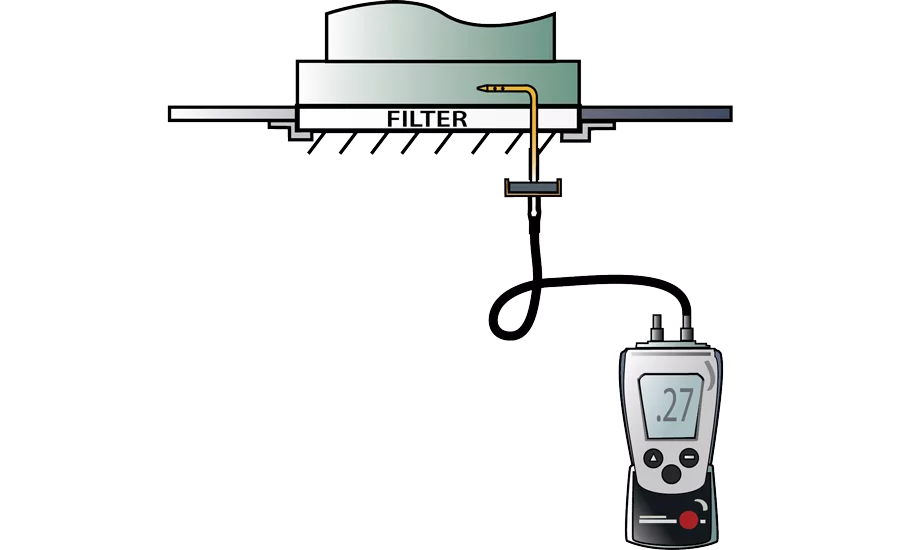
You can’t improve what you don’t measure. The measurement process is simple: measure the pressure difference across the filter before and after removing it.
ASHRAE Standard 52.2-2017 tests filters at specific face velocities, most commonly 492 FPM.⁴ But real-world installed velocities vary wildly. A standard 20 x 25 return grille at 1,000 CFM produces roughly 345 FPM, well below the test speed. An undersized 16 x 20 return at 800 CFM can exceed 600 FPM. The MERV rating on the box was earned at one velocity. Your installation runs at another. This is why field measurement matters more than the box rating.
The process requires a manometer, tubing, and test ports on your return plenum or supply ductwork (before and after the filter). With the system running at normal operating conditions, insert tubing into the upstream port and downstream port, then record the pressure difference. Remove the filter, reinsert the tubing, and take a second reading. The difference between these two readings is the pressure drop created solely by the filter.

If you’re consistently seeing 0.4 w.c. or higher from the filter alone, and your total external static is already at 0.5 w.c., the filter is the limiting factor. You’ve got data to show the customer: “Your filter is using up 80% of your equipment’s static pressure budget. Let’s look at a larger filter.”
The Bottom Line
MERV rating is important for particle capture. But it’s only half the story. Filter size, media surface area, and dust loading curves are the other half.
Measure filter pressure drop systematically. Document it. Use those numbers to guide your recommendations. You’re not pushing customers toward bigger filters; you’re showing them the data and letting them decide. When you walk through your general troubleshooting guide, pull out your manometer during a static pressure test. As you work through non-invasive system testing, measure the contribution of each component. When you find that the filter is the biggest offender, you’ve got a real upgrade to propose backed by evidence.
Remember that a restrictive filter upstream can mask evaporator coil performance issues. A clogged filter reduces airflow across the coil, which reduces heat transfer and makes the coil look weaker than it is. Fix the filter, and you might solve your capacity problem without touching the coil. This data is also the foundation for honest conversations about duct contamination prevention and system cleanliness. A clean system with proper filter sizing runs longer and costs less to maintain.
That’s the difference between being a technician who follows a checklist and being a technician who understands systems.
Additional Sources
- “System Effects of High Efficiency Filters in Homes”, Walker et al., Lawrence Berkeley National Laboratory (LBNL), LBNL-6144E, 2013.
- “Why Refrigerant Charge Programs Fail, and What We Can Do About It”, National Comfort Institute (NCI), White Paper, 2018.
- “What Can 13,000 Air Conditioners Tell Us?”, Proctor and Downey, ACEEE Summer Study Proceedings, 2002.
- “Method of Testing General Ventilation Air-Cleaning Devices for Removal Efficiency by Particle Size”, ASHRAE Standard 52.2-2017.
- “Comparing Filters for Resistance and Efficiency”, Tex-Air Filters, Independent Testing Report, 2020.
Whether you require installation, repair, or maintenance, our technicians will assist you with top-quality service at any time of the day or night. Take comfort in knowing your indoor air quality is the best it can be with MOE heating & cooling services Ontario's solution for heating, air conditioning, and ventilation that’s cooler than the rest.
Contact us to schedule a visit. Our qualified team of technicians, are always ready to help you and guide you for heating and cooling issues. Weather you want to replace an old furnace or install a brand new air conditioner, we are here to help you. Our main office is at Kitchener but we can service most of Ontario's cities
Source link