
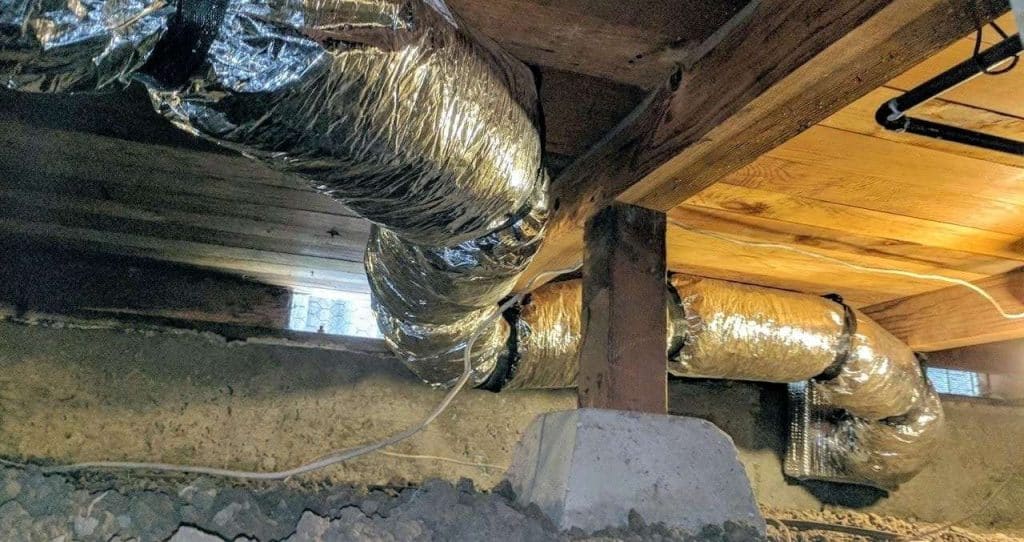
You live in the South Bay. Maybe it is an older San Jose ranch house, maybe a hillside place with long winding duct runs that snake halfway to the neighbor’s. It is July, the house feels like a sauna, and you have decided the fix is to buy the most expensive, highest-efficiency air conditioner money can buy.
Let me stop you right there, because real HVAC duct repair in San Jose starts long before you ever buy a box.
Bolting a premium variable-speed system onto a bad duct system is putting a Ferrari engine in a golf cart. It will be loud, it will rattle itself apart, and you will not enjoy the ride. You spent Ferrari money to be annoyed.
Most contractors will happily take the check, drop a shiny box in your side yard, and be gone before the concrete sets. We do it differently, because the comfort you actually feel inside your house has almost nothing to do with the brand stamped on the outdoor unit. Your comfort is decided by the invisible stuff: airflow, sizing, and duct design. That is what HVAC duct repair in San Jose is really about. Here is the science we use to engineer it, why we measure when everyone else eyeballs, and why airflow is the only thing that genuinely fixes a miserable house.
The Big HVAC Lie, Bigger Is Not Better
There is a stubborn myth in this industry. If a three-ton unit is struggling to cool your house, a four-ton will surely crush it. Wrong. An oversized air conditioner is one of the worst things you can put in a home.
An air conditioner does two jobs. It drops the temperature, and it pulls the humidity out. To wring the moisture out of your air, it needs to run in long steady cycles over a cold coil. Drop in a wildly oversized unit and it blasts the room cold in ten minutes and shuts off before it has removed any of the moisture.
That is short cycling. The house reads 70 degrees and still feels like a damp basement, because the humidity never left. It is clammy, it burns electricity, and all that slamming on and off kills your compressor years early. So we do not size a system off square footage and a gut feeling. We use the math.
Manual J, S, And D: The Math Behind The Magic
When we design a system for your house, we lean on three industry standards. No rules of thumb, no guessing. We calculate.
- Manual J is the load calculation. It is the math that figures out exactly how much heat moves in and out of your specific house. Square footage, wall insulation, window type, which direction the house faces. That tells us precisely how much heating and cooling you need on the worst day a valley heat pocket can throw at you.
- Manual S is equipment selection. Once we know your load, we match it to the real performance data of the equipment, so it handles both the temperature load and the humidity load instead of just one.
- Manual D is the duct design. This is how the conditioned air actually reaches every room. Airflow is not a race, it is a traffic jam. Every sharp turn, every crushed flex duct, every brick-wall filter adds friction. Ignore that friction and the air simply never makes it to the bedroom at the end of the hall.
System Blood Pressure And The Danger Of High Static
Your doctor checks your blood pressure to see whether your heart is straining to push blood through your arteries. We do the same thing for your system. We call it total external static pressure.
The blower motor is the heart. The ducts are the arteries. If your returns are undersized, or somebody slapped in a thick allergy filter that breathes like a phone book, the blower has to fight to move air. When static pressure climbs too high, a modern high-efficiency motor just spins harder and harder to muscle through the resistance. Your vents start to sound like a jet on a runway, your bill climbs, and the motor cooks itself.
High static is also the real hidden cause of a frozen coil. People think an air conditioner makes cold. It does not, it moves heat. If bad ductwork keeps warm house air from crossing the indoor coil, the refrigerant has no heat to grab, drops below freezing, and the moisture in your air turns to ice right on the coil. A frozen coil is almost never the thermostat set too low. It is a flashing sign that the system is starving for air. We measure static pressure on every job so we know the thing can actually breathe.
The Double Whammy Of Attic Duct Leakage
Plenty of older South Bay homes run their ducts through a blistering unconditioned attic. If those ducts are not sealed tight, you have duct leakage to the outside, and it hits you twice.
First, you are paying to cool air and then blowing some of it straight into the attic. Second, and this is the part people miss, every cubic foot of air pushed out of the house has to be replaced by a cubic foot sucked back in.
So when your leaky supply ducts dump air into the attic, your living space goes negative, and the house starts pulling replacement air through every gap it can find. Around the recessed lights, along the baseboards, past the windows. You are now drawing 120-degree dusty attic air straight into your living room and calling it air conditioning.
That is why we take duct sealing and Title 24 seriously, and not just to satisfy the city inspector. We use diagnostic tools to prove your ducts are tight. Sealed ductwork kills the double whammy, drops your bills, and keeps the dust and attic grime where it belongs.
How HVAC Duct Repair In San Jose Actually Fixes Your House
Good HVAC duct repair in San Jose is not about selling you a metal box. It is about comfort that actually shows up in the room you are sitting in.
So we use digital airflow grids to measure the real volume of air landing in your house, and we prove the system is moving exactly what the math says it should. We do the hot, sweaty, meticulous work up in the attic so you never have to think about any of it again.
Hire us and you get even temperatures room to room, lower bills, equipment that easily clears a decade, and the quiet of never thinking about your HVAC. That is what honest HVAC duct repair in San Jose delivers. We measure, we calculate, and we prove it.
Tired of one room that never gets comfortable?
We measure the airflow and static pressure, find the choke point, and fix it. HVAC duct repair in San Jose that actually evens out your house.
South Bay Airflow FAQ
Why is one room always hotter than the rest?
When one room is wildly out of step with the rest of the house, it is almost always an airflow and duct design problem. The run to that room may be too long, crushed, or packed with sharp bends that pile on friction. It can also happen when the room has no proper return path for the air to get back to the system. We find the exact choke point and modify the ductwork to balance it.
Why is my upstairs so hot?
Heat rises, but a roasting upstairs usually means the ducts are not delivering enough air volume to beat the heat coming off your roof, and often there is leakage on top of it. If the upstairs ducts are bleeding cold air into the attic, the system will never catch up. We measure the delivered airflow to the second floor to pinpoint exactly where the math is failing.
Do I need new ducts?
Not always. Sometimes the system just needs surgical fixes, like upsizing the main return, sealing the connections at the air handler, or swapping out a few strangling fittings. But if your ducts are decades old, falling apart, or far too small for modern equipment, starting fresh is the only way to guarantee the new system performs. Either way, we measure static pressure first, because honest HVAC duct repair in San Jose starts with a number, not a sales pitch.
Is a bigger AC better?
No, and an oversized one is a genuine problem. It cools the house too fast and shuts off before it pulls any humidity, leaving you cold, clammy, and unevenly cooled, with a compressor dying early from all the stopping and starting. We run a load calculation so your system is the exact right size, not the biggest one on the truck.
What is static pressure, and why does it matter?
Static pressure is the resistance your blower fights to push air through the ducts, basically the blood pressure of your HVAC system. Too high, usually from undersized returns or a restrictive filter, and the motor strains, the vents get loud, the bill climbs, and the motor fails early. Most residential systems should sit at or below 0.5 inches of water column. We measure it on every job.
Whether you require installation, repair, or maintenance, our technicians will assist you with top-quality service at any time of the day or night. Take comfort in knowing your indoor air quality is the best it can be with MOE heating & cooling services Ontario's solution for heating, air conditioning, and ventilation that’s cooler than the rest.
Contact us to schedule a visit. Our qualified team of technicians, are always ready to help you and guide you for heating and cooling issues. Weather you want to replace an old furnace or install a brand new air conditioner, we are here to help you. Our main office is at Kitchener but we can service most of Ontario's cities
Source link