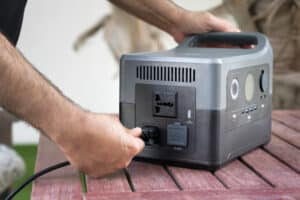
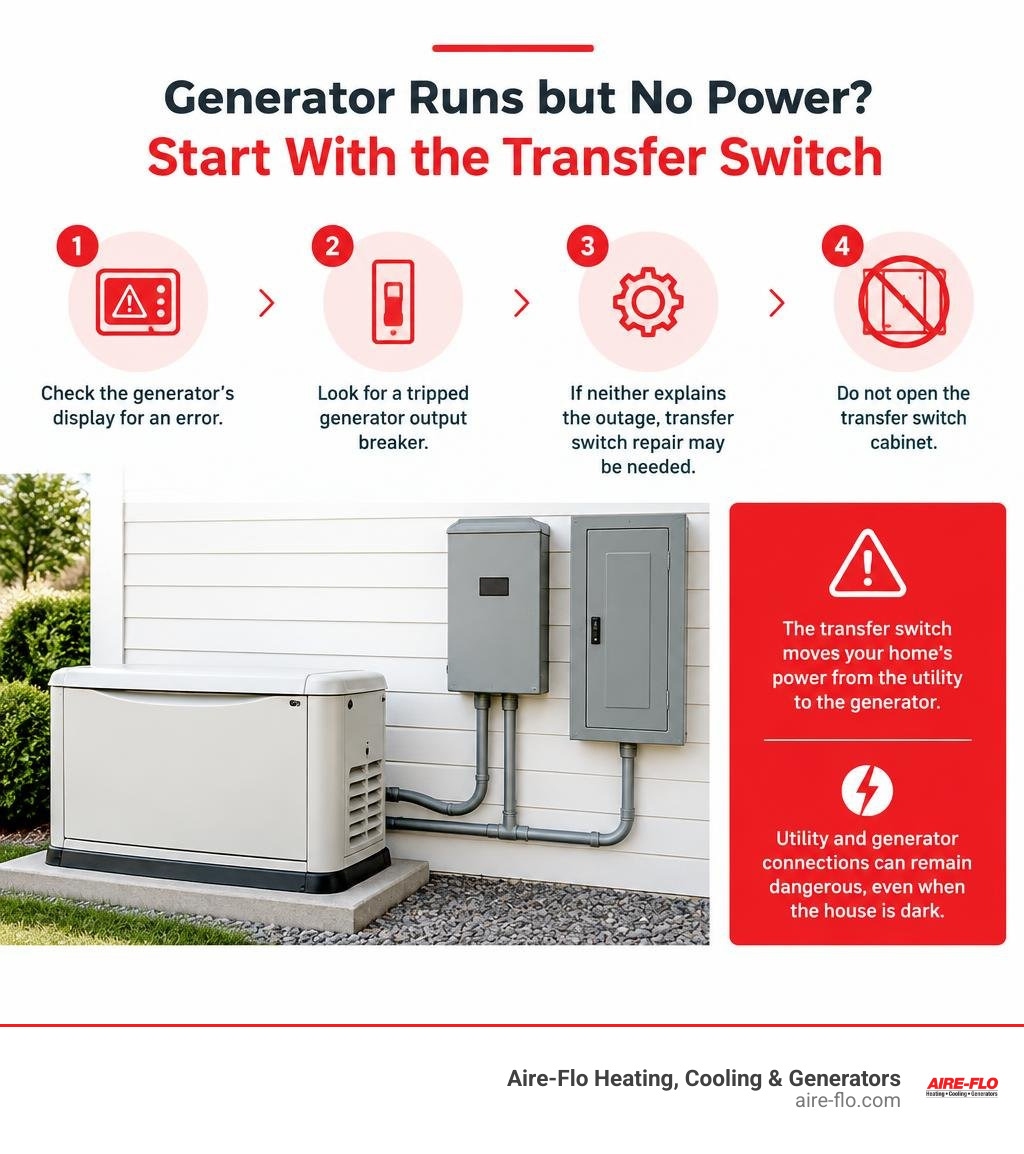
Generator Runs but No Power? Start With the Transfer Switch
If your generator runs but your house has no power, check the generator’s display for an error and look for a tripped generator output breaker. If neither explains the outage, generator transfer switch repair may be needed. The switch should move your home’s power supply from the utility to the generator, but a sensing, wiring, or mechanical fault can stop it. Do not open the transfer switch cabinet: utility and generator connections can remain dangerous even when the house is dark.
Our team at Aire-Flo Heating, Cooling & Generators has decades of experience providing HVAC and generator services in the Columbus area. We’ll explain how to spot a possible transfer switch fault, what generator transfer switch repair may involve, and when to contact our team.
Understanding the Automatic Transfer Switch and Why It Fails
An automatic transfer switch (ATS) acts as the brain and traffic controller for your entire emergency power setup. Its primary job is load monitoring and serving as an impenetrable safety barrier. When the municipal grid drops offline, the ATS senses the voltage loss, signals your standby generator to start, and safely shifts your home’s electrical circuits over to backup power.
More importantly, it prevents a dangerous hazard known as backfeeding. Backfeeding happens when electricity from a home generator flows backward into neighborhood power lines. This can electrocute utility line workers who are working to restore the grid.

A high-quality automatic transfer switch typically lasts between fifteen and twenty-five years when properly maintained. However, because it contains both delicate microelectronics and heavy mechanical components, wear and tear will eventually take a toll. Over years of seasonal storms, the internal contactors experience electrical arcing every time they snap open or closed under load.
Controllers can suffer logic lockups, and mechanical linkages can become stiff. When you understand the ultimate guide to home electric backup generators, you realize that even the best engine outside is useless if the switch inside cannot route that power into your home.
Open Transition vs. Closed Transition Switch Operations
Transfer switches manage power transfers using two main designs: open transition and closed transition. Both approaches must adhere to electrical safety standards established by the National Fire Protection Association under NFPA 70 to prevent hazardous utility cross-connections.
- Open Transition (“Break-Before-Make”): This is the standard design for residential homes. The switch completely disconnects your house from the utility grid before connecting it to the generator. This creates a split-second pause where the home is entirely without power. This mechanical separation guarantees that the generator and the electric utility can never feed the home at the exact same time.
- Closed Transition (“Make-Before-Break”): This design is reserved for critical commercial settings like hospitals and data centers. It synchronizes both power sources and briefly connects them in parallel before dropping the outgoing source, ensuring zero interruption in electrical flow.
| Feature | Open Transition (Residential Standard) | Closed Transition (Commercial Only) |
|---|---|---|
| Switching Mechanism | Break-before-make | Make-before-break |
| Power Interruption | Momentary drop (a fraction of a second) | Zero interruption |
| System Complexity | Moderate, highly reliable for homes | High, requires precise phase synchronization |
| Primary Application | Residential homes and light commercial | Hospitals, data centers, and critical facilities |
| Grid Interaction | Never parallels with the grid | Parallels with the grid for under 100 milliseconds |
Environmental Stressors, Corrosion, and Transient Voltage
Transfer switches often sit in garages, basements, or outdoor enclosures where temperature swings and moisture can cause problems. High humidity creates oxidation on copper terminals, aluminum lugs, and small relay pins. When connections corrode, electrical resistance goes up, leading to localized heating, false voltage readings, and intermittent signal drops.
Transient voltage surges from nearby lightning strikes or sudden utility grid switching also present a serious threat. A sudden voltage spike can bypass older surge arrestors and burn the sensitive printed circuit boards (PCBs) inside the transfer switch. Modern units include built-in Transient Voltage Surge Suppression (TVSS) modules to absorb these spikes, but repeated surges will eventually degrade these components, requiring dedicated generator repair to restore reliable operation.
Troubleshooting Guide: Common Generator Transfer Switch Repair Scenarios
When an electrical storm knocks out power in Columbus, your system must respond instantly. When it does not, identifying whether the failure is electrical, mechanical, or logic-based is the key to solving the issue.
Generator Runs but ATS Fails to Transfer Power
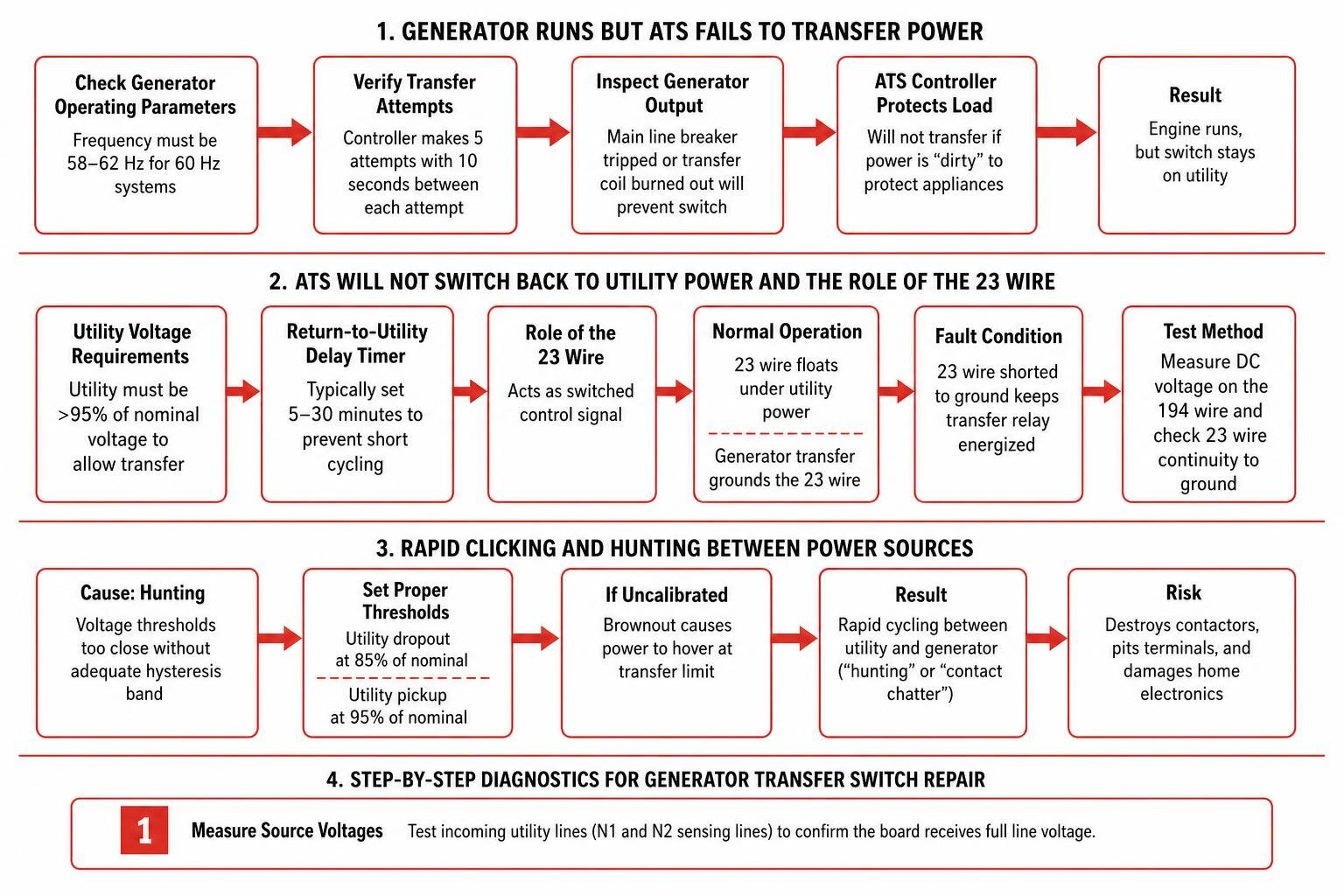
One of the most frustrating situations occurs when the generator engine fires up, roars to life, but the house stays dark. In most cases, the transfer switch is intentionally holding back because the generator output has not met strict operating parameters.
Standard transfer switch controllers require generator frequency to remain strictly within fifty-eight to sixty-two hertz for sixty hertz systems before permitting a transfer. If the generator engine is running slightly too slow (for example, at fifty-six hertz) or too fast, the ATS controller considers the power “dirty” and will refuse to switch to protect your household appliances.
Additionally, the control makes five attempts (with ten seconds between each attempt) to connect to or disconnect from power before it logs a hard failure code. If the main line breaker on the generator body is tripped, or if the internal transfer coil inside the switch is burned out, the mechanism will never throw the physical switch.
ATS Will Not Switch Back to Utility Power and the Role of the 23 Wire
When grid power returns, your home should smoothly revert back to utility lines, but sometimes the system gets stuck running on the generator. Transfer switch logic requires utility voltage to rise above a set pickup threshold, typically ninety-five percent of nominal voltage, to ensure the grid is stable. It also relies on a return-to-utility delay timer, usually set between five and thirty minutes, to prevent your home from bouncing back to the grid during brief utility fluctuations.
In many popular residential systems, such as Generac units, switching control relies on a dedicated wire run known as the 23 wire. The 23 wire acts as a switched control signal. Under normal utility operation, this line floats; when the generator wants to transfer your house to standby power, it connects the 23 wire circuit to ground.
If this wire is pinched inside conduit, nicked by a screw, or shorted to ground against the metal cabinet chassis, the transfer relay stays continuously energized. As long as the 23 circuit remains grounded, the switch assumes the generator must continue powering the home, even with the utility grid fully restored. Technicians test this by measuring DC voltage on the 194 wire (which supplies control power) and checking the continuity of the 23 wire to ground.
Rapid Clicking and Hunting Between Power Sources
If your transfer switch rapidly clicks back and forth, a problem known as “hunting” or “contact chatter,” the system is caught in a sensing loop. This happens when the voltage thresholds are set too close together without an adequate hysteresis band.
Technicians prevent this by setting the utility dropout at eighty-five percent of nominal and the utility pickup at ninety-five percent of nominal. If a brownout causes incoming grid power to hover right at the edge of the transfer limit, an uncalibrated switch will frantically cycle between the grid and the generator. This rapid cycling can destroy the mechanical contactors, pit the copper terminals, and damage delicate electronics throughout your home.
Step-by-Step Diagnostics for Generator Transfer Switch Repair
Diagnosing an automatic transfer switch requires a systematic approach to isolate electrical signals from mechanical movements. Knowing the signs it is time to call for professional generator repair keeps you from guessing when dealing with complex electrical panels.
Identifying Solenoid, Relay, and Control Board Issues in Generator Transfer Switch Repair
To determine which component has failed, technicians follow a strict elimination process:
- Measure Source Voltages: Test incoming utility lines (N1 and N2 sensing lines) to confirm the board receives full line voltage.
- Verify Generator Input: Measure the generator supply terminals to confirm true sixty-hertz frequency and proper voltage.
- Perform a Hard Logic Reset: Disconnect all DC control power from the board for two full minutes to clear latching faults and memory errors.
- Inspect the Transfer Mechanism: If the control board sends signal voltage to the transfer coil but the switch does not move, the issue is a stuck solenoid, mechanical binding, or damaged microswitches.
- Test Manual Operation: With all sources completely disconnected, a technician uses an insulated manual transfer handle to verify that the internal linkages move freely without physical resistance.
Critical Safety Protocols for Generator Transfer Switch Repair
Working inside a transfer switch enclosure involves extreme hazards. Unlike a standard breaker panel that can be shut off using a single main disconnect, an ATS is connected to two independent, live power sources. Even when utility power is dead, the generator can start automatically at any second, instantly energizing the internal bus bars.
- Lockout/Tagout (LOTO): Always shut off and lock the main utility service disconnect before servicing high-voltage components.
- Disable Generator Control: Switch the generator controller to the OFF position and disconnect the starting battery to prevent accidental engine cranking.
- Personal Protective Equipment (PPE): Technicians must wear NFPA-rated arc flash safety gear, face shields, and rated insulated gloves.
- Voltage Verification: Always verify that all terminals are de-energized with a calibrated digital multimeter before touching any internal component.
Component Maintenance: When to Repair Contactors vs. Replace Control Boards
Deciding whether to replace an individual component or install an entire new assembly depends on the age of the unit, the extent of wear, and the availability of parts. Reviewing generator repair vs replacement guidelines helps you make an informed financial choice.
| Component | Common Symptoms of Failure | Repair or Service Action | Replacement Criteria |
|---|---|---|---|
| Main Contactors | Buzzing noise, localized heat, slight pitting | Clean light surface oxidation; re-torque connection lugs | Deep contact erosion, melted casing, welded contact points |
| Solenoid / Actuator | Loud hum without movement, sticky switching | Clear mechanical debris, align linkage bars | Burned coil windings, broken internal return springs |
| Control Logic Board | Blank display, erratic timing, false error codes | Perform hard reset, clean terminal block connections | Burned circuit traces, failed microprocessors, surge damage |
| Sensing Fuses | Generator runs continuously during normal power | Test continuity with multimeter; replace blown fuse | Repeatedly blowing fuses due to internal board shorts |
During an annual inspection, our technicians clean the contact surfaces, apply anti-oxidation compounds to aluminum wiring, verify terminal torque values to prevent loose-wire heating, and test the TVSS surge components. If you are planning an upgrade or a new setup, our certified team handles complete generator installation across the Columbus area.
Frequently Asked Questions About Generator Transfer Switch Repair
Why does my generator run during an outage while my house receives no electricity?
The most common causes are a tripped main breaker on the generator body, an engine running outside the required 58 to 62 Hz frequency window, a blown utility sensing fuse inside the ATS cabinet, or a jammed mechanical contactor assembly.
Can a power surge damage my automatic transfer switch?
Yes. Electrical surges caused by lightning or grid utility switching can burn out the sensitive microprocessors on the ATS logic board and degrade the built-in surge suppression modules. Installing comprehensive whole-home surge protection at the main electrical panel helps safeguard these electronics.
How often should an automatic transfer switch be tested and serviced?
You should perform a monthly visual check and allow your system to complete its automated no-load exercise cycle. A certified technician should perform full functional testing, torque checks, and contact cleaning annually, following a complete home generator maintenance schedule.
Conclusion: Restoring Reliable Backup Power to Your Home
When severe weather rolls through Central Ohio, your family counts on your emergency backup system to keep the lights on, the heat running, and your home safe. An automatic transfer switch is a sophisticated piece of equipment that requires precise voltage sensing, clean wiring, and smooth mechanical operation.
At Aire-Flo Heating, Cooling & Generators, we bring 75 years of trusted, top-rated service to homeowners in Columbus, Dublin, Upper Arlington, Worthington, and the surrounding communities. Whether your system needs a quick wiring repair, a new control board, or routine seasonal maintenance, our experienced technicians deliver prompt, dependable service backed by a 100% satisfaction guarantee.
Do not wait for the next storm to discover an electrical issue. If your system is showing warning signs, contact our professional generator transfer switch repair technicians to schedule your professional transfer switch inspection and keep your home protected.
Whether you require installation, repair, or maintenance, our technicians will assist you with top-quality service at any time of the day or night. Take comfort in knowing your indoor air quality is the best it can be with MOE heating & cooling services Ontario's solution for heating, air conditioning, and ventilation that’s cooler than the rest.
Contact us to schedule a visit. Our qualified team of technicians, are always ready to help you and guide you for heating and cooling issues. Weather you want to replace an old furnace or install a brand new air conditioner, we are here to help you. Our main office is at Kitchener but we can service most of Ontario's cities
Source link