How Does a Heat Pump Work? A Simple Answer for Indiana Homeowners
How does a heat pump work is one of the most common questions we hear from homeowners across Fishers and central Indiana — and for good reason. Heat pumps are replacing traditional furnaces and air conditioners in homes across the region, yet most people have never had the mechanics explained in plain language.
Here is the short answer:
A heat pump moves heat from one place to another — it does not generate heat.
- In winter: It pulls heat energy from outdoor air and transfers it inside your home.
- In summer: It reverses the process, pulling heat from inside your home and releasing it outdoors.
- The engine behind it: A refrigerant fluid cycles through four key components — a compressor, a reversing valve, an expansion valve, and two coils — absorbing and releasing heat as it changes between liquid and gas.
- Why it saves energy: Moving heat requires far less electricity than creating it. A typical heat pump delivers roughly 3 to 4 units of heating energy for every 1 unit of electricity it consumes.
Even on a cold Indiana winter day, there is still usable heat energy in the outdoor air. The heat pump’s refrigerant is made cold enough to absorb that energy, compress it, and release it as warmth inside your home. It almost seems like it shouldn’t work — but it does, and very efficiently.
I’m Jeff Rich II, operations leader at Star Heating, Cooling & Plumbing, and I’ve spent my career helping Indiana homeowners understand how does a heat pump work and whether it’s the right fit for their home — starting from hands-on experience I gained working alongside my father and uncle in the trades. In this guide, I’ll walk you through the full picture, from the refrigerant cycle to real-world performance in Indiana’s climate, so you can make a confident, informed decision.
Understanding the Basics: What is a Heat Pump?
To understand a heat pump, it helps to first look at what it is not. Most of us grew up with gas furnaces. How does a gas furnace work? It burns fuel—usually natural gas or propane—to create a flame that heats a metal box called a heat exchanger. Air blows over that box, gets hot, and travels through your vents. It is a process of generation.
A heat pump, however, is a mechanical-compression refrigeration system. It doesn’t have a “fire” inside it. Instead, it relies on the laws of thermodynamics. Think of it like your kitchen refrigerator. Your fridge doesn’t “create cold”; it actually just grabs the heat from inside the insulated box and throws it out into your kitchen (if you’ve ever felt the warm air blowing from the bottom of your fridge, you’ve felt a heat pump in action).
In What is a heat pump? terms, it is a dual-purpose system. It provides year-round comfort by acting as a high-efficiency air conditioner in the summer and a powerful heater in the winter. Because it moves heat rather than burning fuel to create it, it is often 3 to 5 times more energy efficient than a gas boiler or an electric furnace.
How Does a Heat Pump Work?
The “magic” of the heat pump lies in the vapor-compression cycle. This cycle relies on a special fluid called refrigerant. Refrigerant is a bit of a scientific marvel because it has an incredibly low boiling point. While water boils at 212°F, many refrigerants boil at temperatures well below -40°F.
This allows the system to leverage three fundamental rules of physics:
- Heat moves toward cold: Thermal energy always seeks out a lower-temperature area.
- Pressure affects temperature: When you compress a gas, it gets hotter. When you let it expand, it gets colder.
- Phase changes move energy: It takes a massive amount of energy to turn a liquid into a gas (evaporation) and that same energy is released when the gas turns back into a liquid (condensation). This is known as latent heat.
How does a heat pump work in heating mode?
When the temperature drops in Noblesville or Zionsville, your heat pump enters heating mode. Even when it feels “freezing” to us, there is a surprising amount of heat in the air. In fact, the heat content of air at -18°C (-0.4°F) still contains about 85% of the heat energy found in air at 21°C (70°F).
Here is the step-by-step process:
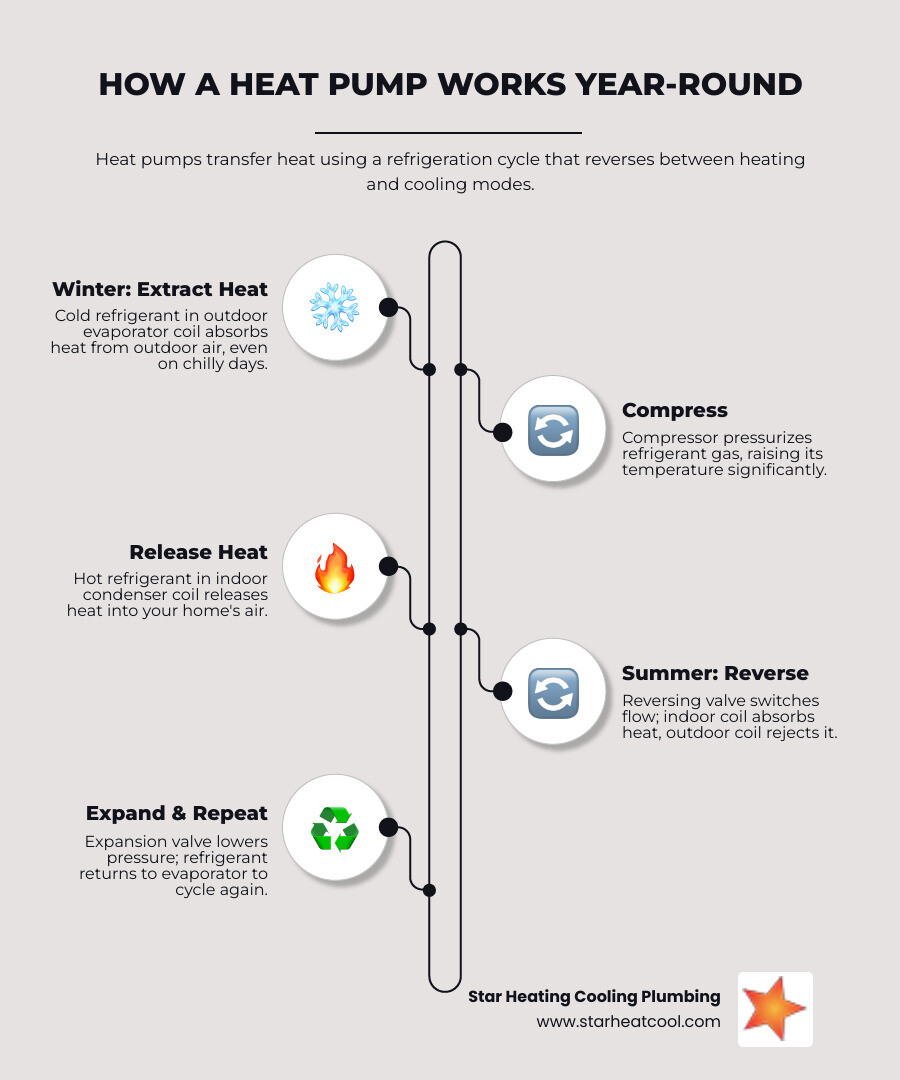
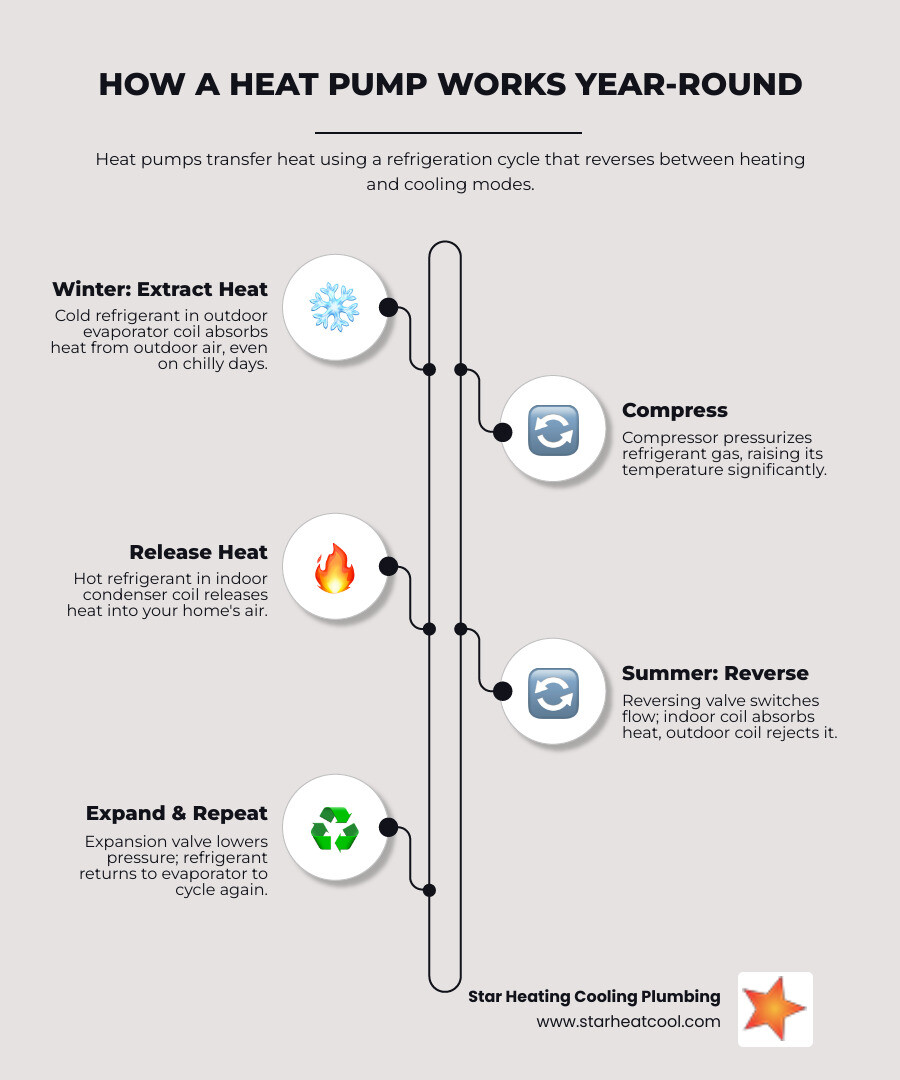
- Extraction: The outdoor unit acts as an evaporator. Cold, liquid refrigerant flows through the outdoor coils. Because the refrigerant is much colder than the outdoor air, the “warmth” from the Indiana winter air moves into the coils. This causes the refrigerant to evaporate into a low-pressure gas.
- Compression: This gas travels to the compressor, which squeezes it tightly. Just like a bike pump gets hot when you use it, compressing this gas causes its temperature to skyrocket.
- Release: This hot gas flows to the indoor coil. Your home’s blower fan pushes air across the coil. The heat from the gas moves into your home’s air, warming your living room. As it loses heat, the refrigerant condenses back into a liquid.
- Return: The liquid refrigerant passes through an expansion valve, which drops its pressure and temperature, preparing it to head back outside and start the cycle over.
Many homeowners ask, How effective are heat pumps in cold weather months? With modern technology, they are incredibly effective, though they may require a “defrost cycle” or supplemental heat during extreme polar vortex events.
How does a heat pump work in cooling mode?
In the summer, a heat pump is virtually identical to a central air conditioner. How does your central air conditioner cool your home? It simply reverses the cycle described above.
Instead of grabbing heat from the outside, it grabs heat from inside your home. The indoor coil becomes the evaporator, soaking up the heat from your hallway and bedrooms. The refrigerant then carries that heat to the outdoor unit (the condenser), where it is squeezed and released into the outdoor air. As an added bonus, as the indoor coil gets cold, it pulls moisture out of the air, providing excellent dehumidification for those muggy Indiana July afternoons.
The Four Critical Components of the Refrigeration Cycle
To keep this cycle moving, we rely on four main “players” inside the cabinet:
- The Compressor: Often called the heart of the system. It moves the refrigerant and provides the pressure needed to raise the temperature.
- The Reversing Valve: This is the component that separates a heat pump from a standard AC. It is a four-way valve that literally flips the direction of the refrigerant flow. One minute it’s a heater; the next, it’s a cooler.
- The Expansion Valve: This acts as a gateway. It regulates how much refrigerant enters the evaporator and creates the pressure drop that turns the refrigerant icy cold.
- The Coils (Evaporator and Condenser): These are the heat exchangers. One is located inside your air handler or furnace, and the other is in the outdoor unit.
For homeowners looking for the absolute pinnacle of this technology, The Infinity Series Greenspeed Heat Pump from Carrier uses a variable-speed compressor. This allows the system to “throttle” up and down like a dimmer switch, rather than just turning on and off, providing incredible efficiency and consistent temperatures.
Efficiency Ratings and Performance in Indiana’s Climate
When you are shopping for a heat pump in Fishers or Carmel, you’ll see a few different acronyms. Understanding these is key to knowing how does a heat pump work for your wallet.
- SEER2 (Seasonal Energy Efficiency Ratio): This measures cooling efficiency. The higher the number, the less electricity it uses in the summer.
- HSPF2 (Heating Seasonal Performance Factor): This measures heating efficiency over a typical season.
- COP (Coefficient of Performance): This is a snapshot of efficiency at a specific temperature. A COP of 4 means the unit provides 4 units of heat for every 1 unit of electricity. For comparison, an electric space heater has a COP of 1.
In Indiana, we have to deal with frost. When it’s damp and cold outside, ice can form on the outdoor coils. To fix this, heat pumps have a defrost cycle. The unit temporarily switches back into cooling mode to send warm refrigerant to the outdoor coil and melt the ice. Don’t worry—your backup heat usually kicks on during this time so you don’t feel a cold draft!
Modern “Cold Climate” technology has changed the game. While older units struggled when it got below freezing, today’s high-performance models can maintain high efficiency even when it’s 5°F outside. Some specialized models, like those from Carrier, can continue to operate and provide heat down to -22°F. This makes them a very viable primary heat source for our region. Are heat pumps a good choice for Indiana residents? Absolutely, especially when paired with the right backup system.
Is a Heat Pump Right for My Fishers Home?
Deciding between a heat pump and a furnace often comes down to your home’s existing setup and your long-term energy goals. Is a heat pump or a gas furnace right for my home?
| Feature | Air-Source Heat Pump | Gas Furnace |
|---|---|---|
| Energy Source | Electricity | Natural Gas / Propane |
| Function | Heats and Cools | Heating Only (Requires separate AC) |
| Efficiency | 200% – 400% (Moves heat) | 80% – 98% (Creates heat) |
| Environment | Lower carbon footprint | Fossil fuel combustion |
| Extreme Cold | May need backup below 25°F | Extremely powerful in all temps |
For many in the Indianapolis area, the “Goldilocks” solution is a Dual-Fuel or Hybrid System. This pairs an electric heat pump with a gas furnace. The heat pump handles the heating for about 85% of the winter when temperatures are above 25°F. When a true Indiana cold snap hits, the system automatically switches over to the gas furnace. This gives you the efficiency of electricity and the raw “punch” of gas when you need it most.
We also see a lot of interest in ductless mini-splits. These are perfect for older homes in Pendleton or McCordsville that don’t have ductwork, or for finished basements and “bonus rooms” that are always too hot or too cold.
Frequently Asked Questions About Heat Pump Operation
Do heat pumps use a lot of electricity?
This is a bit of a trick question. While a heat pump uses more electricity than a gas furnace (which only uses electricity for the fan), it uses significantly less total energy. The annual consumption for a typical household heat pump falls between 6,176 and 10,244 kWh. Compared to electric baseboard heat or an electric furnace, a heat pump can save you roughly 65% on your heating energy costs. Are heat pumps good in Indiana Star Heating and Cooling—the answer is yes, particularly if you are currently using propane or all-electric resistance heat.
At what temperature does a heat pump become ineffective?
Standard heat pumps begin to lose efficiency when temperatures drop below 25°F (-4°C). This is called the “thermal balance point,” where the heat pump can no longer pull enough heat from the air to keep up with the heat escaping your home. At this point, supplemental heat (like electric heat strips or a gas furnace) kicks in. However, cold-climate models can operate effectively down to -22°F.
What is a defrost cycle and why is it needed?
Because the outdoor coil is colder than the air around it, moisture in the air can freeze on the coil. If too much ice builds up, air can’t pass through, and the heat pump can’t do its job. The defrost cycle is a 5-to-15 minute “thaw” that keeps the unit running at peak performance. It’s a completely normal part of how does a heat pump work in a snowy Indiana winter.
Conclusion
As we look toward the future of home comfort in 2026, heat pump technology is no longer a “best-kept secret.” It is a proven, reliable, and incredibly efficient way to keep your family comfortable in Fishers, Zionsville, or Greenfield. Whether you are looking to lower your carbon footprint or simply want a more consistent temperature in your home, understanding how does a heat pump work is the first step toward a smarter HVAC choice.
At Star Heating, Cooling & Plumbing, we’ve been part of the Central Indiana community since 1987. As a family-owned, Carrier Factory Authorized Dealer, we take pride in our transparency and our commitment to doing the job right the first time. Our licensed technicians are experts in helping you navigate the transition to heat pump technology, ensuring your system is sized perfectly for your home’s unique needs.
If you’re ready to explore your options or would like to schedule service for your current system, our team is ready to assist. From Westfield to New Palestine, we serve homeowners throughout the region.
Heat pump installation replacement Fishers IN
Whether you require installation, repair, or maintenance, our technicians will assist you with top-quality service at any time of the day or night. Take comfort in knowing your indoor air quality is the best it can be with MOE heating & cooling services Ontario's solution for heating, air conditioning, and ventilation that’s cooler than the rest.
Contact us to schedule a visit. Our qualified team of technicians, are always ready to help you and guide you for heating and cooling issues. Weather you want to replace an old furnace or install a brand new air conditioner, we are here to help you. Our main office is at Kitchener but we can service most of Ontario's cities
Source link