
I’ve been a huge fan of heat pumps for a long time, and one of the biggest reasons is the comfort they offer regardless of climate zone. Every hybrid customer I’ve worked with has told me they prefer the heat pump heat to the furnace — it’s more even, more consistent.
Jim Bergmann of MeasureQuick got a hybrid after years of me prodding him and has written several love letters about how much he loves the comfort they provide, and how it made his always-cold basement warm for the first time.
I’ll explain why in a moment, but first — I can always see the next objection coming: heat pumps don’t work in cold climates.
When you look at how many hours a city actually spends at certain temperatures, that objection largely goes away.
What The Data Shows
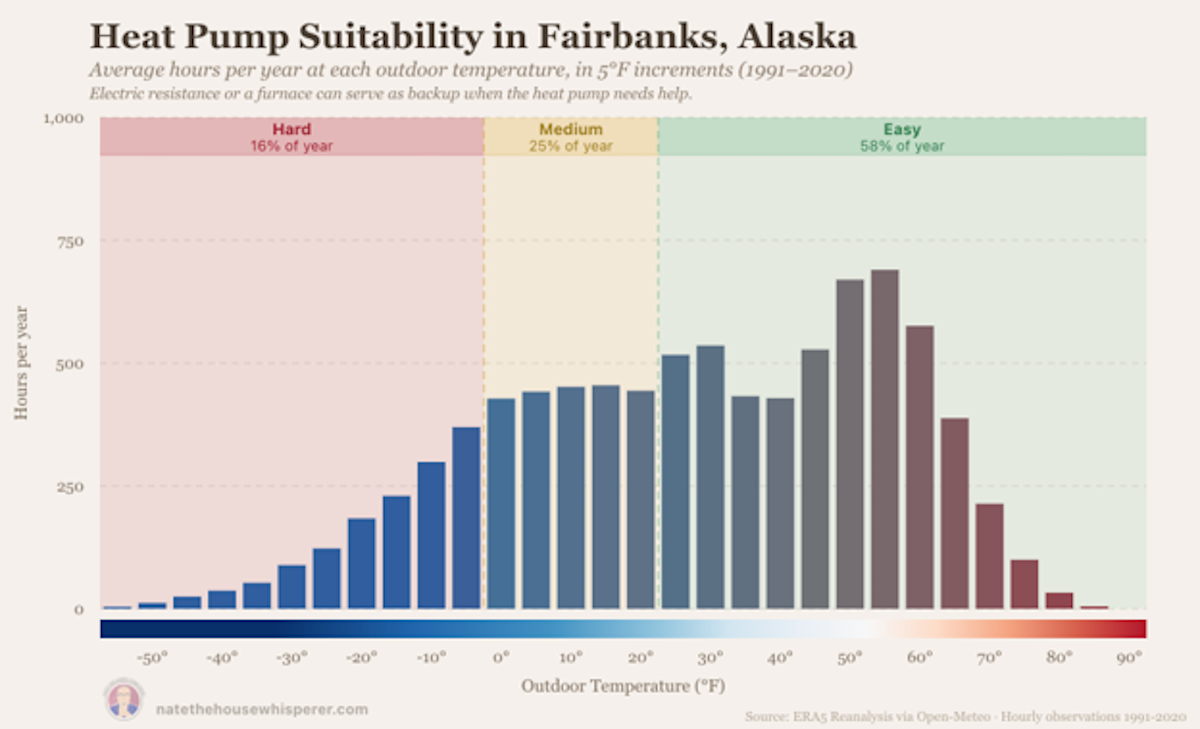
Bin data is useful here — it shows you how many hours a year that a city spends in a given temperature range. For reference, 750 hours is roughly a month. Let’s start with the hardest city I could find in North America: Fairbanks, Alaska.
NORTHERN EXPOSURE: Fairbanks, Alaska temperature range. (Courtesy of Nate Adams)
Even in Fairbanks — the coldest city with really solid temperature data I can find in North America — 58% of the year falls in the Easy range, with another 25% in Medium. Only 16% of the year is genuinely Hard.
I consider everything above 25–30°F easy territory for a single-stage heat pump in most homes. The Medium range calls for a cold climate rated heat pump. The Hard range requires either a top-of-the-line unit like a Hyper Heat or DOE Cold Climate Challenge-rated system — or just make it a hybrid and let the furnace handle the coldest hours. That’s often the simpler answer.
Looking for quick answers on air conditioning, heating and refrigeration topics?
Try Ask ACHR NEWS, our new smart AI search tool.
Ask ACHR NEWS
When you look at how many hours a climate actually spends in each temperature range, installing a heat pump instead of an air conditioner stops being a gamble and starts being the obvious decision. On normal winter days in many cities, the middle of the day still falls in the Easy range.
Fairbanks is an extreme case. Minneapolis is the most realistic worst-case for the continental United States — the largest cold-weather city in the U.S. Even there, 81% of the year falls in the Easy range, with another 17% in Medium. Hard hours account for just 3% of the year.

BEST CASE FOR THE WORST CASE: Minneapolis, Minnesota temperature range. (Courtesy of Nate Adams)
Then there’s Cleveland, where I cut my teeth on heat pumps, installing my first one back in 2014. The systems I installed often made it through entire winters without ever triggering resistance heat. Cleveland sits at 91% Easy, 9% Medium, with less than 1% of the year in the Hard range. The first two were heat pump-only systems in century homes. Both are still running.

BUCKEYE BULLSEYE: Cleveland, Ohio temperature range. (Courtesy of Nate Adams)
And then there’s Charlotte, North Carolina — 99% Easy, less than 1% Medium, no Hard hours at all. If you’re installing a furnace in Charlotte, it’s worth asking why.

SOUTHERN COMFORT: Charlotte, North Carolina temperature range. (Courtesy of Nate Adams)
If you watch actual runtime data, a single-stage system sized to cooling load will frequently handle a home down to 25–30°F — which covers the Easy zone entirely and often a bit beyond. In most homes, that’s the majority of the heating season handled by equipment your client was going to buy anyway — just with the addition of a reversing valve.
My rule of thumb: climate zones 1 through 4 are prime candidates for heat pump-only systems. Zones 5 through 8 are prime candidates for hybrids. Either way, they involve a heat pump — a two-way air conditioner that can heat as well as cool, since your clients are already buying an air conditioner.
More Than a Feeling
The reason heat pumps feel better is simple: they run more and even out temperatures better than an oversized furnace can.
Constantly pushing out a small amount of heat warms every surface in the house — the walls, the windows, the couch, the ceiling, the floors.
Post install, clients consistently told me they couldn’t believe it was the same house.
This hit home for me when I walked into that first client’s house with a new heat pump in a 100-year-old home and thought, “This is the most comfortable home I’ve ever been in, by an order of magnitude.” We hadn’t even finished the insulation and air sealing yet. I believed it intellectually before that, but that day I felt it in my bones.
Every friend and colleague who has tried a next-generation heat pump has ended up feeling the same way. The next time you install a system in your own home, use a heat pump — I highly recommend a fully communicating one — whether on its own or as a hybrid. Give it an honest chance and see what you think.
P.S. Curious what this chart looks like in your city? Try out the calculator. It covers 185 cities across the United States and Canada.
Whether you require installation, repair, or maintenance, our technicians will assist you with top-quality service at any time of the day or night. Take comfort in knowing your indoor air quality is the best it can be with MOE heating & cooling services Ontario's solution for heating, air conditioning, and ventilation that’s cooler than the rest.
Contact us to schedule a visit. Our qualified team of technicians, are always ready to help you and guide you for heating and cooling issues. Weather you want to replace an old furnace or install a brand new air conditioner, we are here to help you. Our main office is at Kitchener but we can service most of Ontario's cities
Source link