You should service your air conditioner at least once a year, ideally in spring before the cooling season, with every two years being the absolute minimum. Gas heating systems are different: they should be checked at least every two years, always with a carbon monoxide test. At QuickAir, we’ve serviced heating and cooling for more than 20,000 Australian homes, and the pattern is consistent. The units that get a yearly service run cheaper, last longer, and break down far less often than the ones that get left alone.
An annual service is the baseline because a system that runs through a full summer picks up dust, loses a little refrigerant charge, and slowly clogs its filters and coils. A yearly check-up puts all of that back to normal before the next heatwave. If your unit gets very light use, you can usually stretch to every two years. If it works hard, runs year-round, or sits in a dusty or coastal spot, twice a year is the safer schedule.
Below is the full picture: the recommended intervals by how you actually use your system, what pushes the number up or down, the best time of year to book, and what a service is worth in running costs.
How often should you service your air conditioner?
For most homes, once a year is the right answer. The interval mainly comes down to how hard the system works:
- Light use (a few weeks a year): Every two years is usually fine. This is the minimum we’d recommend for any working system.
- Regular household use (a full summer, some winter): Once a year, booked before peak season.
- Heavy or year-round use, or dusty and coastal areas: Twice a year, typically before summer and again before winter.
- Gas heaters and ducted gas systems: At least every two years, always paired with a carbon monoxide test.
If you can’t remember the last time your system was serviced, treat that as a sign it’s due now rather than a reason to wait for a set date.
Recommended air conditioner service intervals
The table below shows the service frequency we recommend based on how your system is used. It lines up with what major manufacturers and energy bodies advise: manufacturers such as Carrier and Daikin recommend a yearly professional check-up for residential systems, and the US ENERGY STAR program advises annual pre-season check-ups by a qualified technician.
| Usage and environment | Recommended interval | Why |
| Light, occasional use | Every 2 years | Slow build-up of dust and wear; the minimum for a working system |
| Regular household use | Once a year | Restores efficiency before each peak season |
| Heavy or year-round use | Twice a year | Constant runtime fouls coils and filters faster |
| Coastal, dusty or bushfire-prone areas | Twice a year | Salt and dust accelerate coil and filter fouling |
| Gas heaters and ducted gas | Every 2 years, with a CO test | Safety and combustion checks matter as much as efficiency |
Use this as a starting point. A system near the edge of two rows, an older unit, or one that’s been skipped for a few years all point toward the shorter interval.
What affects how often your air conditioner needs a service?
Two identical units in two different homes can need very different schedules. The main factors are how much the system runs, where it lives, and how old it is.
| Factor | What it does | What we suggest |
| Runtime and load | Longer running hours foul filters and coils faster | Move from yearly to twice yearly for heavy use |
| Climate | Hot, humid regions push systems harder for longer | Service before summer, sooner in hot climates |
| Coastal or dusty location | Salt air and dust clog the outdoor coil | Shorten the interval; consider a deep clean |
| System age | Older parts wear and drift out of spec | Service yearly once the system is past its early years |
| Gas versus electric | Gas adds a combustion and carbon monoxide risk | Every two years minimum, with a CO test |
Runtime is the biggest lever. A ducted system cooling a whole house every day of summer does far more work than a single bedroom split that runs a few nights a month, and it needs servicing more often as a result. Location matters too. Homes near the ocean or on a dusty block collect more grime on the outdoor unit, which is the part that quietly drives up your power bill when it’s dirty. A system running year-round, such as a ducted reverse cycle system that both heats and cools, sits at the higher-service end of the scale for the same reason.
When is the best time of year to service your air conditioner?
The best time to book a service is in spring, before the first real heat of summer. A pre-season check means any worn part or low refrigerant charge is sorted before you actually need the system, not during the first 40 degree day when every technician in the city is booked out.
For systems that heat as well as cool, autumn is the second natural window, before winter. Households that use a gas heater should treat the pre-winter check as non-negotiable, because that’s when a carbon monoxide problem would show up. Booking ahead of each season also means you’re not competing for a slot during the busiest weeks of the year, which is exactly when a broken system is hardest to live with.
How often should you change your air conditioner filter?
Between professional services, the one job worth doing yourself is the filter. Check it monthly and clean or replace it every one to three months during heavy use. ENERGY STAR recommends inspecting the filter once a month, because a clogged filter slows airflow, forces the system to work harder, and pushes up your running costs.
A clean filter is the cheapest efficiency gain available to any homeowner. It won’t replace a full service, since it doesn’t touch the coils, refrigerant, electricals or drains, but it keeps the system breathing between visits and makes the professional service more effective when it happens.
How often should you service a gas heater?
Gas heaters and ducted gas systems should be serviced and safety-checked at least every two years, and every service should include a carbon monoxide test. Carbon monoxide is invisible and has no smell, and it’s produced when a gas heater isn’t burning correctly, so the test is the part of the service that protects your household rather than your power bill.
This is one area where we won’t tell you to stretch the interval. The efficiency case for servicing is about money, but the case for testing a gas heater is about safety, and two years is the longest we’d leave any gas appliance unchecked.
What does a professional air conditioner service include?
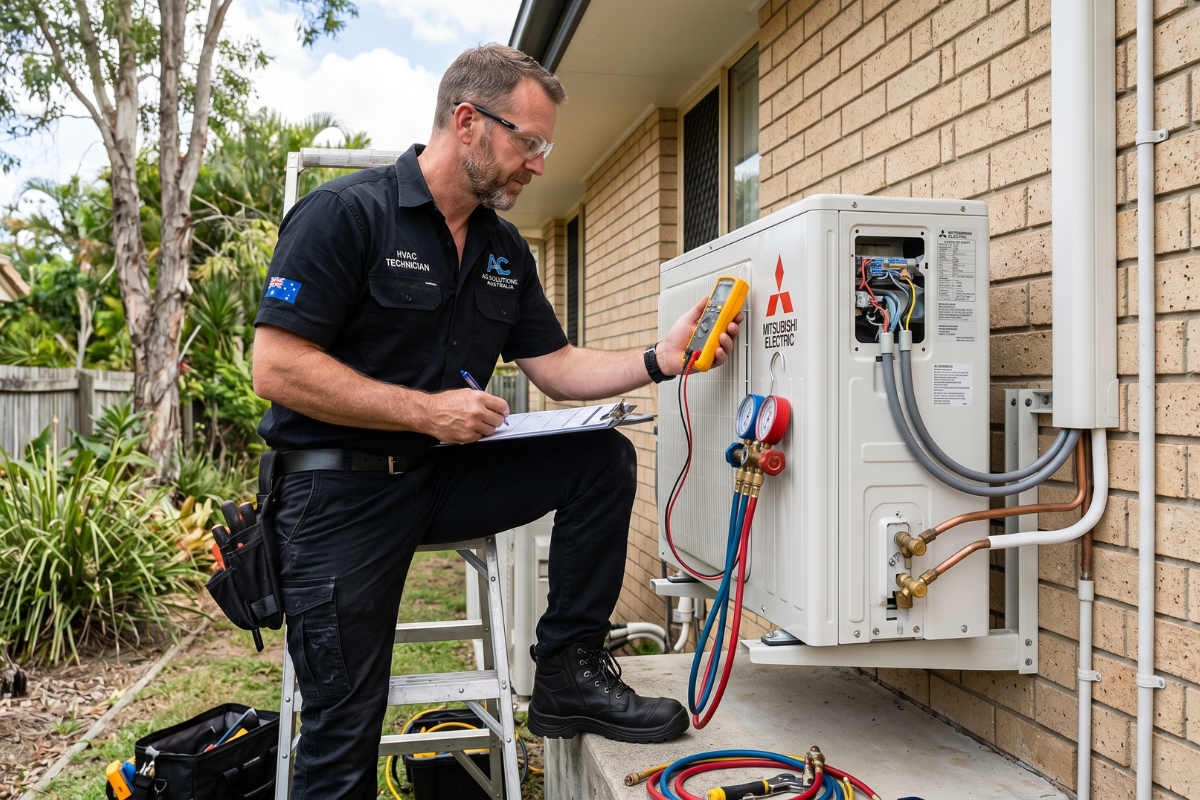
A proper service is more than a filter clean. A standard QuickAir service takes about an hour and works through the whole system, indoor and outdoor. It covers:
- Checking gas (refrigerant) levels and running pressures
- Cleaning filters and coils
- Checking airflow and the controller
- Testing the thermostat and oiling the fan motor
- Cleaning the grille and face cover
- Checking condensation drains and clearing the outdoor unit
- Inspecting all electrical components and the compressor’s amp draw
- A general condition check of the indoor and outdoor units
- Carbon monoxide testing on gas systems
If a system has been neglected for years, a standard service sometimes isn’t enough to shift built-up grime, mould or a badly fouled coil. In those cases a deep clean restores performance that a routine service alone can’t, and we’ll tell you honestly which one your system actually needs.
Does regular servicing actually save money?
Yes, and the numbers are hard to ignore. Heating and cooling is one of the largest slices of a household energy bill, so small efficiency losses add up fast. The savings come from three places: lower running costs, fewer breakdowns, and a longer equipment life.
On running costs, energy research has found that a dirty condenser coil can push a compressor’s energy use up by around 30%. A US Federal Energy Management Program study found that a coil clean often pays for itself within months, and one estimate puts the energy wasted by dirty condenser coils at roughly $400 per unit each year. The US Department of Energy estimates that proper maintenance can save in the order of 5 to 20% on heating and cooling energy. Keeping a system serviced by a licensed technician is the simplest way to hold on to that efficiency.
On reliability, preventive maintenance is even more valuable. Industry maintenance data shows that planned servicing can reduce breakdowns by roughly 70 to 75%, which is the difference between a scheduled spring check-up and an emergency call-out on the hottest day of the year. A serviced system is also far less likely to need an unplanned breakdown repair, and catching a worn part early usually costs a fraction of replacing it after it fails.
Frequently asked questions
Is it okay to service an air conditioner every two years?
Every two years is an acceptable minimum for a system that gets light use. For regular household use we recommend once a year, and for heavy or year-round use, twice a year. Two years is the longest we’d leave any working system between services.
How often should ducted air conditioning be serviced?
Ducted systems should be serviced once a year, and twice a year if they run year-round or cover a whole house. They work harder than a single split system, so they collect dust and lose efficiency faster.
What happens if you don’t service your air conditioner?
An unserviced system slowly loses efficiency and costs more to run, with a dirty coil alone adding up to around 30% to compressor energy use. It’s also far more likely to break down, since planned servicing cuts breakdowns by roughly 70 to 75%.
How long does an air conditioner service take?
A standard service takes about an hour. It can run longer if access is difficult, the system needs extra attention, or a faulty part is found and needs discussing before any repair.
How much does an air conditioner service cost?
At QuickAir, a service is a fixed $259, or $249 for returning customers, with additional units on the same visit charged at a lower rate. The price is published upfront, so you know the cost before the technician leaves the depot.
Can I service my air conditioner myself?
You can clean or replace the filter yourself every one to three months, and it’s worth doing. A full service, which covers refrigerant, coils, electricals and drains, needs a licensed technician, both for safety and to keep the manufacturer’s warranty valid.
Book your air conditioner service
If your system is due, spring is the time to book, before the first heatwave makes it urgent. Most QuickAir bookings are same day or next morning, even in peak season, because we have 350+ licensed technicians across every capital city. The service is a fixed $259, or $249 for returning customers, takes about an hour, and the price you see is the price you pay. Every job is backed by our 100% workmanship guarantee, the same standard we’ve brought to national insurers and telcos for over a decade. Book a service, get in touch, or call us on 1300 730 896.
Whether you require installation, repair, or maintenance, our technicians will assist you with top-quality service at any time of the day or night. Take comfort in knowing your indoor air quality is the best it can be with MOE heating & cooling services Ontario's solution for heating, air conditioning, and ventilation that’s cooler than the rest.
Contact us to schedule a visit. Our qualified team of technicians, are always ready to help you and guide you for heating and cooling issues. Weather you want to replace an old furnace or install a brand new air conditioner, we are here to help you. Our main office is at Kitchener but we can service most of Ontario's cities
Source link