
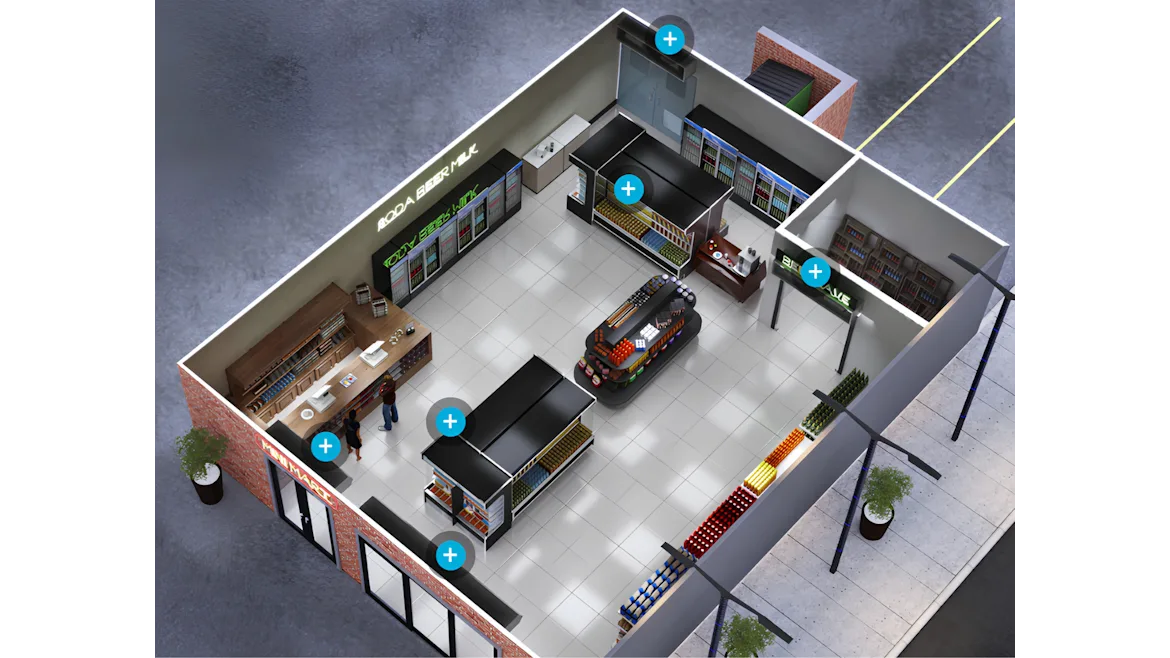
When people talk about refrigeration performance in supermarkets and other food service facilities, they usually focus on what is happening inside the mechanical room. Compressors, evaporators, and controls all deserve that attention. But there is another part of the system that adds to the load every day: the doorways.
Doors in a typical supermarket rarely stay closed. Receiving doors roll up, employees cycle in and out of walk-in coolers, and customers pass through the front entrance. Air infiltration occurs at all of these openings, creating an immediate exchange with dense, cold air, which spills outward along the floor while warm, moisture-laden ambient air rushes inward across the upper portion of the doorway threshold.
This counterflowing air loop introduces two distinct heat loads: sensible heat (elevating space air temperature) and latent heat (moisture vapor). Extracting latent heat requires the refrigeration system to force water vapor through expensive phase changes (condensing gas into liquid and freezing liquid into ice on evaporator coils). Repeated hundreds of times daily, unmanaged doorway infiltration becomes a major driver of elevated energy costs, equipment wear, ice accumulation, and coil defrost penalties.
Managing Air Filtration
Air curtains offer a practical solution to manage air infiltration across these openings. They create a focused stream of air across an open doorway, forming an invisible barrier between adjoining spaces. At supermarket entrances and receiving doors, they help stabilize indoor temperatures, limit the loss of conditioned air, and reduce the entry of flying pests. At cooler and freezer doors, they help maintain the separation between refrigerated spaces and the surrounding store.
Unlike flexible plastic strip curtains, which scratch, become dirty over time, and pose a physical nuisance to operators, air curtains leave the doorway completely unobstructed. Personnel, forklifts, and shopping carts move freely with clear visibility, eliminating collision risks, and frequent sanitation headaches.
At a walk-in cooler or freezer, an air curtain can help reduce the movement of warm, humid air into the refrigerated space while the door is open. This supports more consistent temperatures, reduces fogging and condensation, protects packaging, and limits water accumulation on the floor. These openings are one part of a broader effort to manage air exchange throughout the supermarket.
Receiving and loading dock doors are another important point of infiltration. These openings face both thermal air exchange and external wind pressure. Air curtains can help limit the entry of outdoor air, dust, debris, and flying pests while supporting more stable temperature and humidity conditions inside the facility. Controlling infiltration here helps maintain the conditions surrounding refrigerated spaces.
Looking for quick answers on air conditioning, heating and refrigeration topics?
Try Ask ACHR NEWS, our new smart AI search tool.
Ask ACHR NEWS
Customer entrances are another place where air exchange can quietly add up, allowing outdoor air in and conditioned air out. Air curtains help reduce that exchange, stabilize indoor temperatures, and improve comfort near entrances and checkout areas. In high-traffic retail spaces, air curtains serve as an energy-saving alternative to physical construction vestibules (recognized under building energy codes like ASHRAE Standard 90.1). They also help limit the entry of flying pests, making them useful for both environmental control and sanitation in busy supermarkets.
Select Right Configuration
Selecting an effective air curtain requires matching equipment aerodynamic performance to the specific opening dynamics rather than simply matching door width. Key criteria include:
- Doorway dimensions: Opening height dictates the necessary air discharge velocity and volume (CFM) required for the jet stream to reach the floor threshold with sufficient core momentum.
- Mounting orientation: Overhead horizontal mounting is standard for most commercial and walk-in doors. However, for extremely tall or wide industrial dock doors, vertical side-mounted units are often more effective and easier to install.
- Heated vs. unheated configurations: While unheated units are standard for environmental containment and cold storage, heated models (utilizing low-kW electric or hot water/steam coils) are frequently specified for exterior docks or customer entrances in humid climates to elevate the discharge air jet above ambient dew point and eliminate localized header condensation.
- Building pressurization: Facilities operating under positive or negative internal pressure require careful sizing. Standard air curtains perform best with balanced building pressure; elevated pressure differentials require adjusting the nozzles discharge directional vanes into the pressure source or selecting a higher velocity performance model to maintain the environmental seal.
Proper installation and routine maintenance are essential to ensuring air curtains deliver their calculated energy payback and environmental seal. During commissioning, installers should adjust the discharge directional vanes toward the warmer or unconditioned side to counteract draft momentum and prevent thermal gravity spillage.
Integrating automated controls such as door micro-switches, time-delay relays, or building management system ensures the unit energizes instantly upon door opening and shuts off smoothly after traffic clears, eliminating unnecessary runtime and noise.
Finally, routine maintenance remains straightforward but vital: periodically inspecting and cleaning intake grilles and filters removes dust buildup, preserving the clean intake paths required to maintain full design airflow (CFM), discharge velocity, and jet momentum.
Beyond Energy Savings
The value of controlling infiltration is not limited to the utility bill. Across supermarket doorways, air curtains help maintain stable indoor temperatures, support comfortable working and shopping conditions, and limit the entry of flying pests and airborne debris. They also help walk-in coolers and freezers maintain more stable temperatures, which supports food safety, product quality, and longer shelf life.
For supermarkets, managing infiltration means considering every doorway. Each opening contributes to the conditions inside the store. By controlling air exchange across these doorways, facilities can maintain more stable indoor temperatures, support flying pest control, and create a more consistent environment for people, products, and refrigeration equipment.
Doors will continue to open. With properly selected and installed air curtains, supermarkets can better manage the air that moves through them.
Whether you require installation, repair, or maintenance, our technicians will assist you with top-quality service at any time of the day or night. Take comfort in knowing your indoor air quality is the best it can be with MOE heating & cooling services Ontario's solution for heating, air conditioning, and ventilation that’s cooler than the rest.
Contact us to schedule a visit. Our qualified team of technicians, are always ready to help you and guide you for heating and cooling issues. Weather you want to replace an old furnace or install a brand new air conditioner, we are here to help you. Our main office is at Kitchener but we can service most of Ontario's cities
Source link

