Why Your Attic Is the Key to Home Comfort and Lower Energy Bills
HVAC attic insulation experts are the professionals Central Texas homeowners turn to when their home feels like an oven in July, their AC never seems to shut off, and their energy bills keep climbing month after month. If any of that sounds familiar, the problem very likely starts above your ceiling, not inside your HVAC equipment.
Here is what HVAC attic insulation experts do and why it matters:
- Evaluate your attic’s current insulation levels and identify gaps in your thermal barrier
- Seal air leaks that allow conditioned air to escape and outdoor heat to enter
- Install the right type and R-value of insulation for your home’s size and climate zone
- Reduce the workload on your AC and heating system, which lowers energy bills and extends equipment life
- Address moisture, mold, and indoor air quality issues that often originate in a poorly insulated attic
The numbers behind this are hard to ignore. According to the EPA, proper attic insulation and air sealing can reduce heating and cooling costs by up to 15%. Industry data goes further, with some attic improvement projects showing monthly energy savings of 17% to 34%. In Texas, where attic temperatures can soar past 150 degrees in summer, the strain on your HVAC system is constant and costly.
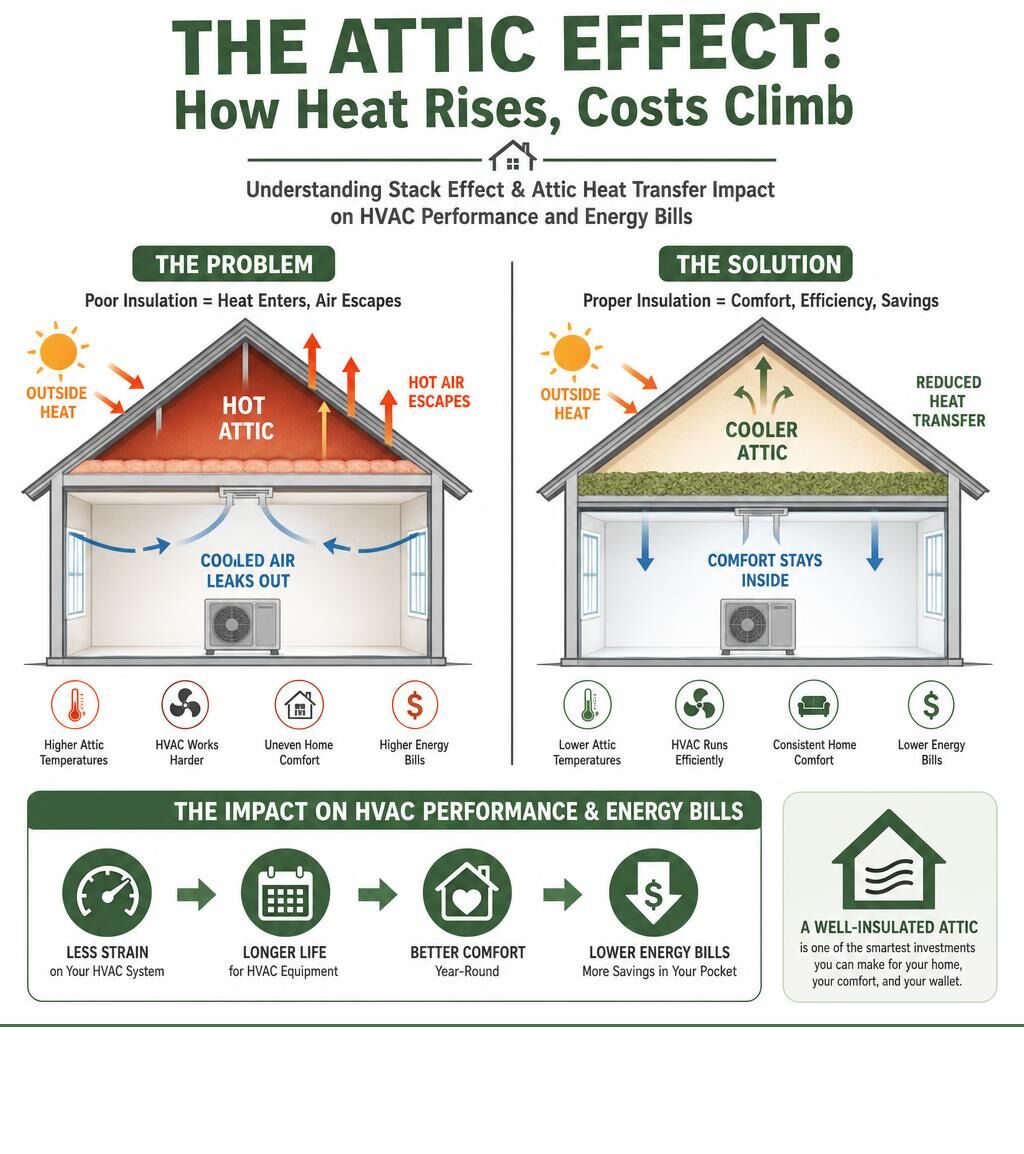
Most homeowners do not think about their attic until something goes wrong. But the attic is where your home’s thermal battle is won or lost. Poor insulation allows heat to pour into your living space, forcing your AC to run longer, work harder, and wear out faster. It also creates uneven temperatures from room to room, leaves upper floors unbearably hot, and can contribute to moisture problems that affect your indoor air quality and even your ductwork.
The good news is that upgrading your attic insulation is one of the highest-return home improvements available, and the process is faster and less disruptive than most homeowners expect.
I’m Chris Woods, owner of Woods Comfort Systems, a third-generation HVAC company serving Central Texas since 1956, and I have seen how proper attic insulation transforms home comfort and takes pressure off heating and cooling systems. As HVAC attic insulation experts, our team regularly diagnoses comfort and efficiency problems that trace directly back to an underperforming attic thermal barrier.
Why Attic Insulation is Critical for HVAC Performance
When most homeowners in San Marcos, TX or Austin, TX experience comfort issues, their first instinct is to blame their AC unit. They call for emergency repairs, assuming a low refrigerant charge or a failing compressor is the culprit. While mechanical issues certainly happen, many of these service calls actually trace back to the attic.
Your attic serves as the primary buffer zone between the harsh Texas elements and your conditioned living space. Without a strong thermal barrier, heat transfer occurs rapidly. In the summer, radiant heat from your roof tiles bakes your attic, raising temperatures to a staggering 150 degrees. This heat naturally migrates downward into your cooler rooms. In the winter, the precious heat generated by your furnace rises and escapes right through your ceiling.
The effectiveness of this thermal barrier is measured by R-value, which represents the material’s resistance to heat flow. The higher the R-value, the better the insulation performs. When your attic lacks sufficient R-value, your HVAC system has to work twice as hard to maintain your thermostat settings. Understanding the connection between poor attic insulation and home systems is the first step toward reclaiming your home comfort and protecting your expensive mechanical investments.
The Thermodynamics of a Hot Texas Attic
To understand why insulation is so critical, we must look at how heat moves. Heat naturally travels from warmer areas to cooler areas. In a typical home, this happens in three ways: radiation, conduction, and convection. Radiant heat from the sun beats down on your roof, conducting through the shingles and decking into the attic space. Once inside, this heat radiates downward onto your ceiling drywall.
Without a proper barrier, that heat conducts directly through the drywall into your living space. This process creates a heavy thermal load that your AC must constantly fight. By working with HVAC attic insulation experts, you can establish a robust defense system that blocks this heat transfer, keeping your home cooler and your energy usage lower.
How HVAC Attic Insulation Experts Prevent System Strain
Your AC system is designed to run in balanced cycles. It turns on, cools the home to the set temperature, and shuts off. However, when heat constantly floods through an under-insulated ceiling, your home loses its cool air almost as fast as your AC can produce it. This leads to short-cycling, where the system turns on and off rapidly, or continuous running, where the compressor never gets a break.
This constant operation accelerates wear and tear on vital components like the compressor, fan motors, and electrical contactors. It also compromises overall airflow, as system components can freeze up under the relentless load. By hiring HVAC attic insulation experts to restore your thermal barrier, you can immediately reduce this mechanical strain. When your home holds onto its conditioned air, your AC cycles less frequently, which significantly extends the overall lifespan of your equipment. Homeowners who invest in these upgrades benefit from attic insulation year-round, enjoying stable temperatures and a much quieter indoor environment.
The Cost of Neglecting Your Attic Thermal Barrier
Neglecting your attic’s thermal barrier is a direct path to financial drain. When your AC is forced to run continuously to fight attic heat, your monthly utility bills skyrocket. This energy waste is not just a minor inconvenience, it represents hundreds of dollars literally escaping through your roof line every single season.
Furthermore, the cost of premature HVAC replacement can be incredibly high. An AC system that should have lasted 15 years might fail after just 8 or 9 years due to the constant overwork caused by poor insulation. Why high energy bills point to poor insulation is a question we answer daily for our clients in New Braunfels, TX and Wimberley, TX. Addressing the root cause in the attic is always more cost-effective than repeatedly repairing an overworked AC unit.
Common Types of Insulation Recommended by HVAC Attic Insulation Experts
Not all insulation materials are created equal, and different attics require different solutions. When evaluating your home, professional contractors look at your attic’s structure, existing materials, and ventilation to recommend the best fit.
| Insulation Type | Average R-Value Per Inch | Best Used For | Key Advantage |
|---|---|---|---|
| Blown-In Fiberglass | 2.2 to 2.7 | Unfinished attic floors, topping off | Lightweight, does not settle easily |
| Blown-In Cellulose | 3.2 to 3.8 | Hard-to-reach areas, eco-friendly focus | Dense, excellent sound dampening |
| Closed-Cell Spray Foam | 6.5 to 7.0 | Roof decks, vaulted ceilings | Creates complete air and moisture seal |
| Radiant Barriers | N/A (Reflective) | Underneath roof rafters in hot climates | Reflects up to 97% of radiant heat |
Blown-In Cellulose and Fiberglass
Blown-in insulation is the most common choice for residential attic floors in Central Texas. This method uses specialized pneumatic machinery to blow loose-fill material through a large hose, ensuring complete and seamless coverage over joists, wiring, and tight corners where traditional batts leave gaps.
Blown-in fiberglass is made from spun glass fibers and is highly resistant to moisture and settling. Blown-in cellulose is composed of recycled paper products treated with boric acid for fire, pest, and mold resistance. Cellulose is much denser than fiberglass, providing a higher R-value per inch and superior soundproofing properties. If you want to learn more about how these options compare, check out our definitive guide to attic insulation to find the perfect match for your home’s architecture.
Understanding R-Value Requirements in Central Texas
The Department of Energy establishes recommended R-values based on climate zones. Central Texas falls into Zone 2 and Zone 3, which generally require an attic insulation level of R-30 to R-49. If your attic has less than 10 inches of insulation, you are likely under-insulated.
Upgrading to the proper R-value ensures that your home has sufficient thermal resistance to block extreme summer heat. When HVAC attic insulation experts evaluate your home, they will measure your current depth and calculate exactly how many inches of new material are needed to reach the optimal R-value for maximum energy savings.
Spray Foam and Radiant Barriers
For homeowners seeking maximum energy efficiency, spray foam insulation and radiant barriers offer advanced protection. Spray foam is applied as a liquid that expands rapidly into a thick foam, filling every tiny crack and crevice. It acts as both an insulation material and a complete air barrier, making it ideal for sealing off unconditioned attic spaces entirely.
Radiant barriers, on the other hand, do not stop conductive heat transfer. Instead, they consist of a highly reflective foil material installed along the underside of your roof rafters. This foil reflects radiant heat from the sun back out through your roof vents, preventing it from ever reaching your attic floor. This is especially critical in hot regions like San Antonio, TX and Kyle, TX. Discovering how to beat the Texas heat often involves combining a radiant barrier with high-quality blown-in insulation to create a multi-layered defense system.
Signs Your Home Needs an Upgrade
Many homeowners do not realize their insulation is failing until they are faced with a complete system breakdown or a shocking utility bill. However, your home will usually drop several hints that it is time to call in the professionals.
Common warning signs include rooms that feel like different climate zones, drafty hallways, and an AC unit that seems to run non-stop even on mild days. If you notice any of these signs of poor attic insulation, it is highly recommended to have your attic evaluated before the peak of summer or winter hits.
Temperature Fluctuations and Hot Spots
Have you ever walked upstairs only to feel like you stepped into a sauna? Or perhaps your living room is perfectly comfortable, but your master bedroom is freezing. These drastic temperature fluctuations are classic signs of depleted or unevenly distributed attic insulation.
When insulation settles, shifts, or was poorly installed, it leaves thermal bridges, areas where heat can easily pass between your attic and your ceiling. This makes it impossible for your thermostat to read the temperature accurately, leading to constant thermostat battles and drafty, uncomfortable rooms. Achieving true home comfort requires ensuring comfort in every season by maintaining a uniform, high-performing thermal barrier across your entire attic floor.
How Attic Conditions Impact Indoor Air Quality
Your attic is not a sealed vault. It is filled with dust, outdoor pollutants, and potentially mold spores or pest dander. When your home lacks proper air sealing and insulation, a phenomenon known as the stack effect occurs. Warm air escapes out of the top of your home, creating negative pressure that pulls dirty attic air down into your living spaces through recessed lights, electrical outlets, and ceiling fixtures.
This continuous cycle can aggravate allergies, asthma, and other respiratory issues. By sealing these bypasses and installing fresh, high-quality insulation, you create a clean barrier that keeps attic pollutants out of your breathing zone, significantly improving your indoor air quality.
Moisture, Mold, and Indoor Air Quality Issues
Your attic insulation does more than just regulate temperature, it also plays a massive role in managing moisture. When warm, humid indoor air rises and meets a cold, poorly insulated roof deck, condensation forms. Over time, this moisture can drip down into your ceiling drywall, warp roof timbers, and ruin your existing insulation.
More importantly, damp attics are breeding grounds for mold and mildew. Mold spores can easily find their way into your living spaces through tiny ceiling bypasses or leaky ductwork, severely impacting your family’s health and respiratory system. When you have insulation hurting HVAC and plumbing systems, you run the risk of structural damage, frozen pipes in rare winter freezes, and poor indoor air quality.
The Professional Attic Evaluation and Installation Process
When you partner with experienced professionals, upgrading your attic is a smooth, highly engineered process. It is not just about throwing some fiberglass over your ceiling joists, it requires a comprehensive approach to optimize your entire home envelope.

The process begins with an in-depth attic inspection where technicians map out your existing insulation depth, locate hidden air leaks, and inspect your ductwork for leaks or structural damage. Our professional attic insulation services are designed to address all of these critical areas to ensure your home performs at its absolute best.
Why HVAC Attic Insulation Experts Recommend Air Sealing First
Simply adding more insulation over a leaky ceiling is like putting a warm sweater on over an open windbreaker. Air will still find a way through. That is why professional contractors always perform comprehensive air sealing before blowing in new insulation.
Using thermal imaging cameras and physical inspections, technicians locate attic bypasses, which are small gaps around recessed lights, plumbing stacks, electrical wires, and chimney chases. These gaps are sealed using expanding foam or fire-rated caulk. Additionally, because leaky ductwork in an unconditioned attic can lose up to 30% of your system’s airflow, duct sealing is performed to keep your conditioned air inside your home where it belongs. Learning how to improve attic insulation always begins with creating a completely airtight seal between your living space and your attic.
The Critical Role of Attic Ventilation
Insulation and ventilation are two sides of the same coin. While insulation blocks heat transfer, proper ventilation ensures that heat and moisture do not get trapped in your attic space. Without balanced ventilation, heat builds up to extreme levels, baking your shingles and radiating downward despite your insulation.
Professional installers ensure that your soffit vents, ridge vents, and gable vents are completely unobstructed. They install specialized attic baffles, also known as wind washing guards, to keep blown-in insulation from blocking the airflow coming from your eaves. This balanced system keeps your attic dry, cool, and structurally sound.
Safe Removal and Precision Installation
If your existing insulation is water-damaged, contaminated by pests, or contains hazardous materials, it must be safely removed before new material can be installed. Technicians use high-powered vacuum systems stationed outside the home to safely extract the old material, keeping dust and allergens out of your living areas. The space is then thoroughly sanitized.
Once prepped and air-sealed, the new insulation is installed to precise depth standards. Technicians install depth gauges throughout the attic to ensure even coverage and to verify that the target R-value has been met. While homeowners in cold climates might reference attic insulation standards in cold climates to prevent issues like ice damming, Central Texas homes focus heavily on preventing extreme heat intrusion and managing high humidity levels.
Frequently Asked Questions About Attic Insulation
What is the recommended R-value for attics in San Marcos, TX?
For homes in San Marcos, TX and the surrounding Central Texas region, the Department of Energy recommends insulating attics to an R-value between R-30 and R-49. This typically translates to about 10 to 15 inches of insulation, depending on the specific material used.
How does attic insulation extend the lifespan of my AC unit?
By slowing down the rate of heat transfer, proper insulation allows your home to retain its cool air for much longer. This means your AC unit does not have to run constantly or cycle on and off rapidly to maintain your target temperature, reducing wear on the compressor and fan motors.
Can I install attic insulation over existing insulation?
Yes, in many cases you can top off existing insulation to save on costs. However, this should only be done if the old insulation is completely dry, free of mold, and has not been nested in by rodents or other pests.
What is the difference between blown-in fiberglass and cellulose?
Blown-in fiberglass is made of spun glass, is highly resistant to moisture, and does not settle much over time. Cellulose is made from recycled paper, is denser than fiberglass, and offers a slightly higher R-value per inch along with superior sound-dampening qualities.
How long does a professional attic insulation installation take?
Most residential attic insulation projects can be completed in just one day. If your project requires extensive air sealing, duct repairs, or the complete removal of old, contaminated insulation, it may take two days.
Does attic insulation help with soundproofing?
Yes, both fiberglass and cellulose insulation act as excellent acoustic barriers. Upgrading your attic insulation can significantly reduce outdoor noises like traffic, sirens, heavy rain, and thunder.
Are there rebates or tax credits available for attic insulation in Texas?
Yes, there are several financial incentives available. Homeowners can often take advantage of federal tax credits under the Energy Efficient Home Improvement Credit, and local utility providers in Central Texas frequently offer rebates for professional insulation and air sealing upgrades.
Why is air sealing performed before installing insulation?
Air sealing stops convective heat transfer, which is the physical movement of air through gaps and cracks. If you do not seal these bypasses first, hot attic air and allergens will still leak into your living space right through your new insulation.
How often should attic insulation be replaced or topped off?
High-quality attic insulation can last for several decades if it remains undisturbed. However, you should have it inspected every 15 years to check for settling, pest damage, or moisture accumulation that may have compromised its R-value.
Can poor attic insulation cause mold growth?
Yes, if your attic lacks proper insulation and ventilation, warm indoor air can meet cold surfaces and create condensation. This persistent moisture can quickly lead to mold growth on your roof deck, rafters, and drywall.
Conclusion
Upgrading your attic insulation is one of the smartest, most cost-effective investments you can make for your home. By creating a strong, continuous thermal barrier, you can protect your expensive HVAC equipment from premature failure, eliminate frustrating hot spots, and enjoy significantly lower utility bills season after season.
Whether you need fast AC repairs, seasonal HVAC maintenance, or a complete system replacement, the team at Woods Comfort Systems is ready to help. Schedule your professional HVAC service today to restore comfort and efficiency to your home.
Whether you require installation, repair, or maintenance, our technicians will assist you with top-quality service at any time of the day or night. Take comfort in knowing your indoor air quality is the best it can be with MOE heating & cooling services Ontario's solution for heating, air conditioning, and ventilation that’s cooler than the rest.
Contact us to schedule a visit. Our qualified team of technicians, are always ready to help you and guide you for heating and cooling issues. Weather you want to replace an old furnace or install a brand new air conditioner, we are here to help you. Our main office is at Kitchener but we can service most of Ontario's cities
Source link