
Contractors serving markets where heating oil remains prevalent need to emphasize early maintenance and educate customers on alternative energy sources, according to two Northeastern HVAC contractors.
As previously reported, oil prices are surging. As a result, average residential heating oil prices are predicted to be between $5.26 and $5.97 per gallon this winter, a 21% increase over last year, according to the U.S. Energy Information Administration.
In the Northeast, oil-based heating costs are expected to be at least 30% higher than last year. On Oct. 21, the Trump administration announced it would release up to one-third of the Northeast Home Heating Oil Reserve to lower costs.
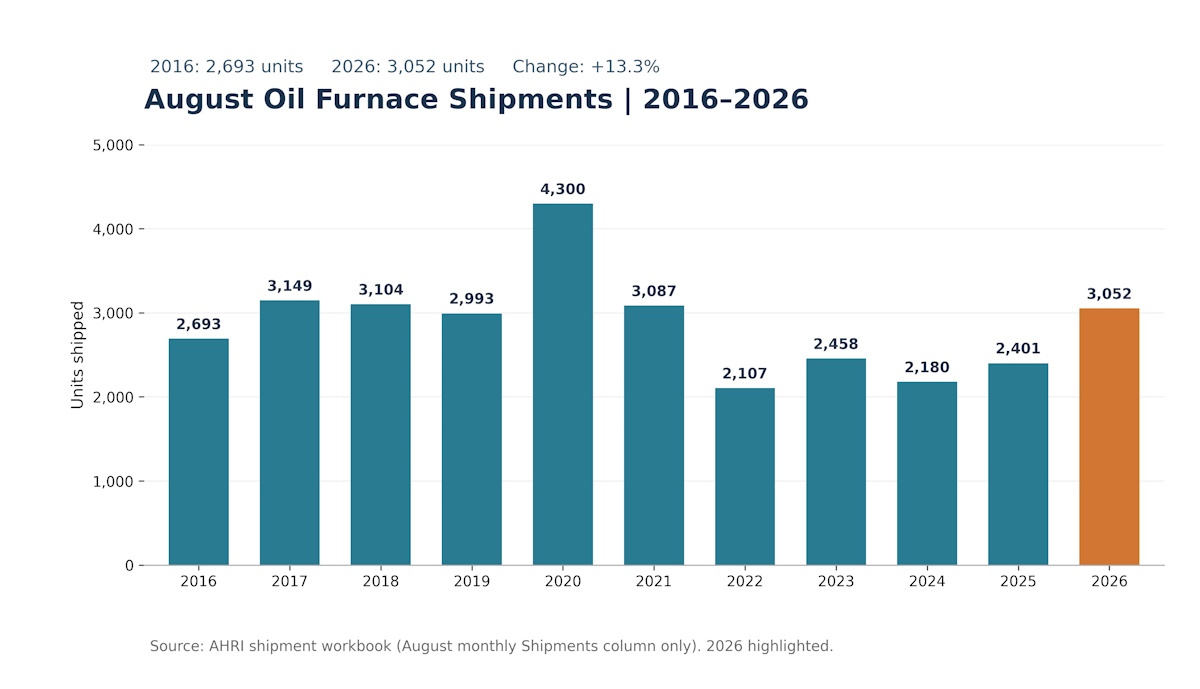
Meanwhile, year-to-date oil warm-air furnace shipments were up 15.7% in August 2026 compared to August 2025, per Air-Conditioning, Heating, & Refrigeration Institute data. In July 2026, oil warm-air furnace shipments were up 36.6% from the same time last year.
Shipments don’t necessarily reflect new installations or increased oil-heating adoption, but the figures indicate continued activity in a sector facing rising fuel costs. It puts HVAC contractors in a tough spot as customers seek solutions to higher utility bills.
“Everyone is struggling financially. Everyone needs heat every day for the next six months in Maine and many other states,” said Jennifer Manzo, owner/founder of HVA-Chicks Coalition and Valeriani Air Conditioning in Maine.
“All it takes is that sweet young family with a newborn to run out faster than usual and not have the means to get more until it’s too late, or that elderly couple to call too late to get more oil and be forced to wait a week due to high demand and low supply, and people could literally freeze to death.”
Looking for quick answers on air conditioning, heating and refrigeration topics?
Try Ask ACHR NEWS, our new smart AI search tool.
Ask ACHR NEWS
OIL FURNACE SHIPMENTS: The latest shipment data from the Air-Conditioning, Heating, & Refrigeration Institute shows shipments of oil furnaces increased 13.3% from August 2016 to August 2026. (Graph generated by ChatGPT using AHRI data)
A Costly Wake-Up Call
Ryan Williams, president of 128 Plumbing, Heating, Cooling & Electric in Massachusetts, said his company has received more inquiries about moving away from oil this year than in years past.
“Here in Massachusetts, customers recognize that energy costs across the board are higher than they used to be,” he said. “Oil prices are making headlines and prompting more conversations, but homeowners are also concerned about the cost of the alternatives.”
He said rising heating costs are prompting customers to pay attention to how their systems are operating and act earlier in the season, particularly around maintenance and having existing equipment ready for winter.
In Maine, as of 2022, about 56% of households rely on fuel oil for their primary heating fuel, according to data from the U.S. Census Bureau. Manzo said many of these customers have had a “kind of attachment” to their oil systems, regardless of fluctuating oil prices.
“The cost has been high for a number of years, and many customers have chosen to keep their oil systems out of loyalty or fear of change, and this year we have seen so many panicking as that need for change hits them dead on,” she said.
As homeowners weigh their options, they’re reaching out to contractors for help, shining a spotlight on the need for education for contractors and customers.
“There is still a significant gap in understanding what a heat pump does and which applications it can serve,” Williams said. “Homeowners with oil-fired hot water boilers, in particular, are asking about advancements in air to water heat pumps and what might be possible for their homes. The underlying question is often, ‘What can a heat pump actually do for me?’”
Manzo agreed, saying she has received panicked calls from customers asking her to explain advancements in gas systems. Her company also runs a hotline for contractors, and she has seen a knowledge gap that needs addressing.
“Most homeowners have no knowledge of what dual-fuel is, let alone a heat pump,” she said. “Companies and techs even in my area typically mean ‘mini split’ when they refer to a ‘heat pump’ and have no education themselves in how heat pumps or dual-fuel work, what they’re capable of or how to properly design and install them.”
To Replace or Maintain?
With more customers asking what options are available, Manzo and Williams said HVAC contractors need to be prepared to have discussions with customers on whether they plan to maintain or replace their systems.
Manzo said more of what her company is handling is replacements, and the rest of the conversations with customers revolve around needing educating them on how often and what kind of maintenance they need to keep their oil system running.
She goes a step further, saying that, as much as customer choice matters, it might be time for contractors to strongly encourage customers to replace their oil-based equipment.
“We need to explain, justify and prove to every customer that oil is a dead industry for residential heating and help them — not force them — into the future for their own good,” she said.
Williams said that despite seeing more customers be proactive in requesting maintenance or information, they are stuck in a holding pattern.
“Customers have questions about newer equipment, have heard stories about problems with high efficiency systems, and are concerned about what heat pumps will cost to operate with our electric rates,” he said. “Many are gathering information but waiting before making a substantial investment they might regret.”
For homeowners concerned about replacing an entire heating system, adding a heat pump while retaining an existing oil-fired system offers another option. However, this relies on contractor knowledge of installing the systems, such as calculating heat loads and equipment compatibility.
What Contractors Should Focus On
Williams said at this point in the season, his priority is completing maintenance early and making sure it is thorough. This includes proper cleanings and attention to critical items like the oil filter, pump screen, and nozzle.
“Controls and efficiency enhancements certainly have value, but changes to a mechanical system can require follow-up adjustments and fine-tuning,” he said. “Contractors should discuss that timing with customers.
“The immediate focus should be making sure the existing system is ready to operate reliably through winter.”
Manzo believes contractors should be showing customers the benefits of switching to gas or dual-fuel, saying she has been pushing dual-fuel systems when a customer calls wanting their oil unit retired. She also encourages contractors to focus their training on dual-fuel and heat pump systems.
“Customers are being done a major disservice by set-in-their-ways or under-educated techs every day, and it makes it so much harder for the rest of us to fix customers’ problems even though the reality is that we truly can,” she said.
Whether you require installation, repair, or maintenance, our technicians will assist you with top-quality service at any time of the day or night. Take comfort in knowing your indoor air quality is the best it can be with MOE heating & cooling services Ontario's solution for heating, air conditioning, and ventilation that’s cooler than the rest.
Contact us to schedule a visit. Our qualified team of technicians, are always ready to help you and guide you for heating and cooling issues. Weather you want to replace an old furnace or install a brand new air conditioner, we are here to help you. Our main office is at Kitchener but we can service most of Ontario's cities
Source link
