Key Takeaways
- Fans convert mechanical energy into airflow: Axial fans move air straight through and suit open or unducted applications, while centrifugal fans build the higher static pressure that ducted systems need.
- Match the fan type to the job: Propeller, tube-axial, and vane-axial fans trade cost for velocity and control. Forward-curved, backward-inclined, airfoil, and radial centrifugal fans trade efficiency, noise, and tolerance for dirt.
- Filters trade pressure drop for capture: A filter’s MERV rating, thickness, and media decide how fine it filters and how much static pressure it adds, and that resistance climbs as the filter loads with debris.
- Maintenance protects both airflow and air quality: A loaded filter chokes airflow and drags system performance, so cleaning or replacing on schedule (as often as every three months) keeps coils clean and air moving.
HVAC and refrigeration systems rely largely on fans to move their air and filters to clean it. The two work together to circulate supply, return, and exhaust air as the application requires, while maintaining indoor air quality and keeping coils and components clean.
Technicians need to understand the function of fans and filters, along with their different types and characteristics. This article works through both, so you can better diagnose airflow problems, perform effective maintenance, and optimize performance. It is divided into two main parts: fans and filters. Images in this article are courtesy of RC Mechanical, from their Industrial Refrigeration Operator textbook.
Fans
Fans operate by converting mechanical energy into air pressure, creating airflow through duct systems or open spaces. Air pressure at a fan inlet is negative, while discharge pressure is positive. The difference is the differential pressure, which increases with fan speed. Fan curves help operators evaluate performance by showing horsepower, static pressure, volume, and efficiency. A fan curve for an axial propeller fan is shown below.

The two main types of fans for HVAC systems are axial and centrifugal.
Axial Fans

Axial fans move air straight through the fan and are typically used without ductwork. The three main types are propeller, tube-axial, and vane-axial.
Propeller fans are simple and cost-effective. There is a propeller fan in the first image of this article on an evaporative condenser, and propeller fans are very common on any type of condenser or condensing unit.
Tube-axial fans generate higher velocities and are used in applications with higher airflow requirements. An example of a portable tube-axial fan can be seen at the bottom of the image below. In the portable format, it can be moved as required to produce a large amount of airflow.

Vane-axial fans add internal vanes for improved efficiency and airflow control. The physical position of the vanes in the assembly can be seen in the image above.
Centrifugal Fans
Centrifugal fans move air at higher pressures and are common in ducted systems. The four main types are forward-curved, backward-inclined, airfoil, and radial.

Forward-curved fans are inexpensive and move large volumes of air. They are commonly used as the blower motor fan in domestic HVAC units. The image below shows an exhaust fan system for an industrial plant using a forward-curved fan. Keep in mind that a squirrel-cage forward-curved blower depends on the resistance of the duct system to control its amp draw, so pulling a blower door or disconnecting ductwork can over-amp the motor.

Backward-inclined fans provide higher efficiency as they “slap” the air in their rotation. They are also quite quiet. Airfoil fans improve further on both efficiency and noise, but they are prone to becoming dirty and are challenging to clean. Radial-blade fans excel in dirty environments thanks to their straight, easy-to-clean blades, though they are not as efficient as other centrifugal types.
Filters
Air filters improve indoor air quality and protect equipment by capturing dust, particles, and contaminants. Their thickness, construction, and material determine their pressure drop and filtration performance. As filters fill with debris, airflow resistance increases. A neglected filter can restrict airflow enough to drop coil temperature and freeze an evaporator, which is why regular cleaning and maintenance, as often as every three months, is important. That same airflow directly drives the coil’s temperature difference and overall capacity.
Many HVAC/R filters are rated on the MERV scale, which runs from 1 to 16 under ASHRAE Standard 52.2, with higher numbers indicating finer filtration.¹ True HEPA filters are rated on a separate, higher scale (sometimes shown informally as MERV 17 to 20). Common filter types include:
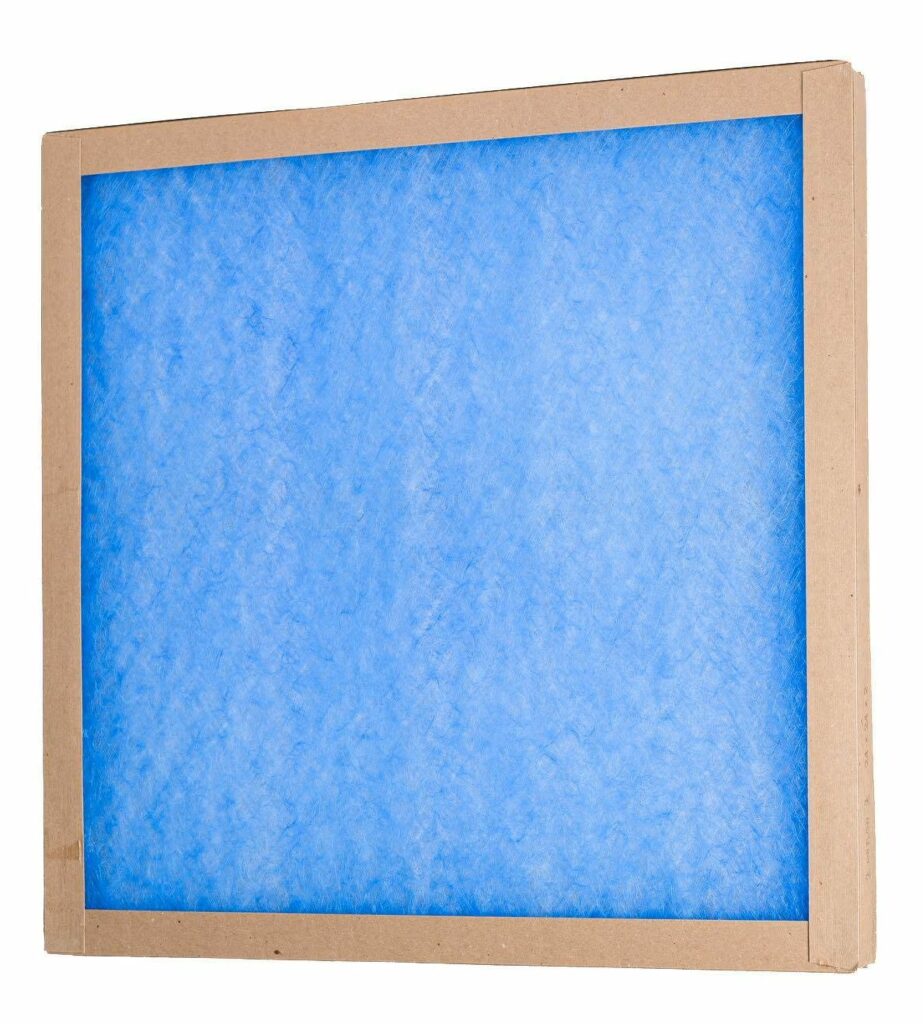
Fiberglass (MERV 1 to 4): Basic protection against large dust particles.

Pleated (MERV 5 to 13): Increased surface area for capturing finer contaminants like pollen and mold.

Bag filters (MERV 11 to 15): High-efficiency filters capable of capturing smoke and bacteria.

HEPA: Extremely high efficiency, removing 99.97% of particles down to 0.3 microns.²
Washable: Reusable, low-cost filters for light filtration.
Activated carbon: Absorbs gases and odors, typically paired with particulate filters.
Electrostatic: Uses a static charge to capture particles, with performance that depends on regular cleaning.
Ultraviolet (UV): Uses UV light to neutralize microorganisms, requires pre-filters and periodic lamp replacement.
Summary
Fans and filters work together to ensure proper airflow, system efficiency, and indoor air quality in HVAC and refrigeration systems. Understanding the characteristics of different fans and filters helps technicians diagnose potential issues, perform effective maintenance, and optimize performance for a healthy and efficient system. Airflow comes first, and the coil work that follows starts with understanding evaporator coils.
Additional Sources
- “ANSI/ASHRAE Standard 52.2: Method of Testing General Ventilation Air-Cleaning Devices for Removal Efficiency by Particle Size”, ASHRAE, Standard, 2017.
- “DOE-STD-3020: Specification for HEPA Filters Used by DOE Contractors”, U.S. Department of Energy, Standard, 2015.
Whether you require installation, repair, or maintenance, our technicians will assist you with top-quality service at any time of the day or night. Take comfort in knowing your indoor air quality is the best it can be with MOE heating & cooling services Ontario's solution for heating, air conditioning, and ventilation that’s cooler than the rest.
Contact us to schedule a visit. Our qualified team of technicians, are always ready to help you and guide you for heating and cooling issues. Weather you want to replace an old furnace or install a brand new air conditioner, we are here to help you. Our main office is at Kitchener but we can service most of Ontario's cities
Source link