
Key Takeaways
- Temperature, pressure, and humidity are the three sensor categories that drive field diagnostics: Every measurement you take falls into one of these buckets. You need all three on every call, even if you don’t use all three for every fault.
- Sensor placement determines accuracy more than sensor quality: A $50 thermometer in the right spot beats a $500 digital probe in the wrong spot. Placement errors cause the biggest measurement headaches in the field.
- Digital probes eliminate the parallax and vibration errors that plague analog gauges: The diagnostic speed gain and error reduction from digital manometers and smart probes justify the cost within the first month of use.
- Always measure static pressure first: Static pressure tells you if the blower is working and the airflow path is clear. Every other reading downstream depends on that baseline being right.
You’re standing in front of a system with gauges in one hand and a tablet in the other. Three sensor readings are on your screen. Which ones move the diagnosis forward? Which ones are you taking out of habit?
The difference between a tech who burns through callbacks and one who nails diagnostics on the first visit comes down to one thing: knowing which measurements matter and which waste your time on the job.
This is about understanding what your sensors tell you, where to place them to get clean data, and which reading order cuts your diagnostic time in half. Sensor price and brand don’t drive success. Measurement order does.
The Three Sensor Categories Every Tech Needs to Understand
Every measurement you take in the field falls into one of three buckets: temperature, pressure, or humidity. Each category tells a different story about your system’s performance.
Temperature sensors measure the most fundamental data. You clip a thermocouple or immersion probe to a refrigerant line, suction line, or discharge line. The reading tells you if the system is operating in the right thermal window. ASHRAE standards require temperature sensor accuracy of at least 0.5°C (roughly 1°F) for building automation systems, and modern field probes exceed that spec.¹ A temperature reading that’s 2 degrees off the mark won’t change your diagnosis, but a reading that’s 10 degrees off (often from probe placement error) will send you down the wrong path.
Pressure sensors are your workhorse. High-side, low-side, suction pressure, discharge pressure, and static pressure all tell different parts of the story. Pressure readings are more sensitive to installation error than temperature measurements. A Fieldpiece SDMN6, the industry standard dual-port manometer, measures pressure with ±0.02 inWC accuracy on the 0-2 inch range and ±1.5% full-scale accuracy up to 60 inches of water column.² See A General Guide To HVAC Troubleshooting for detailed pressure measurement techniques. That precision doesn’t mean much if your probe port is installed in a turbulent zone or if you’re measuring static pressure 6 inches from a register instead of 12 inches into the ductwork.
Humidity sensors are the underutilized category. Most techs skip humidity measurement entirely. But when you’re commissioning a system, troubleshooting latent load problems, or diagnosing outdoor air issues, humidity readings matter. Modern capacitive polymer humidity sensors are more accurate and resistant to drift than older resistive sensors, and they integrate with connected diagnostic platforms.³
Here’s what matters: you need all three categories on every call. You won’t use all three readings to diagnose every fault, but without the ability to measure all three, you’ll miss patterns.
Placement Over Price: Where You Measure Matters More Than What You Use
A $50 analog thermometer in the right spot beats a $500 digital probe in the wrong spot. Every time.
Most techs know this in theory. In practice, placement errors cause the biggest measurement headaches in the field. Temperature coefficient specifications from manufacturers like Fieldpiece show this reality: your probe’s accuracy degrades by 0.1x the spec accuracy for every 1.8°F change outside the operating range.⁴ That’s not the sensor failing. That’s ambient temperature swinging between a freezing attic in January and a 120-degree rooftop in July.
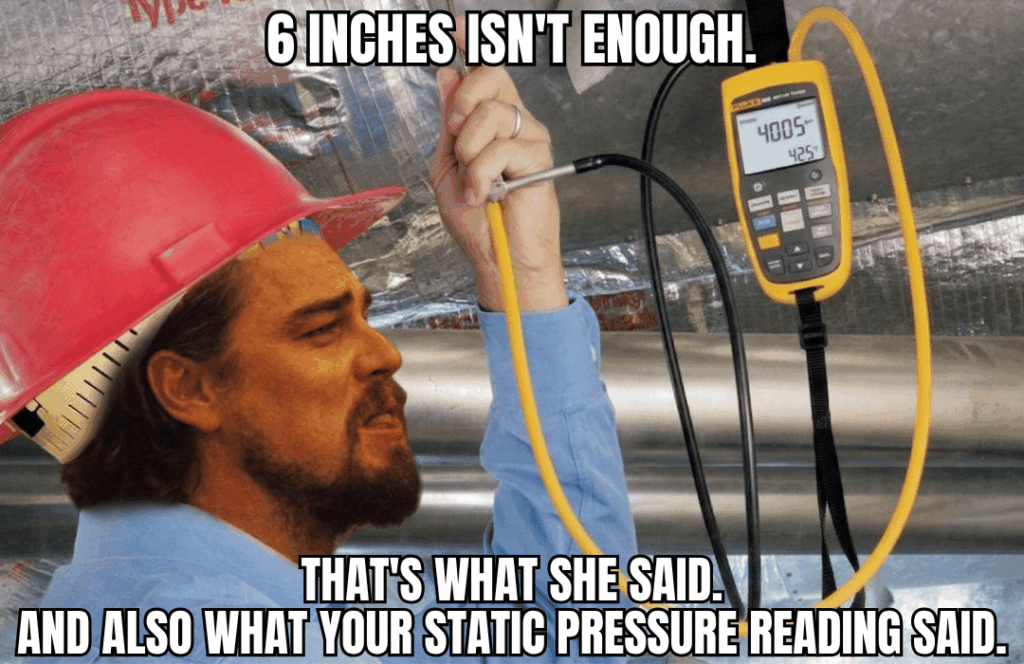
Static pressure placement is where this matters most. Take static pressure at the return duct, not at the return filter. Take it 12 inches into the ductwork from a register, not 6 inches. Take it on the wall, not above or below the centerline where turbulence skews your reading. The difference between a properly placed probe and a sloppy one is often 0.1 to 0.3 inches of water column, which can make a marginal airflow problem look like a healthy system or vice versa.
Temperature probe placement matters too. Immersion probes need 2 to 3 inches of contact time with the fluid flowing past them. Clipping a thermocouple to the outside of a refrigerant line gets you close, but the metal line acts as a heat sink. Wrapping the probe in insulation foam and letting it stabilize for 30 seconds costs you 30 seconds and gains you a clean reading.
Humidity sensors are even more placement-critical. They’re sensitive to radiant heat. Put a humidity probe near a sunny window or a heat-generating component, and you’ll read 5 to 10 percentage points higher than the actual conditioned space humidity.
The rule: if your diagnostic tool has a stabilization indicator (beep, LED flash, or screen notification), wait for it. Fieldpiece Rapid Rail sensors stabilize in approximately 3 seconds.⁵ That’s worth the wait on every single measurement.
Analog vs. Digital: When Precision Changes the Diagnosis
Analog gauges have been the standard in HVAC for decades. They’re mechanical, simple, and they work. They’re also a source of constant measurement error.
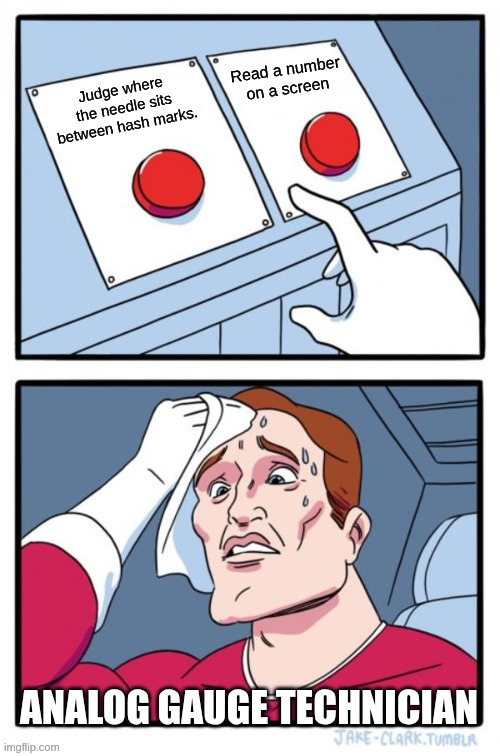
Reading an analog gauge requires you to judge where the needle sits between hash marks on a dial face. Parallax error, vibration from the gauges themselves, and pressure fluctuations in the system combine to create ±2 to ±5 inches of water column errors on routine static pressure measurements. That’s not acceptable for diagnostics.
Digital manometers like the Fieldpiece SDMN6 or Testo units eliminate parallax error entirely. The Testo unit claims 0.25% accuracy across the full measurement range, which means tighter readings across all pressure bands.⁶ For detailed information on non-invasive testing approaches, see A Technician’s Guide To Non-Invasive System Testing. Digital displays freeze readings at the moment you need them, giving you time to process the data without watching a bouncing needle.
For field techs, digital also means data logging. You can capture 50 static pressure readings across a furnace blower cycle, export the data to a tablet, and identify airflow restrictions that would be invisible with a single analog gauge reading.
Digital tools cost more upfront and need batteries. The diagnostic speed gain and error reduction justify the cost within the first month of use.
The Measurement Priority List: What to Read First on Every Call
Not all readings are created equal. Taking them in the wrong order wastes time and loses information.
Start with static pressure. Always. Before superheat, before subcooling, before anything else. Why? Because static pressure tells you if the blower is working and if the airflow path is clear. A low static pressure reading (under 0.1 inWC) means you’ve got bigger problems downstream that will affect every other reading on the system. High static pressure (over 0.4 inWC on return, over 0.2 inWC on supply for most residential systems) means you need to open the airflow path before you’ll get clean temperature and pressure readings on the refrigerant side.
Second, measure discharge and suction pressure. These tell you the refrigerant loop’s health and give you context for temperature readings. High-side pressure with low-side pressure already tells you whether you’re in a charging window or chasing a compressor problem.
Third, grab discharge line superheat if you’re diagnosing a cooling system. Superheat tells you if the expansion device is metering refrigerant correctly and if the system is undercharged or overcharged.
Last, measure suction line subcooling to refine your diagnosis. Subcooling validates charging decisions and tells you if the condenser is doing its job.
Humidity measurement comes in fourth if you’re commissioning or troubleshooting latent load. On a routine repair call, skip humidity unless the call involves a humidity complaint.
This order matters because each reading informs the next. If static pressure is high, your temperature readings will be high as well, and you’ll waste time trying to make sense of data that’s influenced by a blocked filter or kinked ductwork.
Smart Sensors and Connected Diagnostics
The future of HVAC diagnostics isn’t about individual gauges. It’s about connected sensor ecosystems.
Platforms like measureQuick integrate Testo smart probes, Fieldpiece JobLink systems, and other connected tools into a unified ecosystem.⁷ A tech takes a temperature reading on a suction line, and the data syncs to a tablet instantly. Add static pressure, add humidity, add discharge line temperature, and you’ve built a complete diagnostic profile in seconds. For more on how sensor networks integrate with building controls, see BMS Basics: Essential Guide for HVAC Technicians.
The Department of Energy has pushed this evolution through its STEP Campaign, which promotes smart diagnostic tools for HVAC commissioning and maintenance.⁹ The data backs it up: DOE estimates that predictive maintenance programs reduce unplanned downtime by 35 to 45% and maintenance costs by 25 to 30% in facility applications.¹⁰ That’s not marginal improvement. That’s transformational.
For individual techs, the transition to smart sensors means lower callback rates and faster diagnostics. For fleet operators, it means data-driven maintenance schedules and predictive commissioning before problems develop.
The ASHRAE 41-series governs field measurement methodology: Standard 41.1 covers temperature, 41.2 covers pressure, and 41.6-2021 covers humidity measurement.¹¹ Connected sensors make compliance automatic. The data is logged, timestamped, and verified against sensor calibration certificates.
The Bottom Line
You don’t need the most expensive tool in the catalog to get clean diagnostics. You need to understand which of the three sensor categories (temperature, pressure, humidity) matter for the specific fault you’re chasing. You need to place your probes correctly. You need to prioritize static pressure first, then move through the diagnostic chain in order.
Sensor accuracy specs from manufacturers like Fieldpiece and Testo are real performance markers, not just marketing. They matter when you’re trying to separate a system that’s 2 degrees off from a system that’s 20 degrees off.
Take the right reading, in the right order, from the right place. Everything else follows.
Additional Sources
- “Thermal Environmental Conditions for Human Occupancy (Standard 55-2023)”, ASHRAE, Standards Publication, 2023.
- “SDMN6 Dual-Port Manometer Technical Specification”, Fieldpiece Instruments, Product Documentation, 2020.
- “Thermal Environmental Conditions: Humidity Sensor Technology (Standard 55-2023)”, ASHRAE, Standards Publication, 2023.
- “Job Link System Probe Technical Specification”, Fieldpiece Instruments, Product Documentation, 2020.
- “Rapid Rail Sensor Stabilization Specification”, Fieldpiece Instruments, Product Documentation, 2023.
- “Digital Manifold 570s/558s Specifications”, Testo SE & Co. KGaA, Product Documentation, 2024.
- “Smart Tools for HVAC Diagnostics”, measureQuick, Platform Documentation, 2024.
- “JobLink Probes Pipe Clamp Auto-Calibration”, Fieldpiece Instruments, Product Documentation, 2020.
- “Smart Tools for Efficient HVAC Performance (STEP) Campaign”, U.S. Department of Energy, EERE Buildings, 2021.
- “Predictive Maintenance Cost and Downtime Reduction Estimates”, U.S. Department of Energy, Industrial Facilities Data, 2022.
- “Standard Methods for Humidity Measurement (Standard 41.6-2021)”, ASHRAE, Standards Publication, 2021.
Whether you require installation, repair, or maintenance, our technicians will assist you with top-quality service at any time of the day or night. Take comfort in knowing your indoor air quality is the best it can be with MOE heating & cooling services Ontario's solution for heating, air conditioning, and ventilation that’s cooler than the rest.
Contact us to schedule a visit. Our qualified team of technicians, are always ready to help you and guide you for heating and cooling issues. Weather you want to replace an old furnace or install a brand new air conditioner, we are here to help you. Our main office is at Kitchener but we can service most of Ontario's cities
Source link