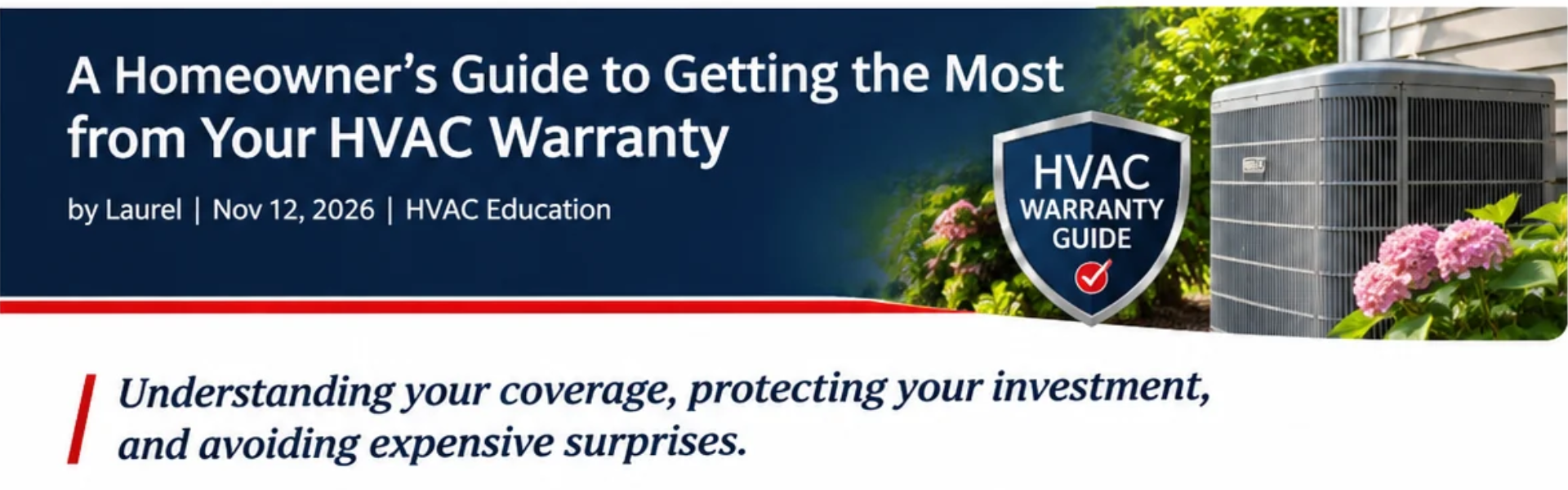

Your HVAC warranty protects one of the hardest-working mechanical systems in your home—your heating and air conditioning equipment. Through sweltering summer afternoons, freezing winter nights, and everything in between, it operates quietly in the background, keeping your family comfortable.
It’s also one of the more substantial investments you’ll make in your home.
When purchasing a new HVAC system, homeowners naturally consider equipment brands, efficiency ratings, installation costs, and financing. But there’s another consideration that deserves just as much attention: the warranty protecting that investment.
A 10-year warranty sounds reassuring. But does it mean that if something breaks during those ten years, you won’t have to pay for the repair?
Not necessarily.
One Small Part. One Surprisingly Expensive Repair
Imagine that your air conditioning system is six years old.
One hot afternoon, you realize the house isn’t cooling properly. You call your HVAC contractor, who discovers a refrigerant leak associated with a failed thermostatic expansion valve, commonly called a TXV.
The TXV is a relatively small component that helps regulate refrigerant flow through your system.
Fortunately, your equipment has a 10-year manufacturer’s parts warranty. The replacement valve qualifies for coverage.
So far, so good.
But replacing that little valve involves considerably more than exchanging one component for another.
The technician must locate and diagnose the failure, access and replace the component, test the repaired refrigeration circuit, evacuate the system, and restore the correct refrigerant charge.
Because the system has been leaking refrigerant, much of its original charge may already be gone.
Although the manufacturer supplies the replacement valve, the homeowner may still be responsible for the labor and replacement refrigerant.
Depending on the repair and the contractor’s pricing, that relatively small component failure could leave a homeowner facing approximately $1,500–$2,000 in out-of-pocket expenses.
Even an extended warranty that includes labor may leave the homeowner responsible for $600–$1,200 in refrigerant-related expenses.
Now compare that with a qualifying protection agreement covering parts, labor, and refrigerant. The eligible expenses associated with the covered failure may be paid under the applicable warranty terms.
Same equipment failure. Same repair.
Three very different financial outcomes. Learn more about refrigerant leaks.

These figures illustrate potential out-of-pocket repair expenses under different warranty arrangements. Actual costs vary according to the equipment, nature of the repair, refrigerant requirements, contractor pricing, and applicable warranty coverage.
A warranty covering the failed part isn’t necessarily a warranty covering the complete repair.
Understanding that distinction is the first step toward making the most of your HVAC warranty.
Understanding the Different Types of HVAC Protection
Not all HVAC warranties provide the same protection, and not every agreement described as a warranty works in the same way.
Generally, homeowners encounter four different types of coverage or service agreements. Understanding extended warranties and service contracts
Manufacturer’s Equipment Warranty
Most new heating and cooling equipment comes with a manufacturer’s limited warranty.
These warranties commonly cover specified equipment components that fail because of qualifying defects in materials or workmanship.
Depending on the manufacturer, equipment, registration requirements, and warranty terms, parts protection may extend for five, ten, or another specified number of years.
However, a manufacturer’s parts warranty generally doesn’t mean that every expense associated with replacing a failed component is covered.
Labor, refrigerant, diagnostic charges, and other expenses may remain the homeowner’s responsibility unless additional protection applies.
Homeowners should also understand that warranties may differ among components within the same system.
For example, certain equipment may have different coverage periods for compressors, heat exchangers, or other major components.
Always review the actual warranty agreement rather than relying exclusively on an advertised number of years.
Extended HVAC Protection Agreements
Extended protection agreements are designed to provide additional coverage beyond the manufacturer’s standard warranty.
Depending on the program, these agreements may cover repair labor, refrigerant, or other specified expenses associated with qualifying equipment failures.
Some are offered through manufacturers. Others are administered or backed by third-party warranty providers.
The fact that an agreement involves a third party does not automatically make it inferior to a manufacturer-backed program.
What matters is the actual protection provided, the financial limits, the claims process, and the company responsible for fulfilling the agreement.
An HVAC-specific extended protection plan can be particularly valuable when it complements an existing manufacturer’s parts warranty.
Whole-Home Warranty Service Contracts: Who Decides How Your Equipment Is Repaired?
Whole-home warranty contracts differ significantly from manufacturers’ equipment warranties and HVAC-specific extended protection agreements.
These contracts typically provide specified repair or replacement benefits for multiple household systems and appliances. However, the warranty company may retain considerable control over how covered repairs are handled.
Depending on the agreement, the company may select the service contractor, require authorization before repairs begin, determine which repair methods are approved, and establish limits on what it will pay.
For example, a homeowner’s HVAC technician may recommend replacing a failing component or assembly, while the home warranty company authorizes a more limited repair. In some cases, the homeowner may have to pay the difference to pursue the preferred solution.
This is a concern homeowners frequently raise with HVAC service providers. They may have purchased the contract expecting protection against expensive repairs, only to discover that their choices are limited by the terms of the agreement.
Before purchasing a whole-home warranty, ask:
- Can I select my own HVAC contractor?
- Who determines whether equipment is repaired or replaced?
- Does the company have the right to approve a less expensive repair?
- What happens if my contractor disagrees with the authorized repair?
- Are there limits on repair or replacement payments?
- What expenses remain my responsibility?
The important distinction is that purchasing repair coverage does not necessarily mean retaining control over every repair decision.
These restrictions vary among providers and contracts. They should not be confused with the terms of every third-party HVAC protection agreement, which may operate quite differently.
HVAC Maintenance Agreements
A maintenance agreement provides scheduled inspections, preventive service, and sometimes additional customer benefits.
Maintenance plans may include discounts on repairs, priority scheduling, or other services.
However, a maintenance agreement is not automatically a warranty against equipment failure.
While regular maintenance helps protect equipment performance and longevity, homeowners should understand precisely which services and benefits their maintenance agreement provides. Learn more about the benefits of regular HVAC inspections and professional maintenance.

What Does Your HVAC Warranty Actually Cover?
Before comparing warranty durations, it’s important to understand the expenses that can arise when equipment fails.
Parts Coverage: The Component Itself
When a covered component fails under qualifying conditions, the manufacturer’s warranty may provide a replacement part.
Depending on the system, covered components may include compressors, motors, control boards, coils, valves, and other specified parts.
But consider what happens after the replacement component arrives.
Someone must diagnose the failure, remove the defective component, install the replacement, and verify that the system is operating correctly.
The replacement part is only one element of the repair.
Labor Coverage: The Work Required to Complete the Repair
HVAC repairs can require substantial technical labor.
Depending on the failure, a technician may need to disassemble equipment, remove refrigerant from a portion of the system, replace components, make refrigerant piping connections, conduct pressure testing, evacuate the repaired circuit, and verify proper operation.
These procedures require specialized training, equipment, and time.
A manufacturer may provide a covered replacement component without paying for the labor required to install it.
This is why extended labor protection can make a meaningful difference in long-term ownership expenses.
Homeowners should also ask whether labor coverage includes diagnostic time, refrigerant-related procedures, and other services necessary to complete a covered repair.
Refrigerant Coverage: An Expense Homeowners Often Overlook
Your air conditioning system or heat pump operates using a sealed refrigerant circuit.
Under normal operating conditions, refrigerant circulates through the system. It isn’t consumed like fuel.
When a system loses refrigerant, the cause needs to be identified and corrected.
Leaks can develop in refrigerant lines, valves, fittings, evaporator coils, condenser coils, and other components.
Some failures involve accessible connections that can be repaired. Others occur in locations where repair is impractical or unreliable.
For example, a leak within an evaporator coil may require replacement of the entire coil.
If substantial refrigerant has escaped before the problem is discovered, the system may require a significant replacement charge after the repair is completed.
Not every leak requires an entirely new charge: the amount of replacement refrigerant depends on what was lost, the repair procedure, and whether the remaining refrigerant can be properly recovered and reused.
Refrigerant expenses can be particularly important when dealing with larger systems, certain refrigerant types, or repairs requiring extensive refrigeration-circuit work.
When comparing warranty agreements, ask whether refrigerant is covered when it is necessary to complete an eligible repair.
Also ask whether reimbursement limits or other restrictions apply.
A warranty that covers parts and labor but excludes refrigerant can still leave the homeowner with a substantial repair expense.
For a more detailed explanation of refrigerant leaks, diagnosis, and repair, see Air Doctor’s article on HVAC Leaks.
Other Expenses That May Not Be Covered
Even comprehensive warranty agreements can contain limitations.
Depending on the contract, homeowners may be responsible for diagnostic charges, deductibles, after-hours service, expedited shipping, or expenses associated with failures that don’t qualify for coverage.
Some programs specify reimbursement limits or require particular claims procedures.
The most useful question isn’t simply, “Do I have a warranty?”
It’s:
“If this equipment fails, exactly what expenses will I be responsible for?”
What Isn’t Covered by Your HVAC Warranty—and Could Homeowners Insurance Help?
An HVAC warranty provides protection against certain equipment failures, but it isn’t insurance against every type of damage your system might experience.
Manufacturer warranties generally focus on qualifying defects in materials or workmanship. Extended protection agreements may provide additional benefits, but they also contain specific exclusions.
Some of the most important exclusions involve damage caused by external events rather than an equipment defect.
Storm Damage and Other Natural Events
Outdoor air conditioning units and heat pumps are exposed to the elements throughout the year.
Severe thunderstorms, hail, high winds, lightning, falling trees, and other weather-related events can damage HVAC equipment.
While manufacturers generally do not cover damage caused by these external events, homeowners insurance may provide coverage when the damage results from an insured event.
For example, if a severe storm causes a tree limb to fall onto your outdoor condenser, the resulting damage may qualify for a homeowners insurance claim rather than an equipment warranty claim.
Coverage depends on the homeowner’s policy, applicable exclusions, and deductible.
It’s also important to understand that not every natural event is covered. Flood damage, for example, is generally excluded from standard homeowners insurance and typically requires separate flood protection.
Electrical Surges and Lightning Damage
Modern HVAC systems contain sophisticated electronic components, including control boards, motors, sensors, and inverter technology.
These components can be vulnerable to electrical disturbances.
A power surge or lightning-related event may damage equipment without any underlying manufacturing defect.
Because this damage originates from an external electrical event, it may be excluded from the equipment manufacturer’s warranty.
However, some homeowners insurance policies cover sudden electrical damage resulting from lightning or qualifying power surges.
Coverage varies, and not every electrical failure or power-related event qualifies.
Homeowners should review their insurance policies and consider asking about equipment breakdown coverage, which may provide additional protection for certain electrical or mechanical failures.
Tampering, Vandalism, and Accidental Damage
HVAC warranties generally do not cover damage caused by intentional interference, vandalism, improper modifications, or certain types of accidental physical damage.
For example, damage to an outdoor unit caused by vandalism may fall outside the manufacturer’s equipment warranty.
Depending on the circumstances, however, vandalism or malicious damage may be covered under the homeowner’s insurance policy.
Damage caused by unauthorized equipment modifications or improper repairs may be treated differently, and homeowners should not assume those losses are insured.
What Should You Do When Damage May Be Covered by Insurance?
If your HVAC system is damaged by a storm, electrical event, or another external cause, it’s important to determine whether the damage may qualify for an insurance claim. Understanding what homeowners insurance may cover
Before authorizing major repairs, consider taking the following steps:
- Document the damage. Take photographs and record when the problem occurred.
- Arrange a professional inspection. Ask your HVAC contractor to identify the damaged components and document the apparent cause of failure.
- Review your insurance coverage. Check your policy for applicable protection, exclusions, and deductibles.
- Contact your insurance company. Ask about claim requirements before proceeding with nonemergency repairs.
- Keep your records. Retain inspection reports, repair estimates, photographs, and correspondence.
If immediate work is necessary to prevent additional damage or address a safety concern, follow your insurer’s emergency mitigation requirements.
A Warranty and Homeowners Insurance Serve Different Purposes
Your HVAC warranty and homeowners insurance are designed to address different types of losses.
A warranty generally protects against specified equipment defects and qualifying failures.
Homeowners insurance may protect against sudden damage caused by covered external events.
Neither provides unlimited protection, and both are subject to their respective agreements.
Understanding the difference can help homeowners avoid paying out of pocket for damage that may be covered under another form of protection.
Protecting Your HVAC Warranty: What Every Homeowner Should Do
A warranty is only as useful as your ability to establish coverage and comply with its requirements.
Fortunately, homeowners can take several practical steps to protect their investment.
1. Make Sure Your Equipment Is Properly Registered
Some manufacturers offer different warranty terms depending on whether equipment is registered within a specified period.
Registration requirements and deadlines vary by manufacturer and applicable law.
When your new system is installed, ask your contractor:
- Is registration required?
- Who is responsible for completing it?
- What is the registration deadline?
- Will I receive confirmation?
- Are all applicable pieces of equipment registered?
A complete installation may include separate indoor and outdoor components with different model and serial numbers.
Keep copies of registration confirmations with your installation paperwork.
At Air Doctor Heating and Air, we handle equipment registration for every installation. We complete the applicable registrations, provide homeowners with the registration documentation, and retain copies in our company records.
This gives customers a record of their registration and provides another source of documentation should warranty service become necessary years later.
Equipment registration does not replace the need to maintain the system and keep maintenance records.
2. Keep Your Warranty Documents
Homeowners often discover that they can’t locate their warranty information when equipment needs repair.
Create a file containing your original installation invoice, equipment model and serial numbers, manufacturer warranty documents, registration confirmations, and any extended protection agreements.
Digital copies are particularly useful.
If you sell your home, these documents may also help the next owner understand any remaining transferable coverage.
3. Maintain Your Equipment and Document Its Service History
Routine HVAC maintenance supports system efficiency, reliability, and equipment longevity. It also helps protect your warranty: manufacturers and warranty administrators may request service records when reviewing a claim.
Many manufacturers specify that equipment must be maintained according to their instructions. Some extended protection agreements expressly require documented professional maintenance at defined intervals. Review the actual agreement to understand which tasks and records are required, rather than assuming all plans are alike.
Maintenance documentation is increasingly important in warranty administration. A claim may be delayed, questioned, or denied under the applicable terms and circumstances if required records cannot be produced. ENERGY STAR’s HVAC maintenance checklist
Keep professional maintenance reports, service invoices, and records of significant repairs for the entire warranty period. Useful records identify the equipment serviced, the service date, the findings, and the work completed. Save digital copies as well as any paper documents.
Missing a maintenance visit or record does not automatically invalidate every claim. Whether a denial is valid depends on the agreement, the failure, and applicable law. But it is far easier to provide records you have kept since installation than to reconstruct them after a failure. Learn more about maintaining your HVAC system.
IMPORTANT: A manufacturer or warranty administrator may ask for maintenance documentation before approving a claim. Keep your records from the first year of ownership.
4. Avoid Unauthorized Equipment Modifications
Changes to refrigerant circuits, electrical components, controls, or other system elements can affect performance and potentially complicate future warranty claims.
Improper installation or repair work may also cause damage that isn’t covered under the manufacturer’s warranty.
Use qualified HVAC professionals and retain documentation of significant repairs or modifications.

What Happens When Your HVAC Equipment Needs Warranty Service?
When equipment stops working, the homeowner’s immediate concern is restoring comfort.
Understanding the warranty process beforehand can make the experience less frustrating.
Identify the Appropriate Service Provider
Start by reviewing your warranty paperwork or contacting the company that installed the equipment.
Some agreements require service through participating or authorized contractors.
Others allow a broader range of qualified service providers.
Don’t assume any contractor can perform warranty-covered work under every agreement.
Arrange a Professional Diagnosis
The technician must determine what failed and, when necessary, why it failed.
This matters because warranty protection generally depends on the cause of the failure and the terms of the applicable agreement.
A failed component isn’t automatically a qualifying warranty claim.
For example, damage caused by an excluded external event may be treated differently from a qualifying manufacturing defect.
Understand the Claims Process
Depending on the warranty, the contractor may need to verify registration, document the failure, obtain claim authorization, or submit information to the manufacturer or warranty administrator.
Some repairs require approval before work begins.
Ask your contractor to explain what is covered and whether you should expect any out-of-pocket expenses.
What Happens If a Manufacturer Denies Your Warranty Claim?
A warranty claim isn’t guaranteed to be approved simply because the equipment is still within its advertised warranty period.
Manufacturers and warranty administrators may require documentation demonstrating that the equipment was properly installed, registered, and maintained according to the applicable warranty requirements.
If a claim is denied, the manufacturer may decline to provide the replacement component or reimburse the repair expenses. Unless another warranty or protection agreement applies, the financial responsibility for completing the repair generally falls to the homeowner.
That can mean paying for the replacement part, diagnostic work, labor, and refrigerant that otherwise might have been covered.
A denied claim isn’t necessarily the final word. Homeowners should request the reason for denial in writing, review the applicable warranty terms, and ask about reconsideration or appeal procedures when appropriate.
Keep Documentation of the Completed Repair
Retain the repair invoice and any available claim information.
This is especially important if the system develops another problem involving the same component or a related part.
What Happens to Your HVAC Warranty When You Sell Your Home?
Transferability is an often-overlooked feature of HVAC warranty protection.
Some warranties allow remaining coverage to transfer to a subsequent homeowner.
Others have restrictions or require registration, notification, documentation, or payment of a transfer fee.
Certain warranties may offer different terms after ownership changes.
Before advertising your home’s HVAC system as being under warranty, confirm exactly what protection transfers.
A documented, transferable warranty may offer reassurance to a prospective buyer, particularly when the equipment is relatively new.
However, transferability should never be assumed simply because the original homeowner received a long warranty term.
How to Compare HVAC Warranties Before Buying a New System
When evaluating replacement proposals, compare the actual warranty protection—not just the advertised duration.
Two contractors may both advertise ten years of coverage while offering substantially different protection.
Before selecting a system, ask:
Parts: Which components are covered, and for how long?
Labor: Is the labor required for a covered repair included?
Refrigerant: Will refrigerant expenses associated with an eligible failure be covered?
Diagnostic charges: Will there be a fee to determine the cause of the problem?
Registration: Who completes the registration, and what are the deadlines?
Maintenance: What maintenance does the warranty agreement require?
Transferability: Can remaining coverage transfer to a future homeowner?
Service providers: Who is authorized to perform warranty repairs?
Repair decisions: Who determines whether covered equipment will be repaired or replaced?
Claims: Does the contractor handle warranty claims, or is the homeowner responsible for contacting the administrator?
Exclusions: What failures, expenses, or circumstances are specifically excluded?
Financial limits: Are there reimbursement caps, deductibles, or other restrictions?
Request copies of the applicable warranty documents before making your final decision.
A knowledgeable contractor should be willing to explain the protection being offered.
 [PROPOSED GRAPHIC: HVAC WARRANTY COMPARISON CHECKLIST]
Air Doctor’s Approach to Long-Term Warranty Protection
At Air Doctor Heating and Air, we believe homeowners should understand the protection accompanying their new HVAC equipment. Visit Air Doctor Heating and Air Warranty Page.
That’s why we emphasize comprehensive warranty coverage when presenting qualifying replacement systems.
Our available protection programs can provide:
10 years of parts coverage.
10 years of labor coverage.
10 years of refrigerant protection.
Depending on the equipment and program, this protection may combine a manufacturer’s equipment warranty with an HVAC-specific extended protection agreement.
Qualifying Champion systems and selected Carrier and Bryant installations can offer comprehensive protection, with applicable third-party programs providing additional labor and refrigerant benefits.
The exact coverage depends on the equipment selected and the terms of the applicable agreements.
Our goal is to help customers understand those terms before purchasing—not discover the limitations when a repair becomes necessary.
We also believe that professional installation, proper system sizing, ongoing maintenance, and responsive service are essential parts of protecting a homeowner’s investment.
A strong warranty complements those responsibilities. It doesn’t replace them.

Frequently Asked Questions About HVAC Warranties
Does my HVAC warranty cover refrigerant leaks?
It depends on the cause of the leak and the warranty agreement.
A qualifying failure involving a covered component may be eligible for parts protection. Labor and refrigerant expenses may require additional coverage.
Not every refrigerant leak qualifies for warranty reimbursement.
Can I use a different contractor for warranty repairs?
Possibly.
Some manufacturer warranties and extended protection agreements permit service through authorized or participating contractors.
Review your documents or contact the warranty provider before arranging repairs.
What happens if my installing contractor goes out of business?
The answer depends on who provides and administers your warranty.
Manufacturer-backed parts protection may remain available through other authorized service providers.
An extended protection agreement may have separate provisions for obtaining service if the original installer is unavailable.
Contractor-provided workmanship warranties may present different circumstances.
This is one reason homeowners should understand who is responsible for each part of their coverage.
Does missing an annual maintenance visit automatically void my warranty?
Not necessarily.
Warranty requirements vary, and the consequences of missed maintenance depend on the agreement and applicable law.
Follow the manufacturer’s recommendations, review any contractual requirements, and maintain records of completed service.
Will my warranty cover an emergency repair?
Coverage depends on the agreement.
Some programs may cover qualifying repair expenses while excluding additional charges for emergency or after-hours service.
Ask about these provisions before an emergency occurs.
Does a 10-year warranty mean I won’t have repair expenses for ten years?
No.
A warranty generally protects against specified failures and expenses under defined conditions.
It isn’t a promise that the equipment will never require repair or that every repair expense will be paid.
Understanding those limitations is essential.
Know Your Coverage Before You Need It
Your heating and cooling equipment works hard to keep your home comfortable, often for thousands of hours every year.
Protecting that investment involves more than selecting a reliable brand.
It means understanding the warranty, knowing what expenses are covered, meeting applicable requirements, and keeping the documentation you may need years later.
Remember the small TXV in our opening example? Its failure shows why the protection behind a warranty matters just as much as the number of years advertised.
Comprehensive coverage can help protect homeowners from eligible repair expenses that might otherwise come as an unwelcome surprise.
Before purchasing a new HVAC system—or assuming your existing warranty covers everything—take time to understand the details.
The best time to learn what your warranty covers is before something breaks.
Questions About HVAC Warranty Protection?
Air Doctor Heating and Air helps homeowners throughout Washington and Frederick counties in Maryland and Berkeley and Jefferson counties in West Virginia understand their HVAC replacement options.
We can explain equipment differences, installation considerations, and the warranty protection available with qualifying systems.
Call or text Air Doctor Heating and Air at 301-799-7200 to discuss your heating and cooling needs or request a free replacement estimate.
AirDoctorHVAC.com
Warranty benefits, eligibility, limitations, registration requirements, and transfer provisions depend on the specific equipment and applicable agreements. Always review the written warranty terms.
Whether you require installation, repair, or maintenance, our technicians will assist you with top-quality service at any time of the day or night. Take comfort in knowing your indoor air quality is the best it can be with MOE heating & cooling services Ontario's solution for heating, air conditioning, and ventilation that’s cooler than the rest.
Contact us to schedule a visit. Our qualified team of technicians, are always ready to help you and guide you for heating and cooling issues. Weather you want to replace an old furnace or install a brand new air conditioner, we are here to help you. Our main office is at Kitchener but we can service most of Ontario's cities
Source link