
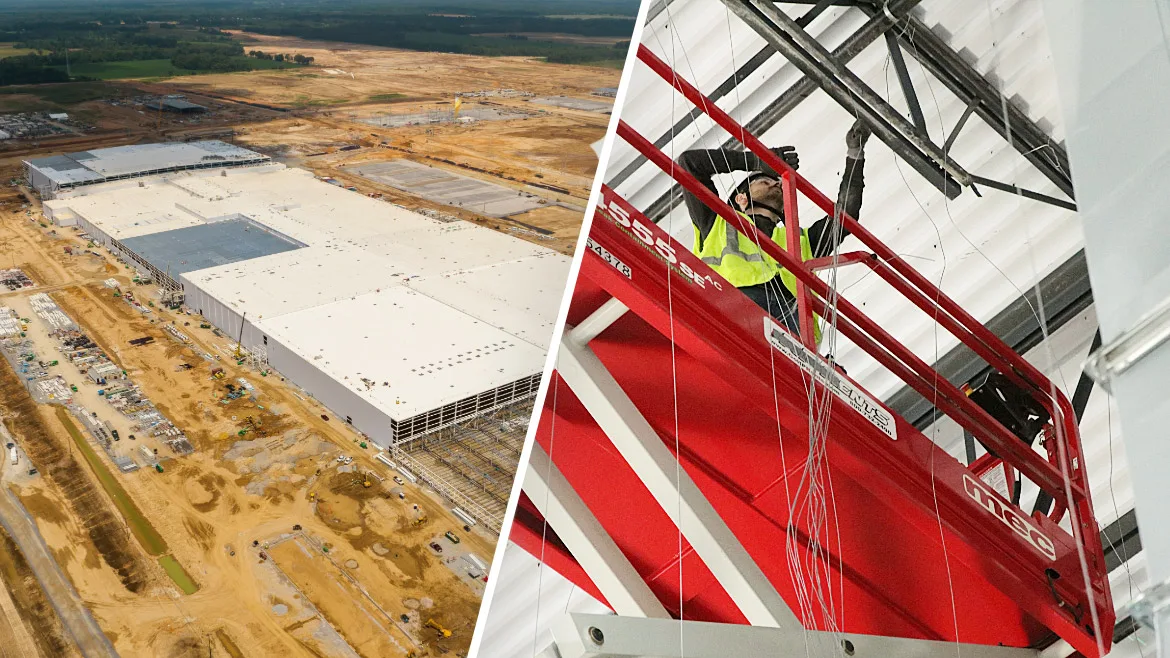
It used to be that a $1 billion construction project was considered massive. Not anymore.
Data center campuses costing many billions of dollars are becoming increasingly common, bringing enormous demand for skilled construction labor into the markets where they are built. For workers, that can mean higher wages and new career opportunities. For contractors, including those that never intend to work on a data center, it means competing for labor in a market increasingly influenced by megaprojects.
The effects are beginning to show. Twenty-eight percent of contractors responding to the Associated General Contractors of America (AGC) and NCCER’s latest workforce survey performed data center construction during the past year. Among firms reporting on the workforce effects of data centers, 58% said the projects increased competition for skilled workers, 49% reported increased wage pressure, 36% said data center construction made open positions harder to fill, and 30% reported increased turnover.
Data centers are adding another competitor for a limited workforce, and one with the resources to pay considerably more. The Wall Street Journal reported that workers moving into data center construction, in roles ranging from electricians to project managers, often earn 25% to 30% more than they did previously, according to Jake Rasweiler, senior vice president of data centers at staffing firm Kelly Services.
That raises a question extending well beyond the data center market: What happens to contractors building everything else when a multibillion-dollar project down the road can pay substantially more for the same workers?
A Labor Pool Already Under Pressure
The competition is hitting an industry that already needs hundreds of thousands of new workers simply to maintain equilibrium. Associated Builders and Contractors (ABC) estimates the construction industry needs to attract 349,000 net new workers in 2026 to keep labor supply and demand in balance.
But that doesn’t mean construction needs 349,000 workers because demand is suddenly booming. ABC Chief Economist Anirban Basu said a majority of the industry’s new-worker demand in 2026 is attributable to retirement rather than increased demand for construction services.
That helps explain an apparent contradiction in today’s construction market. In the AGC/NCCER survey, 37% of respondents reported reducing their firm’s headcount by at least 5% during the past year, compared with 34% that increased it by at least 5%. Yet 87% still have hourly craft openings, and 88% of those firms say the positions are as hard or harder to fill.
Construction’s unemployment rate also fell to a record-low 3.1% in August. Employment increased by 120,000 over the past 12 months, but growth has been concentrated in nonresidential construction. Nonresidential specialty trade contractors added 86,000 workers, or 3%, while residential construction employment declined by about 20,000, or 0.6%.
Data centers, power projects and advanced manufacturing are helping drive employment in the stronger parts of the construction market. But they’re doing it while the industry is already trying to replace experienced workers leaving through retirement.
A new apprentice can eventually become an experienced electrician, foreman or superintendent, but that takes years. In the meantime, the industry’s biggest projects are competing for workers who already possess those skills. Today’s labor shortage is as much about experience and geography as the industry’s total number of workers.
A New Competitor for Labor
ACE Electric is seeing that competition firsthand.
The Valdosta, Georgia-based electrical contractor has experienced double-digit growth in both headcount and revenue for the past three years, according to Mindy Bates, the company’s human resources director. Data centers are a significant part of that growth, and one of ACE’s newest groups is in Ohio, where the contractor expanded because of the volume of data center construction around Columbus.
ACE has added a net of more than 500 employees this year. But in construction, Bates said, adding 500 employees doesn’t mean hiring 500 people.
“You bring in about 700,” she said.
ACE has added four recruiters over the past 18 months and is looking to add another two, while recruiting nationally to meet its needs. Competition is affecting what those workers expect to earn as well.
“The pay scales that the lower skill people are looking for is the same pay scale of what we used to pay the more experienced ones,” Bates said.
The broader industry is responding similarly. Fifty-five percent of firms in the AGC/NCCER survey increased base pay for hourly craft workers by more than they did a year earlier, while another 29% increased pay by approximately the same amount. AGC Chief Economist Ken Simonson said average hourly earnings for construction production and nonsupervisory employees are now 21% higher than for the broader private-sector workforce.
Welcome to Your First Jobsite
Higher wages can attract people into construction, but getting them onto a jobsite doesn’t mean they’ll stay, particularly when a new employee’s introduction to the industry is one of the largest projects ever built in their community.
Boyd Worsham, president and CEO of NCCER, has spent 45 years in construction and has recently visited large data center projects around the country.
“Those jobs are overwhelming to somebody like me who’s been in the industry for 45 years,” Worsham said. “And we take young people who have never walked on a construction job in their life, and we put them on the biggest projects in our country. Of course, they’re going to be overwhelmed.”
Across construction, 83% of surveyed firms reported at least some turnover among new field employees during their first 90 days. Contractors commonly attributed those early departures to a mismatch between workers’ expectations and the realities of construction, followed by the physical demands of the job and travel or scheduling requirements.
Worsham said NCCER does not have research showing that 90-day turnover is specifically higher on data center projects, but said his previous experience managing construction found turnover occurred more frequently on larger projects.
ACE’s experience provides a current example. Bates said its traveling data center teams have the company’s highest turnover, particularly among electricians and helpers. Locally staffed data center projects have lower turnover because employees can return home to their families each day, although Bates said turnover remains somewhat higher than on ACE’s traditional regional and local electrical work.
The distinction suggests the workforce challenge surrounding megaprojects isn’t simply about wages. Travel, scheduling, project scale and workplace expectations can all influence retention.
The Bigger Bottleneck
Contractors can recruit hundreds of new workers, but they can’t instantly turn them into experienced foremen, superintendents, estimators or project managers. That may be the more difficult workforce constraint emerging from the megaproject boom.
Bates said ACE is finding it particularly difficult to recruit project managers, estimators and superintendents. The shortage is already affecting how much work the company can accept.
ACE has turned down projects when it wasn’t confident it could properly staff them, Bates said.
“We don’t want to overcommit ourselves,” she said. “We don’t want to compromise on safety, quality, or put our people at risk.”
Field labor can be an issue, but Bates said leadership is the primary reason ACE has to turn down work, particularly on large hyperscale projects.
Holder Construction is seeing a similar problem.
“The more critical need is in that skilled, maybe five-plus-year, with some leadership experience,” said Asia Gower, senior manager with Holder Construction.
That exposes a fundamental limitation of solving a labor shortage through recruiting alone. The industry can replace a retiring worker with a new entrant, but it cannot immediately replace the experience that walked out the door.
Building the Workforce
The irony is that the projects putting pressure on the workforce are also creating some of construction’s best opportunities.
Data center demand has contributed to three consecutive years of double-digit growth in headcount and revenue at ACE, and Bates expects the company to add another 300 to 500 employees next year. At the same time, that growth has forced ACE to recruit nationally, continually review compensation and occasionally turn down work because it lacks enough experienced leaders.
Large projects may also have the resources to invest in developing the workforce they need.
“We have a project type that, quite frankly, has the financial wherewithal to do that,” Worsham said. “These projects do have the money in them to do that, and we have a new customer type out there that’s willing to invest in that.”
Contractors are making those investments. ACE operates its own apprenticeship program and develops foremen, superintendents, project managers and estimators internally. It has also changed its onboarding process and expanded recruiting through schools, colleges and other workforce programs.
“You cannot hire your way out of this situation,” Bates said. “We got to grow it from within as well.”
Holder is making a similar long-term bet, expanding its high school internship program and working with clients, trade partners and colleges to prepare new workers for construction jobs.
“We’re hopefully solving that problem five years from now because the people entering these programs today are going to be our foremen in five years,” Gower said.
The Megaproject Effect
The AGC/NCCER survey suggests more contractors are reaching the same conclusion. Thirty-five percent of firms initiated or increased spending on training and professional development during the past year, while roughly one-quarter initiated or expanded in-person, on-site craft training. Nearly half increased engagement with career-building programs at high schools, colleges and career and technical education institutions.
And despite softer demand in parts of construction, nearly three-quarters of contractors expect to add employees during the next 12 months.
For workers, megaprojects can mean higher wages and new career opportunities. For contractors, they represent enormous amounts of potential work, but also greater competition for the people needed to perform it.
That’s the paradox. Data centers, power projects and advanced manufacturing are creating some of construction’s best opportunities at the same time the industry needs hundreds of thousands of new workers simply to maintain labor-market equilibrium, with retirements accounting for a majority of that need in 2026.
The effects don’t stop at the fence surrounding a data center. A project large enough to recruit nationally and pay a substantial premium can influence wage expectations, recruiting and retention throughout a local or regional construction market.
Data centers may be the most visible example today, but the larger change is the arrival of projects big enough to influence the labor market around them.
The industry’s biggest projects aren’t just competing for workers anymore. They’re helping set the price for them.
Whether you require installation, repair, or maintenance, our technicians will assist you with top-quality service at any time of the day or night. Take comfort in knowing your indoor air quality is the best it can be with MOE heating & cooling services Ontario's solution for heating, air conditioning, and ventilation that’s cooler than the rest.
Contact us to schedule a visit. Our qualified team of technicians, are always ready to help you and guide you for heating and cooling issues. Weather you want to replace an old furnace or install a brand new air conditioner, we are here to help you. Our main office is at Kitchener but we can service most of Ontario's cities
Source link