
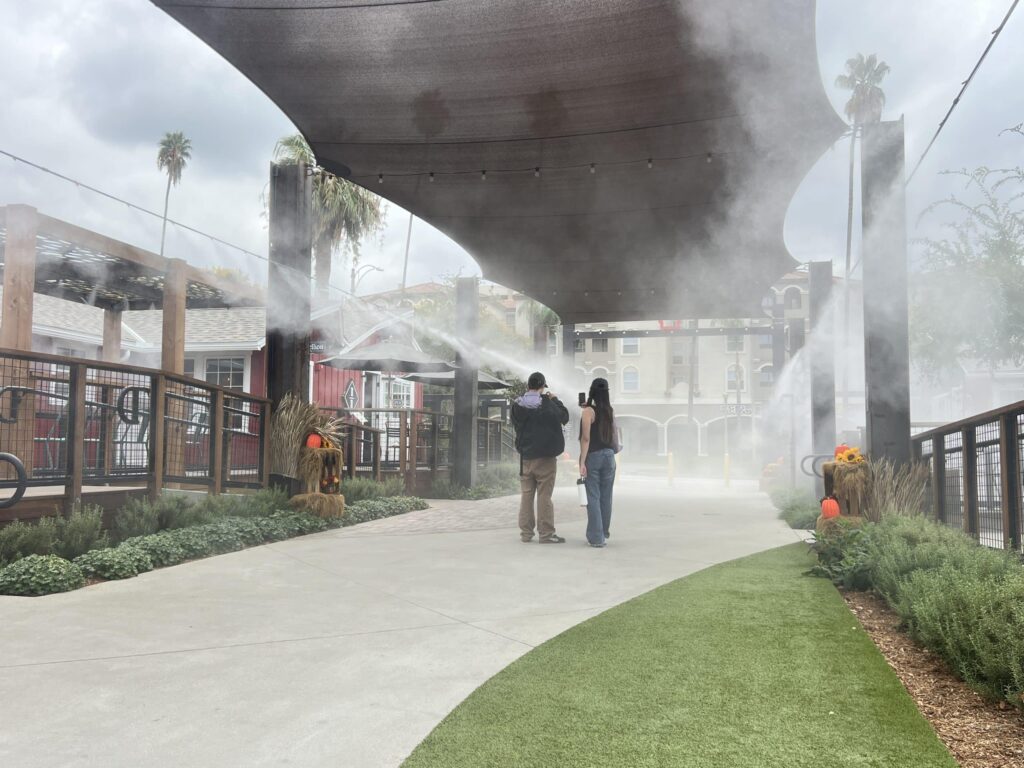
For landscape architects and architects, outdoor comfort is increasingly central to the success of public spaces. Parks, playgrounds, mixed-use developments, cultural destinations, and hospitality environments must remain functional during periods of intense heat while still delivering a distinctive and cohesive visitor experience.
High-pressure mist and fog offer designers a flexible tool for addressing both objectives. Depending on how the technology is configured and integrated, a system can provide evaporative cooling, establish a more comfortable microclimate, invite interaction, reinforce a project narrative, or add an atmospheric layer to the landscape.
The following Koolfog projects illustrate four different approaches to incorporating high-pressure misting systems into outdoor environments.
Extending the Usability of Outdoor Play Environments
Outdoor play areas present a fundamental design challenge: they must encourage physical activity and exploration while remaining comfortable during warm weather. Shade is an important part of the solution, but it may not sufficiently reduce ambient temperatures during periods of extreme heat.
At the Children’s Discovery Museum of the Desert, playground misting systems help create a more comfortable outdoor environment for children and families. The cooling mist complements the museum’s play experience, allowing visitors to remain active outdoors when heat might otherwise limit the use of the space.
For museums, schools, parks, and family attractions, misting can help extend the usable hours and seasonal value of an outdoor play area. It may be integrated into shade structures, incorporated into dedicated misting elements, or positioned to create defined cooling zones near active play and gathering areas.
The goal is not simply to introduce water particles into the landscape. Nozzle selection, mounting height, airflow, coverage, drainage, surrounding materials, and patterns of movement must all be considered to deliver effective cooling and an appropriate visitor experience.
Creating a Site-Wide Outdoor Microclimate
Larger developments often require cooling across several connected spaces rather than within one clearly defined zone. Dining areas, retail storefronts, gathering lawns, event spaces, walkways, and transitional areas may all have different conditions and operating requirements.
The Farm House Collective in Riverside, California demonstrates how an outdoor misting system can support a mixed-use destination at the site level. The restored landmark motel campus has been reimagined as a contemporary dining, retail, and entertainment environment with raised decks, outdoor gathering areas, and landscaped spaces.

Koolfog developed a site-wide misting system to help offset Riverside’s hot, dry climate. Rather than functioning as a separate amenity, the system contributes to the comfort and usability of the overall property, supporting how visitors move between and occupy its different outdoor areas.
Projects of this scale require a coordinated approach to distribution, zoning, controls, and equipment placement. Each area may have different sun exposure, structural conditions, airflow, occupancy patterns, and hours of use. Dividing the system into operational zones can give property managers greater control while allowing misting to respond to changing environmental and programming needs.
Early coordination also makes it possible to integrate lines, nozzles, pumps, and controls more discreetly into the architecture and landscape.
Adding an Experiential and Educational Layer
Mist and fog can perform a role beyond thermal comfort. When incorporated into a larger design concept, they can add movement, atmosphere, and sensory engagement while helping communicate the story of a place.
At the Pier 26 Science Playground in Hudson River Park, Koolfog collaborated with OLIN, the Hudson River Park Trust, Alpine Construction, and playground manufacturer Monstrum to create an immersive fog feature within a marine-inspired play environment.
The playground is anchored by sculptural representations of two endangered species native to the Hudson River: the Atlantic and shortnose sturgeons. Grass shrimp and stylized aquatic vegetation further connect the play area to the river’s ecosystem.
Koolfog’s custom-fabricated fog poles were produced in varying lengths, installed at precise angles, and powder-coated to resemble strands of sea grass. Flush-mounted nozzles create a low-lying fog effect that suggests bubbles, underwater movement, and shifting sediment. The features establish cool zones, with lower fogging elements that invite children into a more immersive interaction with the environment.
The technical system supports the design intent without visually dominating it. The high-pressure pump was positioned away from the active play zone to reduce audible impact while preserving access for service. Programmable controls allow the client to adjust activation frequency and duration throughout the year.
This project demonstrates the value of involving mist and fog specialists early. Coordination among the landscape architect, playground designer, system manufacturer, and installation contractor allowed the fog elements to become part of the playground’s form and educational narrative—not equipment added after the primary design was complete.
Reinforcing Place Identity Through Mist
Public spaces often draw meaning from the cultural or historical context of their location. Mist and fog can help translate that context into an experience visitors can see, feel, and move through.
Whistle Stop Park in Redding, California honors the city’s connection to the California and Oregon Railroad. The two-acre park includes a permanent stage, performance kiosk, lawn, seating, shade, and a cooling mist garden designed as a central experiential feature.
Koolfog collaborated with OLIN and CMS Collaborative to help bring the mist garden concept to life. The resulting feature evokes the steam associated with historic locomotives while creating a cooling microclimate for park visitors.
The installation contributes to several project objectives simultaneously. It provides relief from the heat, introduces movement into the landscape, encourages visitors to interact with the space, and reinforces the park’s historical narrative. Control integration allows the effect to operate as part of the broader park design rather than as a standalone system.
Selecting the Right Role for Mist and Fog
These projects use related technology, but they do not all use it in the same way. A system designed primarily for evaporative cooling will have different performance objectives than one intended to create a visible, immersive fog effect.
During the early design process, project teams should define the system’s intended role:
- Is the primary goal measurable outdoor cooling?
- Should visitors pass through or interact directly with the mist?
- Is the effect intended to remain subtle or become a focal point?
- Should the mist reinforce a broader environmental, cultural, or architectural narrative?
- Will the system serve one defined area or several zones across the site?
- How will pumps, controls, water supply, distribution lines, and service access be incorporated?
Environmental conditions must also be evaluated. Temperature, relative humidity, airflow, installation height, surrounding structures, surface materials, and site exposure all influence system performance and the visitor experience.
Integrating Misting Systems into the Design Process
The most successful misting and fog features begin with a clearly defined purpose and early coordination. When considered alongside architecture, landscape, circulation, utilities, and programming, the system can be integrated cleanly and designed around actual site conditions.
Koolfog works with architects, landscape architects, engineers, contractors, water-feature specialists, and property owners to develop systems that support both performance requirements and design intent.
Whether the objective is to cool an active playground, support a mixed-use destination, interpret a natural ecosystem, or evoke a community’s history, misting systems can become more than a response to heat. They can become an integral part of how an outdoor space looks, feels, and functions.
Whether you require installation, repair, or maintenance, our technicians will assist you with top-quality service at any time of the day or night. Take comfort in knowing your indoor air quality is the best it can be with MOE heating & cooling services Ontario's solution for heating, air conditioning, and ventilation that’s cooler than the rest.
Contact us to schedule a visit. Our qualified team of technicians, are always ready to help you and guide you for heating and cooling issues. Weather you want to replace an old furnace or install a brand new air conditioner, we are here to help you. Our main office is at Kitchener but we can service most of Ontario's cities
Source link