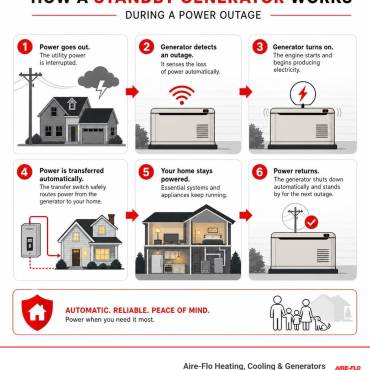
Natural Gas or Propane: Which Generator Fuel Is Right for Your Dublin Home?
When comparing a natural gas vs propane generator in Dublin, most homeowners want a simple answer. Here it is:
Choose natural gas if you already have Columbia Gas of Ohio service at your home and want the lowest operating cost with no fuel storage hassles.
Choose propane if you want full fuel independence, longer emergency runtime, and a reliable supply that doesn’t depend on utility pipelines staying pressurized.
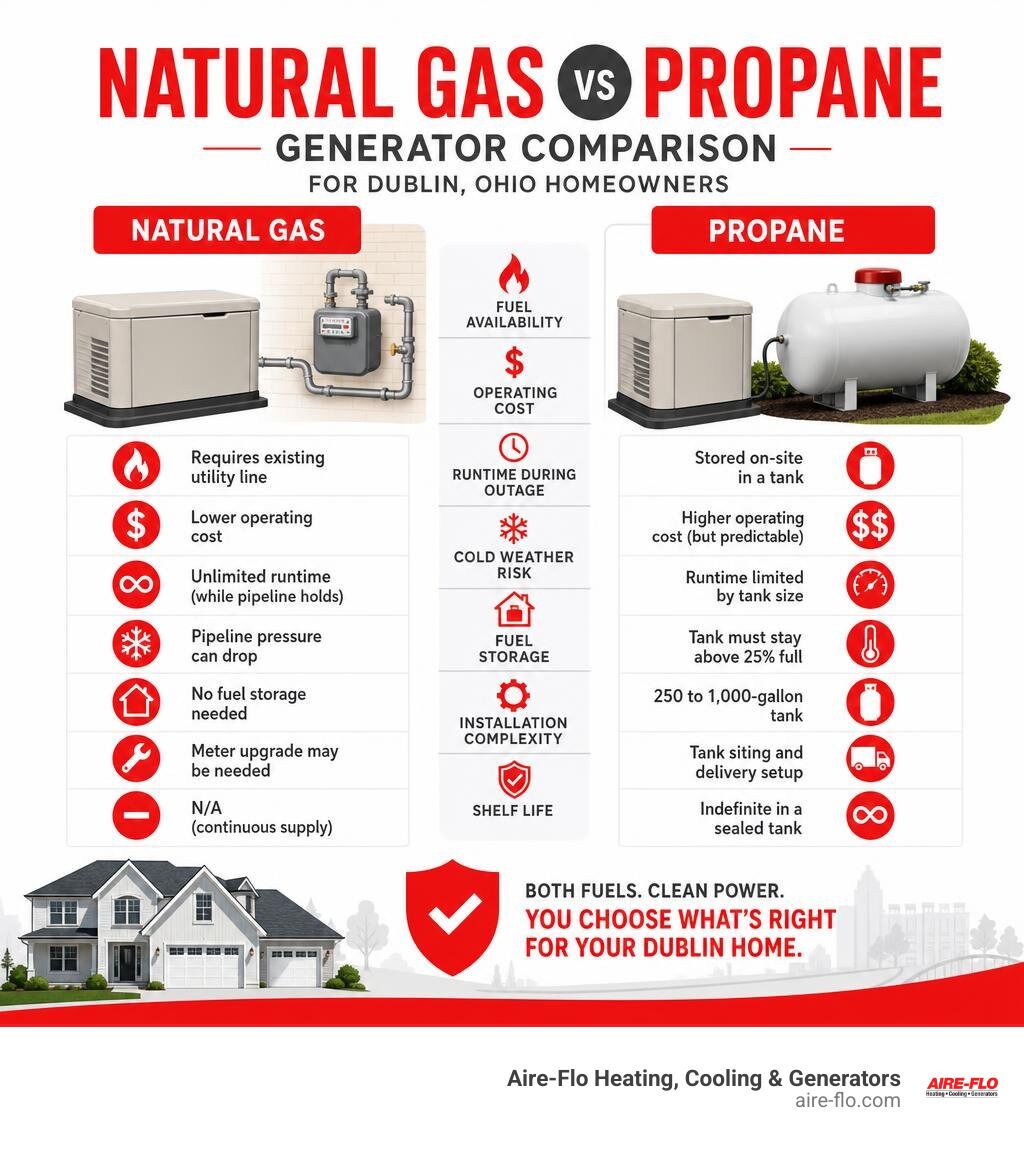
| Factor | Natural Gas | Propane |
|---|---|---|
| Fuel availability | Requires existing utility line | Stored on-site in a tank |
| Operating cost | Lower per hour | Higher, but predictable |
| Runtime during outage | Unlimited while pipeline holds | Limited by tank size |
| Cold weather risk | Pipeline pressure can drop | Tank must stay above 25% full |
| Fuel storage | None needed | 250 to 1,000-gallon tank |
| Installation complexity | Meter upgrade may be needed | Tank siting and delivery setup |
| Shelf life | N/A, continuous supply | Indefinite in a sealed tank |
Both fuels run clean, both can power a whole home, and both are available to Dublin homeowners. The right choice depends on your property, your utility access, and how much independence you want from the grid.
At Aire-Flo Heating, Cooling & Generators, our team has spent decades helping Columbus-area homeowners navigate the natural gas vs propane generator Dublin decision. Whether you’re in a newer Dublin subdivision served by Columbia Gas or a property without pipeline access, we have seen every scenario this region brings to homeowners.
Fuel Availability and Infrastructure in Dublin

Before you choose a generator, you must look at what energy infrastructure already exists on your property. Dublin has a mix of established neighborhoods with deep utility connections and newer or more rural properties that rely on independent fuel setups.
If your home sits in a subdivision near the Muirfield Village area or closer to Bridge Park, you likely have access to a municipal natural gas line. However, if your property sits on a larger lot further out toward Plain City or Delaware County, you might rely entirely on propane for your heating and cooking needs.
At Aire-Flo Heating, Cooling & Generators, we serve the entire Dublin area, and we always begin consultations by checking your local utility access.
Connecting to the Dublin Natural Gas Grid
If your home already connects to the Columbia Gas of Ohio network, installing a natural gas generator is a highly logical step. This setup hooks directly into your existing utility line, providing a continuous supply of fuel that never requires a delivery truck.
However, you cannot simply split your existing gas line and plug in a massive standby generator. Generators require an immense volume of fuel to start and run.
Most standard residential gas meters do not have the capacity to feed a furnace, a water heater, and a whole-home generator at the same time. During our professional generator installation process, we coordinate with Columbia Gas of Ohio to assess your meter capacity and arrange for an upgraded meter if your system requires more pressure.
Propane Delivery and Storage Independence
For homes without natural gas access, or for homeowners who prefer complete utility independence, propane is the gold standard. Instead of relying on underground municipal pipes, you store your fuel on-site in a heavy-duty pressurized tank.
Choosing propane means you must manage your fuel logistics. We typically recommend a 500-gallon tank as the sweet spot for whole-home backup power.
When planning your tank placement, we must also navigate local Homeowners Association (HOA) regulations. Many Dublin neighborhoods have strict rules regarding visible fuel tanks.
To keep your backyard looking pristine and comply with local guidelines, we often recommend installing an underground propane tank. This protects your property values while keeping your fuel supply safe from the elements. The same planning step also helps our team match your home with a generator size and fuel setup that fits your daily electrical needs.
Natural Gas vs Propane Generator Dublin: Cost and Efficiency

When you look at fuel efficiency, you have to compare the physical energy output of each fuel. Propane is much more energy-dense than natural gas.
One cubic foot of propane contains more than double the British Thermal Units (BTUs) of a cubic foot of natural gas. Because of this energy difference, a generator running on propane will often produce about 10% more power output than the same generator running on natural gas.
However, energy density is only one part of the equation. You also need to look at the long-term cost of operating and installing these systems.
Upfront Installation and Equipment Costs
The initial investment for these two systems differs based on the infrastructure you need to install. A natural gas generator installation requires running gas lines from your meter to the generator site, which involves plumbing, permits, and occasional trenching.
A propane generator setup requires purchasing or leasing a storage tank, excavating your yard for an underground tank if chosen, and running high-pressure lines. Because of the extra site preparation and tank equipment, propane installations often carry a higher upfront cost than natural gas connections.
A full generator installation consultation helps confirm which fuel path makes sense before any trenching, tank placement, or gas-line work begins. For broader budget planning, our article on how much home generators cost explains the main factors that affect installation complexity without reducing the decision to one generic price.
Hourly Operational Costs of a Natural Gas vs Propane Generator Dublin
While propane is more energy-dense, natural gas is usually cheaper to purchase. On an hourly basis, running a whole-home generator on natural gas often costs less than running the same unit on propane.
During an extended power outage lasting several days, a propane generator will consume fuel quickly, leading to a higher fuel bill when you refill your tank. Natural gas allows you to run your backup power for days on end without planning around a delivery truck coming to top off your supply.
Reliability and Performance in Ohio Winters
Dublin winters can be brutal. Freezing temperatures, heavy snow, and ice storms frequently threaten our local power grid.
When the power goes out in the middle of a January freeze, your generator must start instantly to keep your pipes from freezing and your family warm. Both fuels perform well in the cold, but they face very different challenges when the temperature drops.
Our winter outage preparation article explains how regular service, clear airflow, and proper testing can help prevent generator failures during winter outages before severe weather reaches Columbus, Dublin, or nearby communities.
Cold Weather Performance and Vaporization Issues
Propane is stored as a liquid inside your tank under high pressure. To burn in your generator engine, that liquid must vaporize into a gas.
As the outdoor temperature drops, the vaporization rate of propane slows down. If your propane tank is nearly empty during a deep freeze, the pressure inside the tank can drop too low to feed the generator at full load.
To prevent this issue, we recommend keeping your propane tank at least 25% full during the winter months. Natural gas does not suffer from vaporization issues because underground pipes deliver it as a gas, making it highly reliable in freezing weather.
Grid Reliability vs. Fuel Independence
While natural gas is incredibly convenient, it is still tied to a utility grid. During historic cold events, like Winter Storm Uri, millions of homes experienced natural gas pressure drops because the upstream pipeline infrastructure struggled to handle the massive heating demand.
If the utility pipeline loses pressure, your natural gas generator will shut down. Propane offers complete fuel independence.
Because your fuel is stored directly on your property, you are insulated from utility company failures, regional pipeline pressure drops, or grid-wide emergencies. If you want to compare standby equipment options before the next storm season, our main generators page outlines the backup power systems we install and service for local homeowners.
Maintenance, Longevity, and Environmental Impact
A whole-home standby generator is a long-term investment designed to protect your property for decades. To get the most out of your system, you must understand how your fuel choice affects engine wear, ongoing maintenance, and your local environmental footprint.
Whether you choose natural gas or propane, scheduling regular professional service is the best way to extend your system’s lifespan. If your system ever struggles to start, Aire-Flo Heating, Cooling & Generators can assist with rapid generator repair.
Engine Lifespan and Maintenance Requirements of a Natural Gas vs Propane Generator Dublin
Both natural gas and propane are incredibly clean-burning fuels compared to gasoline or diesel. They do not leave gummy deposits in the carburetor, and they produce very little carbon buildup inside the engine cylinders.
Because they burn so cleanly, both types of generators can easily last 10 to 30 years with proper care. However, natural gas burns slightly cleaner than propane, which can result in marginally longer intervals between spark plug replacements and less oil contamination over years of operation.
The biggest maintenance advantage of propane is its shelf life. Propane has an indefinite shelf life and will never degrade inside a sealed tank, whereas gasoline goes stale quickly and diesel can degrade in less than a year.
Environmental Footprint and Emissions
For environmentally conscious Dublin residents, both options are highly appealing. Natural gas produces fewer carbon dioxide emissions than oil-based fuels.
Propane is also an exceptionally clean fuel, producing virtually no particulate matter and lower carbon emissions than gasoline or diesel. Because propane is non-toxic, a tank leak will not contaminate your soil or groundwater, making it a safe choice for properties near local waterways or sensitive ecosystems.
Frequently Asked Questions about Home Generators in Dublin
Preparing your home for winter storms and unexpected power outages can raise a lot of questions. Here are the answers to the most common questions we hear from Dublin homeowners.
Which fuel is more reliable during a severe winter storm in Dublin?
Both fuels are highly reliable, but they have different vulnerabilities. Natural gas is incredibly reliable because you do not have to worry about scheduling fuel deliveries during a blizzard when roads are closed.
However, if a historic cold snap causes regional pipeline pressure to drop, your generator could lose power. Propane is completely independent of the utility grid, but you must ensure your tank is filled before the storm hits, as delivery trucks may not be able to navigate snow-covered Dublin roads during an emergency.
How long will a 500-gallon propane tank run a whole-home generator?
A 500-gallon propane tank filled to its standard 80% safety capacity, giving you 400 usable gallons, will comfortably run a standard whole-home generator for approximately 5 to 7 days of continuous operation. If you practice basic energy conservation during the outage, such as running fewer heavy appliances at the same time, your fuel supply can easily stretch to last 6 to 9 days.
Can I convert my generator from natural gas to propane?
Yes. Many modern standby generators are manufactured with dual-fuel engines that can run on either natural gas or propane.
If you currently use propane but plan to connect to a natural gas line in the future, our certified technicians can install a manufacturer-approved conversion kit. This process involves adjusting the fuel regulator and carburetion settings to safely accommodate the different pressures of each fuel.
Conclusion
Choosing between a natural gas and a propane generator comes down to your home’s location, your budget, and how much you value complete fuel independence. Natural gas offers lower hourly running costs and an endless supply of fuel through your utility connection. Propane provides unmatched reliability and a self-contained fuel source that works even if the municipal grid fails.
No matter which fuel you choose, our team at Aire-Flo Heating, Cooling & Generators is here to guide you through every step of the process. We bring 75 years of trusted, top-rated service to the Columbus area, backed by our 100% satisfaction guarantee.
Ready to secure your home’s power supply before the next big storm? Please contact our generator installation specialists today to schedule your professional home consultation.
Whether you require installation, repair, or maintenance, our technicians will assist you with top-quality service at any time of the day or night. Take comfort in knowing your indoor air quality is the best it can be with MOE heating & cooling services Ontario's solution for heating, air conditioning, and ventilation that’s cooler than the rest.
Contact us to schedule a visit. Our qualified team of technicians, are always ready to help you and guide you for heating and cooling issues. Weather you want to replace an old furnace or install a brand new air conditioner, we are here to help you. Our main office is at Kitchener but we can service most of Ontario's cities
Source link