Key Takeaways
- POE oil chemically bonds with water, and evacuation alone cannot break that bond: A wet POE system will typically plateau around 1,000 microns no matter how long you pump. The vacuum removes moisture from metal surfaces and air, but not from the oil itself.
- Copeland recommends below 50 ppm moisture for optimal compressor performance: POE oil can absorb approximately 2,500 ppm, which is 100 times more than mineral oil’s 25 ppm limit. That absorption capacity is the problem, not the solution.
- Filter dryers are the only practical way to remove moisture from contaminated POE oil: Evacuation handles free moisture. Desiccant handles bonded moisture. You need both.
- Proper cleanup costs $500 to $1,500 versus $1,800 to $2,800 for a compressor replacement: Copeland’s published cleanup protocol has no documented cases of a second failure when followed correctly.
Every modern residential HVAC system runs on POE oil. R-410A, R-454B, R-32: the compressor lubricant is a polyolester. And POE oil is hygroscopic, meaning it chemically bonds with water at the molecular level.
That single property is the reason a good evacuation isn’t always enough, and the reason systems that passed their micron test can still fail within two years.
Jim Bergmann, Founder measureQuick, joined the HVAC Know It All Podcast to explain the chemistry, why standard evacuation falls short, and the cleanup procedure that actually works.
The Chemistry: Why Evacuation Can’t Fix Wet POE Oil
Mineral oil (used in older CFC/HCFC systems) is non-polar. Water doesn’t dissolve in it. Moisture exists as free droplets that can be vaporized under vacuum and pumped out. Maximum acceptable level: about 25 ppm.¹

POE oil is fundamentally different. It’s a synthetic ester with polar molecular bonds that have a strong chemical affinity for water.² POE can absorb approximately 2,500 ppm of moisture, 100 times more than mineral oil.³ And unlike free water, this bonded moisture cannot be removed by reducing pressure. A vacuum pump creates low pressure that vaporizes free moisture from metal surfaces and tube walls, but it can’t break the chemical bond between water and the ester linkages in POE.
Jim put it simply: “You can hardly get any of it out via evacuation.”
This is measurable. A clean, dry POE system pulls below 200 microns. A wet system plateaus around 1,000 microns regardless of pump size, hose diameter, or pump time.⁴ That plateau is the system telling you the free moisture is gone but the oil is still saturated.
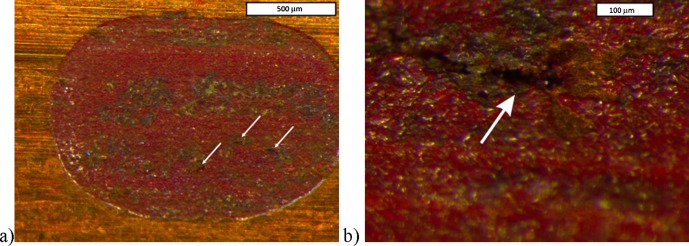
Once moisture bonds with POE, hydrolysis produces carboxylic acids.³ This reaction is autocatalytic (acid accelerates more acid formation) and temperature-dependent, meaning discharge line temperatures supercharge the process. Those acids attack copper tubing internally, causing formicary (ant’s nest) corrosion: microscopic tunnel networks responsible for approximately 10% of early copper coil failures.⁵ The sequence is predictable: moisture bonds to oil, hydrolysis produces acids, acids corrode copper, compressor bearings lose lubrication, system fails.
Understanding how to avoid premature compressor failure starts here, at the oil chemistry level.
Why Your Micron Test Can Lie to You
The industry target is 500 microns or below. At 500 microns, water boils at approximately negative 12 degrees Fahrenheit.⁶ But hitting 500 during the pull only proves the pump can reach that pressure. It doesn’t prove the system is dry.
measureQuick published testing showing a system hit 500 microns during pull, then decayed back to 1,500 to 2,000 microns after adding a single Schrader cap full of water.⁴ The decay test tells the real story: a flat line means clean, dry, and tight. A slow upward curve means moisture (typically in POE oil). A sharp straight-line rise means a leak.
Standard rubber charging hoses compound the problem. They were designed to contain pressure from the inside, not hold vacuum. Under deep vacuum, they permeate enough to produce false readings of 400 to 900+ microns.⁷ Dedicated vacuum hoses with nylon cores outgas below 20 microns.⁸
Bottom line: if your system plateaus near 1,000 microns, the oil is wet. More pump time won’t fix it. You need a filter dryer. For the physics behind this, see The Science of AC Evacuation and On-Site Pull Down.
The Cleanup Procedure That Works
Copeland’s Bulletin AE24-1105 R7 is the industry’s primary cleanup reference, covering both water intrusion and burnout.⁹ Their statement: “When this procedure has been properly followed, we do not know of a single instance where after proper cleaning there has been a second failure.”
The condensed protocol: recover refrigerant, replace failed compressor (if burnout), take an oil sample from the new unit as your reference. Inspect all controls. Install oversized suction line AND liquid line filter dryers (100% molecular sieve for moisture, 75/25 molecular sieve and activated alumina for moisture plus acid, or activated carbon cores like Sporlan HH for post-burnout sludge).¹⁰ For heat pumps, use bi-flow dryers.
Triple evacuate: twice to 1,500 microns with dry nitrogen purge, finally to 500 microns.⁹ Run the system 4 hours minimum, then 48 hours. Compare oil color and odor against your reference sample. Run an acid test. If contaminated: replace dryers, change oil, run another 48 hours. Repeat until oil is clean.
This is condition-based, not fixed. Typical field experience: 2 to 4 dryer changes and 1 to 3 oil changes for moderate contamination.⁹ The filter dryer does what evacuation cannot: its desiccant adsorbs moisture from the oil as it circulates. Each cycle through the dryer pulls more moisture out.
Suction line accumulators add another layer of protection post-cleanup.
The Cost of Getting This Wrong
Up to 80% of compressor failures are attributed to inadequate maintenance or misdiagnosis, not defective compressors.¹¹ Emerson reports 30% of Copeland scrolls returned for failure have no defects at all.¹¹ Residential compressor replacement runs $1,800 to $2,800 average, with 5+ ton systems reaching $3,500.¹² A proper cleanup totals $500 to $1,500.
POE oil absorbs moisture the moment a container is opened, and can absorb through plastic containers.¹³ Only sealed tin canisters prevent atmospheric absorption. Every minute a system is open during service, moisture enters.
Evacuation and filter drying are two different jobs. One handles free moisture. The other handles bonded moisture. You cannot substitute one for the other. The techs who understand this, who measure decay instead of just depth, who reach for a filter dryer instead of running the pump longer, are the ones who build trust through installation quality.
Additional Sources
- “Effects of Water in Synthetic Lubricant Systems (ARTI 21-CR/610-50035-01)”, Spauschus Associates for ARTI/DOE, Research Report, 2001.
- “Polyol Ester (POE) Base Refrigeration Lubricant”, KL Summit, Technical Article, 2024.
- “Effects of Water in Synthetic Lubricant Systems”, Spauschus Associates / ARTI / DOE, Funded Research Report, 2001.
- “Why Hitting 500 Microns Is Not Enough”, measureQuick, Technical Blog Post, 2026.
- “What Causes Formicary Corrosion and How to Prevent It”, Alamo Austin Air Conditioning, Technical Article, 2025.
- “How Long Should I Evacuate a System?”, Industry Technical Guidance, 2025.
- “The Hole Truth About Evacuation Hoses”, AccuTools, Technical Article, 2018.
- “Are You Using the Right Refrigerant Hose?”, HVACOlink, Technical Guide, 2025.
- “Bulletin AE24-1105 R7: Principles of Cleaning Refrigeration Systems”, Copeland LP, Technical Bulletin, June 2025.
- “AE-1402: ZPV063 Copeland Scroll Variable Speed Compressors”, Emerson/Copeland, Application Engineering Bulletin, 2024.
- “The Most Common Problem With Compressors is Misdiagnosis”, Compressors Unlimited, Industry Analysis, 2019.
- “How Much Does an AC Compressor Cost?”, HomeGuide, Cost Analysis, 2025.
- “Oil Best Practices for HFC and HFO-based Systems”, Industry Technical Guidance, 2024.
Whether you require installation, repair, or maintenance, our technicians will assist you with top-quality service at any time of the day or night. Take comfort in knowing your indoor air quality is the best it can be with MOE heating & cooling services Ontario's solution for heating, air conditioning, and ventilation that’s cooler than the rest.
Contact us to schedule a visit. Our qualified team of technicians, are always ready to help you and guide you for heating and cooling issues. Weather you want to replace an old furnace or install a brand new air conditioner, we are here to help you. Our main office is at Kitchener but we can service most of Ontario's cities
Source link