
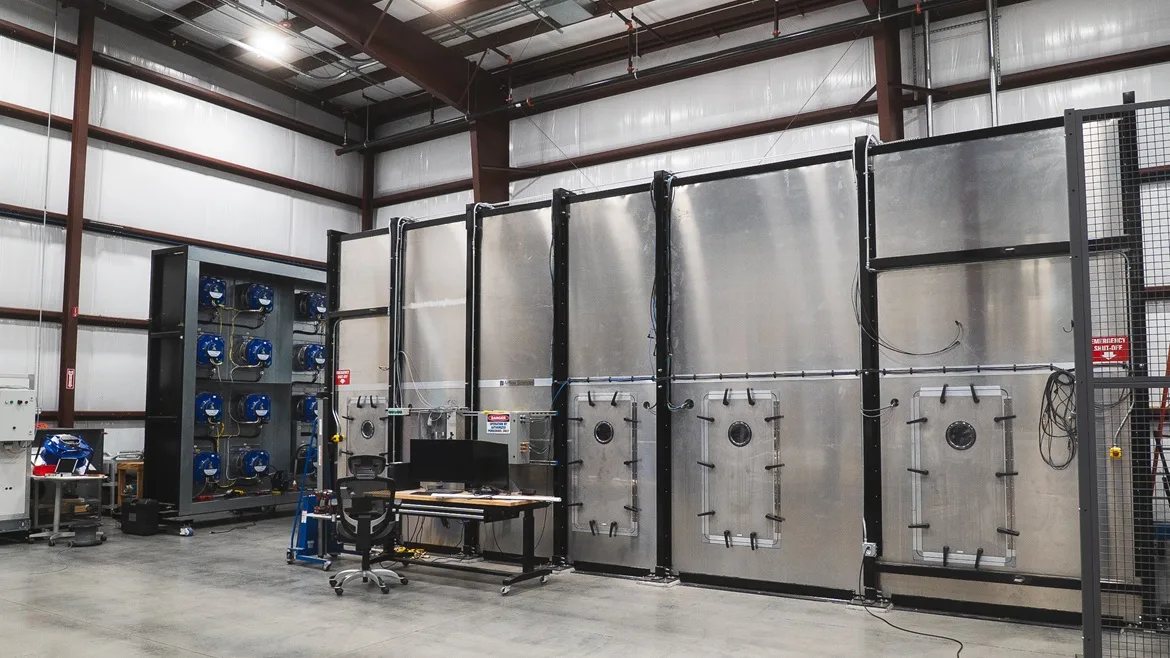
Q-PAC has received what it says is the world’s first Air Movement and Control Association (AMCA) laboratory accreditation for fan array testing under ANSI/AMCA Standard 270 and ANSI/AMCA Standard 210/ASHRAE 51.
The accreditation applies to Q-PAC’s airflow testing laboratory in Elkton, Florida, which can evaluate individual fans and fan arrays under controlled operating conditions. The facility allows engineers to measure airflow and performance across multiple fan configurations, providing data to support equipment selection, design validation, and product development.
AMCA 270 establishes laboratory methods for aerodynamic testing of multiple fans operating together, while AMCA 210/ASHRAE 51 addresses laboratory testing of fans for aerodynamic performance ratings.
“It is a significant industry milestone for the Q-PAC Lab to be awarded accreditation as the first AMCA-accredited laboratory for fan array testing in accordance with ANSI/AMCA Standard 270, Laboratory Methods of Aerodynamic Testing Fan Arrays for Rating,” said Nazme Mohsina, senior director of certification, accreditation, and documentation at AMCA International.
“It demonstrates the team’s technical competence and leadership, establishing Q-PAC as a pioneer in advancing fan array testing and moving the industry forward.”
Testing Fan Arrays Under Operating Conditions
The laboratory can evaluate airflow from 2,000 to 70,000 cubic feet per minute (CFM) at static pressures of up to positive or negative 12 inches of water column. Its 12-foot-by-12-foot plenum accommodates individual fans and larger fan array configurations. The facility was designed to exceed AMCA 270 requirements and support performance testing of Q-PAC’s multimotor plenum fan (MPF) platform.
The laboratory measures and automatically records airflow, static and total pressure, fan speed, input power, temperature, and environmental conditions. Custom tunnel-control software integrates programmable logic controllers (PLCs), LabVIEW, fan controls, automated dampers, and cone closures to execute test plans and collect performance data.
The automated testing process allows engineers to develop fan performance curves, compare configurations, and evaluate how changes in fan quantity, speed, and control strategies affect performance.
For HVAC equipment manufacturers and engineers, the testing capability provides measured data that can be used to evaluate fan array configurations before equipment is installed in the field.
“We built this airflow tunnel to validate performance with the rigor it takes to turn ideas into knowledge, and knowledge into the next generation of fan technology,” said Ken Nguyen, director of Q-PAC research and development.
Simulation Supports Laboratory Design
Q-PAC developed the laboratory in collaboration with Airflow Sciences Corporation, based in Livonia, Michigan.
Computer simulation played a central role in designing the facility to accommodate a wide range of airflow and pressure conditions within a relatively compact footprint. Structural simulations helped evaluate the tunnel’s ability to withstand operating pressures, while airflow simulations were used to optimize airflow paths and support measurement accuracy.
The facility incorporates a modular auxiliary-fan system and 16 flow nozzles with automated closures to measure airflow across different operating conditions. The measurement system captures the parameters required under AMCA 270, including barometric pressure, rotational speed, input power, velocity pressure, static pressure, total pressure, temperature, and nozzle pressure drop.
“Collaborating on this state-of-the-art AMCA 270 flow tunnel was a fantastic effort,” said Robert Mudry, president of Airflow Sciences Corporation in Livonia, Michigan. “Bringing this capability to life gives Q-PAC a powerful platform for advanced testing and product development, and Airflow Sciences is thrilled to have played a key role in making it a reality.”
Accreditation and Performance Verification
To complete the accreditation process, Q-PAC tested its multimotor plenum fan in a two-by-two plug-fan configuration.
The process included verification of AMCA 210 and AMCA 270 testing protocols, flow uniformity, measurement requirements, and remote and on-site witness testing. AMCA also independently tested Q-PAC fans at its Chicago laboratory and confirmed that the results were consistent with measurements generated at Q-PAC’s facility.
The accreditation allows Q-PAC to conduct additional testing of individual fans and fan arrays internally, reducing its reliance on external testing facilities for product development and customer-specific applications. The laboratory’s modular design also allows different fan types and configurations to be evaluated as equipment technologies evolve. Its test and auxiliary-fan sections can be reconfigured, while the control software can be updated to support additional testing requirements.
Q-PAC plans to expand its testing programs to support original equipment manufacturers (OEMs), customer-specific engineering applications, and future fan array designs.
Whether you require installation, repair, or maintenance, our technicians will assist you with top-quality service at any time of the day or night. Take comfort in knowing your indoor air quality is the best it can be with MOE heating & cooling services Ontario's solution for heating, air conditioning, and ventilation that’s cooler than the rest.
Contact us to schedule a visit. Our qualified team of technicians, are always ready to help you and guide you for heating and cooling issues. Weather you want to replace an old furnace or install a brand new air conditioner, we are here to help you. Our main office is at Kitchener but we can service most of Ontario's cities
Source link

