Sheet metal contractors hoping for relief from the recent Supreme Court-mandated tariff refunds are likely to be disappointed: Unless you are the importer of record, you will not see a direct payout or price break.
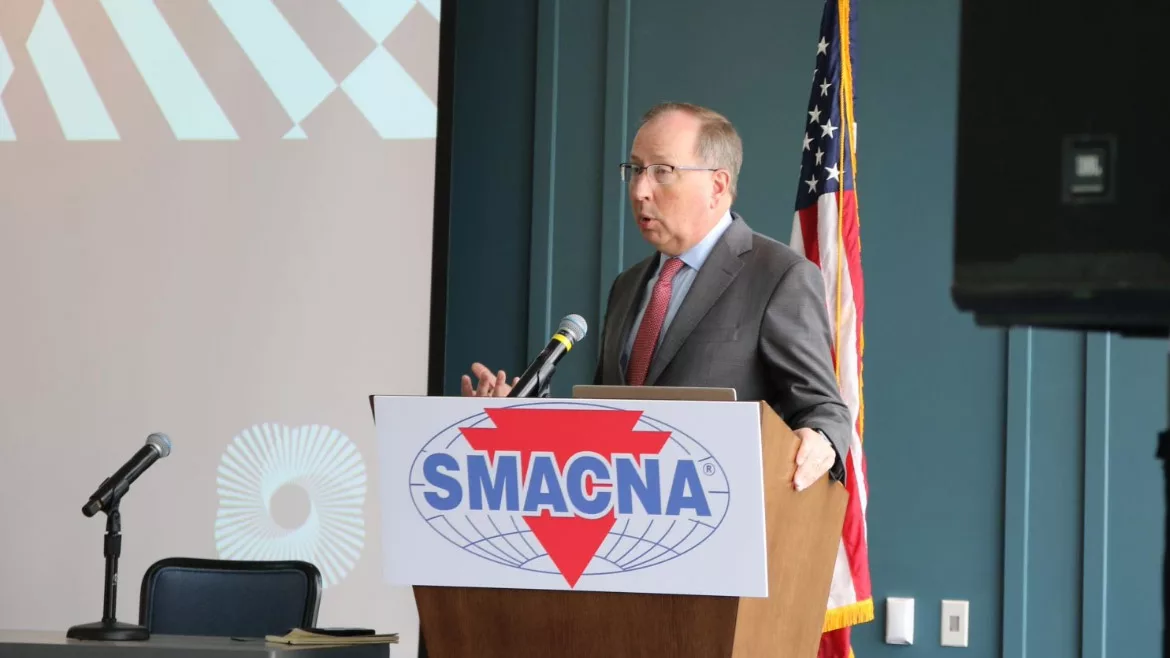
“The money belongs to the importer of record,” John Murphy, senior vice president of international policy at the U.S. Chamber of Commerce, told industry leaders at the 2026 SMACNA Washington, DC Leadership Conference. “There’s a lot of noise in Washington about whether Costco or somebody like that should give the money back to their customers. But the law is clear – it goes right back to the company that paid it.”
The $166 billion in refunds is spread across roughly 53 million import entries and 300,000 importers, underscoring how diffuse any financial benefit will be across the supply chain. “That’s a whole lot of data, but spread across 300,000 importers,” Murphy said, “it’s not a clean windfall.”
For most contractors, that means any hope of downstream price relief is out of reach, as refunds are not passed down through the supply chain.
Murphy described the process as a major milestone for manufacturers and importers battered by years of trade volatility and rising costs. “About half of everything we import in this country is used by U.S. manufacturing companies,” he said. “If you’re setting their prices up, then their ability to compete in global markets is reduced. These are good jobs, and we need more of them.”
Earlier this year, the Supreme Court struck down tariffs imposed under the International Emergency Economic Powers Act (IEEPA), which Murphy called “a pretty good deal” for American companies. “It’s $166 billion that companies paid – American companies. The importer of record has to be an American company or your customs broker,” Murphy said.
Since the ruling, U.S. Customs and Border Protection has built a system for processing refunds through the Automated Commercial Environment, or ACE portal. “We’ve seen construction by Customs and Border Protection of a system for refunds. It’s called CAKE … It’s a tab on the ACE portal, the automated commercial environment that Customs and Border Protection runs,” Murphy said. “You complete a spreadsheet in a certain format for all your entries and upload it. We’re starting to see refunds arrive.”
According to Murphy, two-thirds of the affected imports are “pretty straightforward and simple” to process, while the remaining third involve additional complexities, such as overlapping anti-dumping or countervailing duties.
Refund processing began April 20, with initial payments expected around May 10 and a 60- to 90-day window for review. “They’ve been saying that some of the very first of them start to come out about May 10,” Murphy told the audience. He estimated that roughly half of claims could be resolved by July 1.
Many companies absorbed tariff costs or financed them through loans, and with new or revised tariffs, as well as inflationary pressures from high energy prices, the likelihood that refunds will translate into lower prices for contractors is limited.
Still, the issue of who ultimately benefits from the refunds remains contentious. “Some people are saying, ‘How is Costco going to give back its refund to the customers?’” Murphy said. “It’s complicated, because a lot of small businesses, they hate the tariff. Some of them took out loans. Many industries are facing new tariffs that they have to continue to pay.”
Murphy said the average effective U.S. tariff has risen from about 2% to roughly 10% in the past year – a fivefold increase. Section 232 tariffs remain in place, including 50% duties on steel and aluminum – key inputs for sheet metal fabrication – and 25% on autos and auto parts.
Murphy noted there were 33 changes to tariff classifications last year, compared to a typical single annual update. “That volatility has been a problem for the business community,” he said.
Murphy pointed to roughly 100,000 manufacturing job losses over the past year, including about 40,000 in the auto sector, as higher input costs weighed on hiring and profitability.
Tariffs have become a flashpoint in Washington, with both political parties expressing concern over their impact on prices and economic growth. “Tariffs are not popular, and, in fact, affordability generally is absolutely the biggest negative that the administration is facing right now,” Murphy said.
While Congress is increasingly interested in reclaiming its constitutional authority over trade, Murphy warned that for now, the administration is preparing “a third wave” of tariffs under different statutes. “There’s tariffs don’t seem to be going away,” he said.
For importers waiting on refunds, the process is underway, but patience is required. “It’s a big job,” Murphy said. “But CDP, they’ve shown goodwill, and they’re working really hard.”
And for American manufacturers and small businesses, Murphy said, the outcome of these policies will ripple through the economy. “It all shows how these things are connected, and tariffs and the war are having an impact,” he said. “We want to get to that 3% economic growth. The U.S. economy – it’s hard to keep it down.”
Whether you require installation, repair, or maintenance, our technicians will assist you with top-quality service at any time of the day or night. Take comfort in knowing your indoor air quality is the best it can be with MOE heating & cooling services Ontario's solution for heating, air conditioning, and ventilation that’s cooler than the rest.
Contact us to schedule a visit. Our qualified team of technicians, are always ready to help you and guide you for heating and cooling issues. Weather you want to replace an old furnace or install a brand new air conditioner, we are here to help you. Our main office is at Kitchener but we can service most of Ontario's cities
Source link