
Key Takeaways
- Private equity’s real product is scale, not skill: The margin a roll-up squeezes out comes from centralized pricing, shared back office, recurring service revenue, and buying power, not from better technicians in the field.
- The people one rung up your supply chain already solved this: Independent distributors facing the same consolidation banded into buying cooperatives decades ago. The two largest just merged into a group of 349 distributors with about forty billion dollars in combined purchasing.
- Buying is the piece you can copy without selling equity: A contractor group cannot centralize a competitor’s pricing, but it can pool equipment purchasing and shared admin to close part of the cost gap. Third-party purchasing groups already deliver mid-single-digit material savings.
- The legal guardrails are real and the rules just changed: Joint purchasing is allowed. Coordinating what you charge homeowners, splitting up territory, or rigging bids is not. The old federal safe-harbor thresholds were withdrawn, so get antitrust counsel before you form anything.
Private equity is buying the HVAC industry one shop at a time, and the pitch to owners is always the same. Join the platform, get scale, compete with the big players. Through early June of 2026, private equity firms and their platforms accounted for 39 of 77 tracked HVAC acquisitions, and add-on deals targeting service companies were up sharply year over year.¹ Blackstone alone agreed to buy a residential HVAC and plumbing group of more than twenty brands for around two and a half billion dollars, roughly eighteen times earnings, through a fund with no fixed deadline to sell.² That last detail matters. A traditional buyout fund has to flip the company in five to seven years. This one can hold and keep buying indefinitely.
So the question for an independent owner is not whether consolidation is coming. It is here. The question is whether the only two options are to sell or to get ground down.
There is a third option, and the proof it works is sitting in your supply house.
What the roll-up is actually selling
Start by being honest about where a consolidator’s margin comes from, because the common assumption is wrong. It is not that the platform hires better technicians or does cleaner installs. The margin comes from a bundle of things a single shop cannot do alone: pricing set centrally at headquarters, back-office functions merged so fifty companies share one accounting and dispatch operation, recurring maintenance agreements that produce predictable revenue, and equipment bought in enough volume to command a better price than any one shop can get.³
The uncomfortable part is that the premium a consolidated shop charges the homeowner often is not paying for better service. It is covering the math of the acquisition. That is worth sitting with, because it tells you exactly where an independent can still win and where you cannot. You are not going to out-purchase a national platform by yourself. You can still out-serve one. The full version of that squeeze is laid out in what actually happens to an independent shop when private equity moves into the market.
The precedent nobody in HVAC talks about
The businesses that sell you your equipment faced this exact squeeze a generation ago, and they answered it without selling themselves to anyone.
Independent distributors watched national chains and private buyers roll up their industry, and instead of picking sell-or-die, they pooled their purchasing. They formed member-owned buying groups. Affiliated Distributors and The Commonwealth Group, two of the largest, merged effective at the start of 2026 into a single group of 349 independently owned plumbing, heating and cooling distributors representing about forty billion dollars in combined sales.⁴ They did it for one stated reason: build scale through cooperation so members could negotiate like a giant while staying independent. That is the same defense against the same threat, executed one rung up the same supply chain you buy from every week.
Look further out and the model is everywhere consolidation showed up. Ace Hardware is not a franchise in the usual sense. In 1973 the retailers bought the company and turned it into a cooperative they own. Today more than fifty-seven hundred independent stores run under it, and in 2024 the co-op returned about three hundred fifty-seven million dollars in patronage dividends to those owners.⁵ A patronage dividend is simply the co-op’s profit handed back to members in proportion to how much each one bought through it. Instead of an outside investor skimming profit off the top of what the stores spend, the stores are the owners, so the profit flows back to the people who created it.
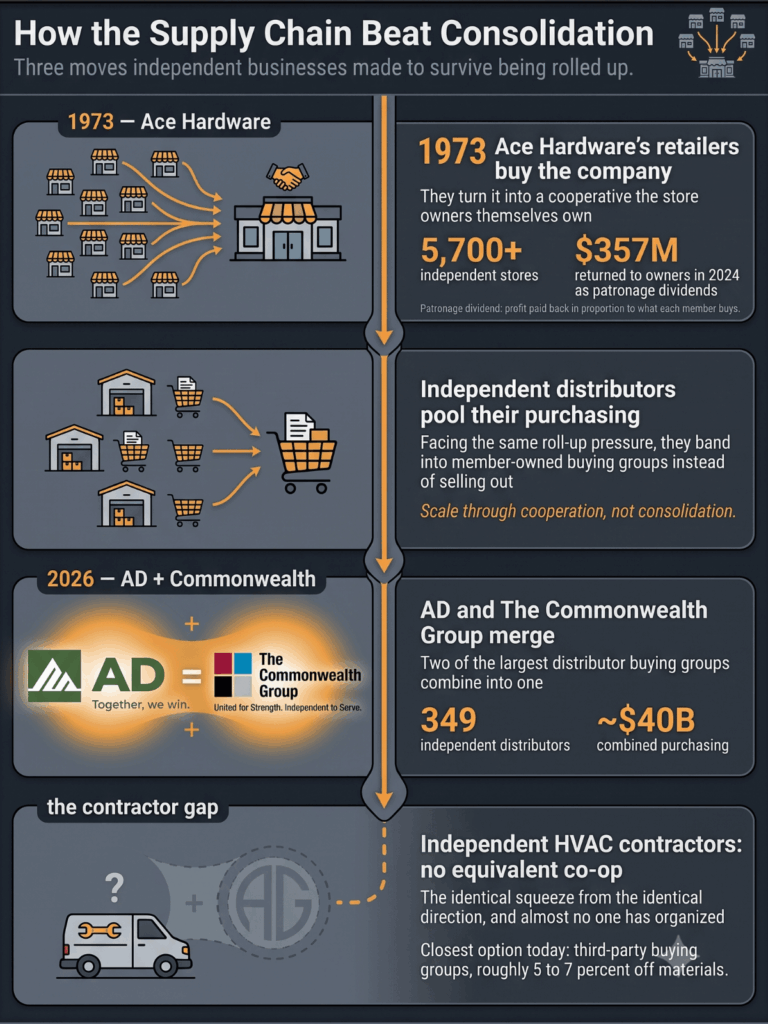
Independent contractors, facing the identical pressure from the identical direction, have almost entirely not done this. There is no contractor-owned HVAC purchasing cooperative of any real scale in the country.⁶ The closest thing available today is a third-party group purchasing organization, a company that signs you up and negotiates supplier deals on your behalf, typically returning something in the range of five to seven percent off materials.⁷ That is real money and worth using. It is also not the same as owning the thing. Gary floated the buying-group idea on his own feed two years ago and the comments landed where this article lands: alliances like this have worked in other industries for decades. Cornelio Martinez is now trying to actually build one.
What a contractor co-op would actually share
If a group of small shops did this, the shared functions are not all equal.
Equipment purchasing is the loudest, because it is the one that directly answers the roll-up’s main advantage. Pooled volume moves you toward the pricing tier a national account gets.

The sleeper is shared administration. The paperwork that buries a small owner, warranty claims, permit filing, and the rebate applications from the cash-flow problem every program-heavy shop knows too well, does not need fifty separate people doing it fifty times. One shared back office serving the whole group is exactly the lever a consolidator pulls, available without the consolidation. If you have felt how much time that paperwork eats, you already understand the admin tax that is quietly draining your billable hours. The single highest-value job a contractor co-op could share might be one skilled person who does nothing but file everyone’s rebates correctly and fast.
After that comes recruiting and training a shared apprentice pipeline, and group-rate insurance and warranty handling. None of it requires anyone to give up their name, their trucks, or their equity. The whole point is to buy scale without becoming someone’s portfolio company. That is a very different path from the one most owners think they are stuck with, and it starts with the same instinct that makes the best owners the ones who came up turning wrenches: solve the real problem, do not just buy the branded solution.
Where the legal line sits
This is where good intentions run into federal law. Competitors pooling their purchasing is generally allowed when it is a real, integrated collaboration that shares risk. What is never allowed, cooperative or not, is agreeing on the prices you charge homeowners, carving up territory so you each stay off the other’s turf, or coordinating bids. Those are treated as automatic violations, and no group structure protects you from them.
The rules around the edges got murkier recently, which is the opposite of a reason to wing it. For years there were federal safe-harbor thresholds that told competitors when a joint-purchasing arrangement was presumed fine. Those guidelines were withdrawn at the end of 2024 and, as of the middle of 2026, nothing has replaced them.⁸ There is no bright-line number to point to anymore. That does not make a buying group illegal. Groups like the ones your distributors run operate legally every day. It does mean the structure has to be genuine, the conduct has to stay on the right side of those bright lines, and you need a real antitrust attorney to set it up rather than a handshake and a group text. The farm cooperatives that get a special federal exemption do not cover contractors, so a trade group relies on ordinary cooperative law and careful structuring.⁹ Understanding how equipment cost flows into what you charge, covered in the difference between marking up and holding margin, is also what keeps the purchasing side legitimate: you are lowering your shared cost, not coordinating your prices.
Private equity’s product is scale, and for a long time the only way to buy scale was to sell your company to someone who already had it. The distributors proved forty years ago that is not true. The playbook is written, it is legal when built right, and it is sitting in the building where you pick up your equipment.
This piece was prompted by a conversation on the HVAC Know It All Business Edition podcast with Cornelio Martinez of Maize Mechanical, who is trying to organize exactly this kind of group among small contractors.
Additional Sources
- “HVAC Mergers and Acquisitions Mid-Year Report”, Capstone Partners, Market Research, 2026.
- “Blackstone to Acquire Champions Group”, Blackstone Press Release, Corporate Announcement, 2026.
- “Prepare Your HVAC Business for Sale: Margin Levers and Valuation”, CT Acquisitions, Industry Analysis, 2026.
- “AD and The Commonwealth Group Complete Merger”, Supply House Times, Trade Press, 2026.
- “Ace Hardware Centennial History and Patronage Dividends”, Ace Hardware Corporation, Company History, 2024.
- “Should HVAC Contractors Use a Group Purchasing Program?”, Raiven, Industry Analysis, 2026.
- “Construction Buying Group Guide for Contractors”, Contractors National Buyer Alliance, Industry Guide, 2026.
- “Withdrawal of the Antitrust Guidelines for Collaborations Among Competitors”, Federal Trade Commission and Department of Justice, Regulatory Notice, 2024.
- “Capper-Volstead Act and Cooperative Legal Structures”, Cooperative Law Reference, Legal Reference, 2026.
Whether you require installation, repair, or maintenance, our technicians will assist you with top-quality service at any time of the day or night. Take comfort in knowing your indoor air quality is the best it can be with MOE heating & cooling services Ontario's solution for heating, air conditioning, and ventilation that’s cooler than the rest.
Contact us to schedule a visit. Our qualified team of technicians, are always ready to help you and guide you for heating and cooling issues. Weather you want to replace an old furnace or install a brand new air conditioner, we are here to help you. Our main office is at Kitchener but we can service most of Ontario's cities
Source link